Ad frequency and ad recency are two critical metrics in PPC advertising that directly impact campaign performance. Here's a quick breakdown:
- Ad Frequency: Measures how often a user sees your ad. High frequency builds brand awareness but risks ad fatigue if overdone. Optimal range: 3–8 exposures.
- Ad Recency: Tracks how long it’s been since a user last interacted with your brand. Focuses on targeting engaged users at the right time. Most impactful within the first 7 days.
Key Insights:
- 80% of ad impact occurs within the first two exposures per week.
- 33% of retargeting impact happens within the first day after a site visit.
- Overexposure (10+ impressions) can increase negative brand sentiment by 16%.
Quick Comparison:
| Aspect | Ad Frequency | Ad Recency |
|---|---|---|
| Definition | Number of impressions per user. | Time since last interaction. |
| Purpose | Build brand recall. | Target high-intent users. |
| Risks | Ad fatigue, rising costs. | Missed broader audience opportunities. |
| Optimal Range | 3–8 exposures. | 0–7 days. |
Balancing these metrics is essential for effective campaigns. Frequency ensures your brand stays visible, while recency targets users when they’re most likely to convert. Mismanagement risks wasted budget and negative user experiences. Adjust frequency caps, segment audiences by intent, and use top PPC tools to prioritize timely engagement and maximize results.
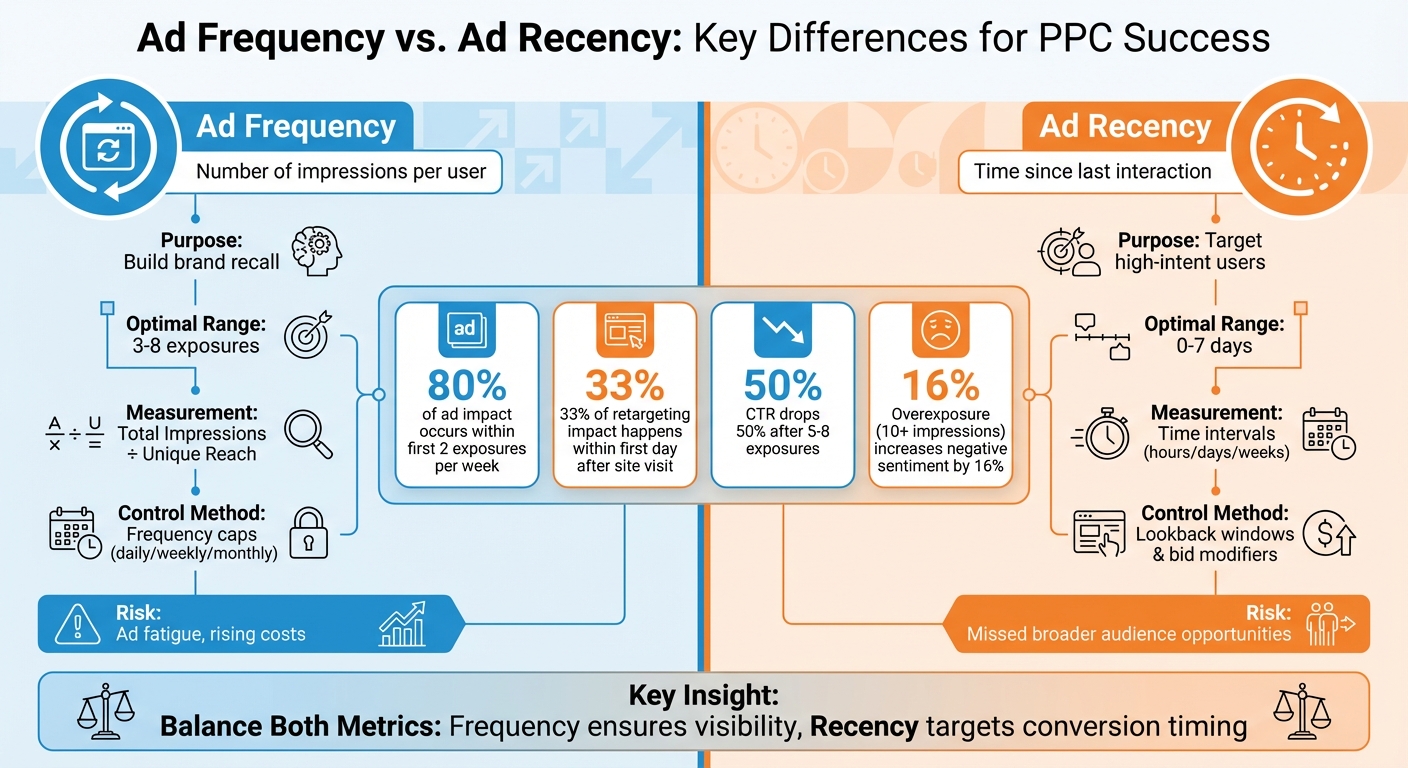
Ad Frequency vs Ad Recency: Key Metrics Comparison for PPC Campaigns
Day 2️⃣: Optimize Frequency Caps #programmaticadvertising
sbb-itb-89b8f36
What is Ad Frequency?
Ad frequency refers to how often a unique user sees your ad during a specific time frame. It’s calculated by dividing the Total Impressions by the Unique Reach. For example, if your campaign generates 10,000 impressions and 2,000 unique users saw the ad, the frequency would be 5.
This metric is a key indicator of campaign performance. If frequency increases but reach stays flat, it could signal overexposure. Let’s dive into how this is measured and why it’s such a critical part of advertising strategy.
How Ad Frequency is Measured
Google Ads provides two main ways to track frequency:
- "Avg. impr. freq. per user": This shows the average number of times a user sees your ad over a 7-day or 30-day window.
- "Frequency distribution": This breaks down how often users encounter your ad (e.g., 1+, 2+, 5+, or 10+ views).
Modern tracking methods go beyond simple cookies. Platforms now use advanced statistical models to account for cross-device behavior, identifying when the same individual views your ad on a phone, laptop, or tablet. For connected TV ads, they even consider "co-viewing", where multiple people might watch the same screen simultaneously.
Keep in mind, these calculations can take up to three days to appear in your Google Ads account. The delay comes from the complex modeling required to deduplicate views across devices. Understanding these metrics is essential to leveraging frequency effectively with Google Ads performance tools - balancing enough exposure to build familiarity without overwhelming your audience.
Benefits of Ad Frequency
When managed well, ad frequency can amplify your message and build trust with your audience. Most people don’t act after seeing an ad just once. They need multiple exposures before your message sticks and influences their decisions. This is especially true for products that are complex or require more consideration, where staying top-of-mind is crucial.
Research shows that 80% of an ad’s impact happens within the first two exposures per week. These early impressions establish familiarity and ensure your brand isn’t forgotten before a potential customer is ready to make a purchase. For retargeting campaigns aimed at users already familiar with your brand, a higher frequency - typically between 3 and 8 exposures - can reinforce your message and drive conversions.
Problems with High Ad Frequency
Repetition is important, but too much of it can backfire. When users see the same ad too often, they may experience ad fatigue. Studies show that click-through rates drop by 50% after a user sees the same creative 5 to 8 times. Worse, if someone sees your ad more than 10 times, negative feelings toward your brand can increase by 16%.
If you notice frequency rising while engagement drops and costs climb, it’s a clear sign your audience is oversaturated. Finding the right balance is key to avoiding these pitfalls while maximizing the effectiveness of your campaigns.
What is Ad Recency?
Ad recency measures the time elapsed since a user last engaged with your brand. This could be through actions like visiting your website, clicking on an ad, or adding items to their cart, which essentially starts the "recency clock". It's a key metric to pair with ad frequency when shaping your PPC strategies.
Unlike frequency, which focuses on how often a user interacts, recency zeroes in on timing. For instance, someone who visited your site two hours ago is likely more engaged than someone who last visited 30 days ago. The recent visitor may still be actively considering your product, whereas the older one may have made a decision or moved on.
Tracking recency allows you to pinpoint high-intent users who are still in the buying process. This insight helps you tailor your bids and messaging based on where a user is in their journey. For example, a cart abandoner from yesterday might respond well to a discount offer, while someone who browsed your homepage a month ago may need a reminder about your brand.
How Ad Recency is Measured
Ad recency is tracked using time-based intervals that segment your audience. Platforms like Google Ads or Facebook Ads measure the time since a user’s last interaction - whether in hours, days, or weeks. These intervals might look like "last 24 hours" or "15-30 days ago."
The measurement process begins the moment a user takes a specific action, such as visiting your site, viewing a product page, or being added to a retargeting list. From there, platforms monitor the "age" of that interaction within your audience segment. This data helps you assess whether your audience is fresh and engaged or stale and less likely to convert.
One issue is that standard programmatic advertising often includes user data up to 90 days old. This makes it essential to set up custom recency windows. Without these, you might waste ad spend targeting users who have already moved on, instead of focusing on those still in the decision-making process.
Benefits of Ad Recency
Ad recency helps you zero in on high-intent users - those who interacted with your brand recently. These users are still engaged in the sales cycle and are significantly more likely to convert compared to someone who visited weeks ago.
This timing advantage allows you to deliver personalized, relevant messages that align with the user’s current intent. For example, you could offer a 10% discount to someone who abandoned their cart a couple of hours ago or send a reminder to someone who viewed a product yesterday. Research indicates that around 33% of a retargeting campaign’s total impact occurs within the first day of the user’s visit.
Recency also ensures smarter budget allocation. By increasing bids for recent visitors and reducing or even eliminating bids for older, less-engaged users, you can focus your spending on those most likely to convert. This approach avoids the common pitfall of wasting budget on cold leads who are no longer interested.
Problems with Focusing on Recency
While recency has its advantages, relying on it too heavily can create gaps in your strategy. Over-prioritizing recent visitors might mean neglecting potential customers who are at the top of the funnel and still researching their options. These users may not have visited your site yet but could still convert with the right awareness-focused ads.
Another challenge with narrow recency windows is budget inefficiency. If you only target users from the last 24 hours, you might not have enough volume to fully utilize your daily budget. This could force you to widen your recency window or accept a smaller campaign scale.
Immediate retargeting also has its risks, especially in B2B contexts. It can sometimes come across as overly aggressive and harm your brand’s credibility. While a 2019 study found that 74% of ad groups targeted specific audiences, only 17% applied recency adjustments. Those who do use recency must balance it carefully with frequency to ensure a well-rounded PPC strategy.
Main Differences Between Ad Frequency and Ad Recency
Ad frequency and ad recency focus on distinct aspects of user behavior. Frequency answers, "How many times has this user seen my ad?", while recency asks, "How long ago did this user last engage with my brand?". In essence, frequency measures repetition, while recency focuses on timing. These differences shape how each metric should be managed.
The way they’re controlled also varies. Frequency relies on exposure caps, which limit how often a user sees your ad within a specific timeframe - daily, weekly, or monthly. On the other hand, recency is managed using lookback windows and bid adjustments. For example, you might increase bids for users who interacted with your brand recently, compared to those who haven’t engaged in a while.
Each metric serves a unique purpose. Frequency helps build brand recall through repeated exposure, with most of an ad’s impact occurring within the first two exposures per week. Recency, however, targets moments of high intent, with 33% of a retargeting campaign’s impact happening within the first day after a user’s visit.
Mismanaging these metrics comes with risks. Overexposing users - more than 10 impressions - can lead to a 16% increase in negative brand sentiment. On the flip side, failing to prioritize recency can waste ad spend on users who are no longer engaged.
Here’s a quick comparison to clarify their differences and guide your PPC strategy:
Comparison Table: Frequency vs. Recency
| Aspect | Ad Frequency | Ad Recency |
|---|---|---|
| Definition | Number of ad impressions per user within a time period. | Time since a user last interacted with a brand. |
| Key Metric | Average impressions per user. | Time elapsed since the last interaction. |
| Primary Use Case | Building brand awareness and reinforcing messaging. | Targeting high-intent users for timely conversions. |
| Common Platforms | Google Ads, Facebook Ads, Amazon DSP. | Google Ads, Retargeting Platforms. |
| Measurement Method | Total Impressions ÷ Unique Reach. | Time intervals (hours, days, or weeks). |
| Control Mechanism | Frequency caps (daily/weekly/monthly). | Lookback windows and bid modifiers. |
| Optimal Range | 3–8 exposures (varies by funnel stage). | 0–7 days (highest impact window). |
| Risk of Excess | Ad fatigue, "stalking" perception, rising CPA. | Missed opportunities and loss of brand relevance. |
Balancing these two metrics is key to getting the most out of your PPC campaigns. While frequency strengthens brand recall, recency ensures you’re engaging users at the right moment. Together, they create a more effective advertising strategy.
How Ad Frequency and Recency Affect PPC Performance
Ad frequency helps establish brand recall, while ad recency focuses on driving timely conversions. According to Google research, the first exposure to an ad delivers the highest impact, but subsequent exposures show diminishing returns, with the second exposure indexing at only 1.5 to 1.8 times the initial value.
While frequency ensures broader exposure, recency capitalizes on moments of peak user intent. For instance, in retargeting campaigns, 33% of the total impact occurs on the first day of ad exposure, highlighting the importance of timely engagement. However, an overemphasis on recency may overlook users who need multiple interactions before making a decision, especially when dealing with complex or high-consideration purchases.
Striking the right balance between frequency and recency is essential. Excessive frequency can lead to wasted ad spend on disengaged users, which can be mitigated through a PPC campaign optimization checklist, while ignoring recency risks missing out on prospects who are ready to convert. Tailoring strategies to include both metrics ensures better performance across different stages of the buyer’s journey.
Psychological factors also play a role. High ad frequency can backfire - 52% of consumers report feeling "stalked" by retargeting ads when they see them too often, which may lead to ad fatigue, lower engagement, or even the use of ad blockers. On the other hand, recency-based campaigns often feel more natural and customer-friendly, as they taper off as user interest fades.
Comparison Table: Performance Impact
| Aspect | Ad Frequency | Ad Recency |
|---|---|---|
| Advantages | Reinforces brand recall; builds familiarity and trust over time; supports long sales cycles. | Targets users at peak interest; boosts conversions; focuses on active prospects; feels less intrusive. |
| Disadvantages | Risk of ad fatigue after 5–8 exposures; diminishing returns; higher CPA from wasted impressions; 52% feel "stalked" without proper limits. | May miss users needing multiple touches; limited reach compared to frequency-based strategies; less effective for new brands. |
| ROI Impact | Plateaus or declines after optimal frequency; 80% of impact occurs within the first 2 exposures weekly. | Peaks shortly after a site visit; 33% of impact occurs on day one; efficiency drops as the recency window widens. |
| User Engagement | CTR drops by 50% after 5–8 exposures; engagement peaks early and follows an inverted-U curve. | Engagement is highest immediately after a visit and declines as more time passes. |
How to Balance Ad Frequency and Recency in PPC Campaigns
Start by setting manual frequency caps. Google Ads defaults to unlimited frequency, which can quickly drain your budget. Instead, apply manual caps for your Display and Video campaigns using top PPC advertising tools. Research suggests that showing ads 3–9 times is the sweet spot for effectiveness.
Next, segment your audiences by intent. For example, cart abandoners can tolerate a higher frequency - around 2–3 impressions daily during the first week. On the other hand, cold prospecting audiences should see fewer ads, such as 1–3 impressions per week, to avoid seeming overly aggressive. Use recency-based capping to adjust ad exposure over time. For instance:
- Days 1–3: 3 impressions/day
- Days 4–7: 2 impressions/day
- Days 8–14: 1 impression/day
- Days 15–30: 3 impressions/week
Once you've segmented, adapt your creative strategies to keep the audience engaged.
"Frequency capping isn't about showing fewer ads. It's about showing the right number of ads to each person - and not one more." – AdBid
Rotate your creative formats to combat ad fatigue. For example, static images often lose 50% of their click-through rate (CTR) within 3–4 weeks, while videos tend to stay effective for 6–8 weeks. Apply the 3R Principle to keep things fresh:
- Repurpose your messaging.
- Reformat by switching from static images to videos.
- Reinvent your creative approach altogether.
Additionally, try sequential messaging to improve engagement. For example, run awareness ads during days 1–7, follow up with social proof ads from days 8–14, and then offer personalized promotions between days 15–30. Providing varied content across platforms can help prevent fatigue while maintaining interest.
Make sure to coordinate across platforms. People often see your ads on multiple platforms like Meta, Google, and Connected TV, which can lead to higher total exposure than any single platform reports. To manage cumulative frequency, set conservative caps for each platform. For example, aim for a total frequency of 10–12 exposures per week across all platforms. For Connected TV, consider limiting impressions to 3–5 per household per week. This approach ensures your overall frequency stays within optimal limits.
Lastly, implement burn rules immediately. Once a user converts, exclude them from all acquisition and retargeting campaigns. This not only conserves your budget but also protects your brand image. Keep an eye on key metrics like CTR and Cost Per Acquisition (CPA) by frequency cohort. If CTR drops by 10% or more week-over-week as frequency rises, it’s a clear sign of ad fatigue.
Conclusion
Understanding the distinction between ad frequency and ad recency is crucial for running successful PPC campaigns. Frequency measures how often users see your ads, while recency focuses on when they see them, particularly in relation to their last interaction with your brand. Together, these metrics play complementary roles - frequency helps establish brand recognition and trust, while recency ensures your ads appear when potential customers are most likely to take action.
Consider these stats: 80% of advertising impact happens within the first two exposures per week, and 33% of a retargeting campaign’s total impact occurs on the first day after a site visit. While repetition is important, overexposure can backfire. For instance, CTR often drops by 50% after 5–8 views of the same ad creative. Without managing recency, you risk wasting budget on users who are no longer engaged.
The key is finding the right balance. Implement strategies like setting manual frequency caps, segmenting audiences by intent, rotating ad creatives, and adjusting bids based on how recently someone visited your site. These approaches help prevent ad fatigue, minimize wasted spend, and maintain a positive brand image, ensuring your campaigns stay effective and efficient.
For additional support, explore tools like the Top PPC Marketing Directory (https://ppcmarketinghub.com). Whether you need automated audits, frequency calculators, or cross-platform tracking, these resources can help you fine-tune your approach to frequency and recency - ultimately boosting the ROI of your paid campaigns.
FAQs
How do I set the right frequency cap for my campaign?
To find the right frequency cap, aim for a balance between giving your audience enough exposure to remember your ad and avoiding overexposure that leads to fatigue. Typically, 3–7 exposures per campaign is a good starting point. Match the frequency to your campaign's goals - brand awareness campaigns may need a higher cap, while direct response campaigns often require fewer exposures.
Leverage data to inform your decisions, experiment with different caps, and keep an eye on metrics like engagement and ROI. Adjust as needed based on how your audience responds and how well the campaign is performing.
What recency windows should I use for retargeting?
Recency windows for retargeting usually fall between 7 to 30 days, but the right choice depends on your audience and goals. For visitors showing high intent, shorter windows - around 7 to 14 days - work best. On the other hand, up to 30 days is more suitable for broader remarketing efforts. Some experts even recommend retargeting within hours or just a few days after a visit to capture attention while interest is fresh. The key is to align your timing with your audience’s decision-making process and the specific objectives of your campaign.
How can I tell if ad fatigue is hurting performance?
You can spot ad fatigue by keeping an eye on a few important metrics. A drop in your click-through rate (CTR), increasing cost-per-click (CPC), or reduced engagement are clear red flags. Other warning signs include higher bounce rates or fewer conversions. By regularly analyzing these metrics, you can catch fatigue early and tweak your campaigns before their performance takes a hit.