Managing Amazon PPC campaigns manually is no longer practical. With over 1.5 million advertisers on the platform and rising costs per click (up 30% in two years), sellers face increasing challenges. Automation tools solve this problem by handling tasks like bid adjustments, keyword optimization, and budget reallocation in real time, cutting management time from 15 hours a week to just 20 minutes. Results include a 35% reduction in ad spend and up to a 42% improvement in ACoS within 100 days.
Key Takeaways:
- Automation Benefits: Saves time, reduces costs, and improves ad performance.
- Case Studies: Examples show businesses cutting costs, boosting revenue, and scaling globally with automation.
- Techniques Used: Bid optimization, negative keyword management, and real-time data analysis.
- Results: Up to 6x ROAS, 40% ACoS reduction, and significant revenue growth.
Automation is the key to staying competitive on Amazon in 2026. Sellers who automate can focus on growth while their campaigns run efficiently in the background.
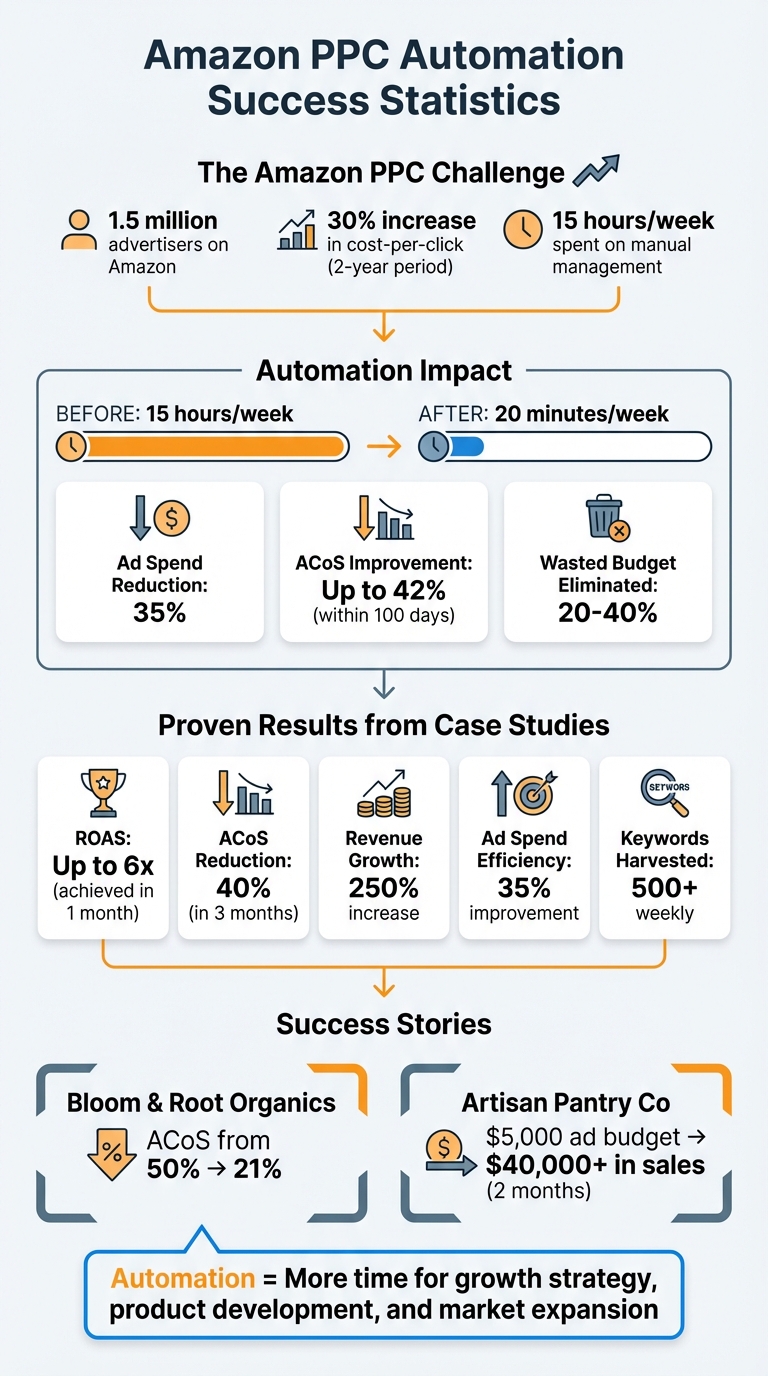
Amazon PPC Automation Results: Key Performance Metrics and Success Statistics
I Let AI Manage My Amazon PPC for 30 Days (This is what happened)
sbb-itb-89b8f36
How Amazon PPC Automation Tools Drive Results
Amazon PPC automation addresses the challenges of managing scale, speed, and consistency in ad campaigns, often requiring top PPC tools to maintain efficiency. Imagine a seller managing 20 SKUs - this could mean juggling 100–200 campaigns and processing thousands of data points weekly. That’s far beyond what manual efforts can handle effectively, making automation a game-changer.
Speed is a key advantage. While Amazon's ad auctions operate in real time, manual bid adjustments - often done weekly - quickly become outdated. Automation, on the other hand, updates bids multiple times a day, instantly responding to shifts in conversion data or competitor actions.
Another area where automation shines is negative keyword optimization. Instead of painstakingly adding 20–50 negative keywords every week, automated tools work nonstop to identify and block unproductive search terms, protecting your budget. Similarly, automation simplifies search term harvesting. High-performing terms from auto or broad campaigns are automatically promoted to exact match campaigns, giving you precise control over bids without the repetitive manual labor.
Dynamic budget allocation is another standout feature. Automation reallocates funds in real time, shifting money away from underperforming campaigns to those delivering strong results. Tools also use dayparting to adjust bids based on conversion patterns, whether it’s a weekend, a holiday, or a major shopping event like Prime Day.
Consistency is perhaps the most underrated benefit of automation. Manual management is prone to human errors, missed updates, or lapses during vacations and sick days, which is why many brands partner with top PPC agencies for oversight. Even skipping a week of negative keyword updates can lead to wasted ad spend. Automation eliminates these risks entirely, ensuring your campaigns stay optimized around the clock.
With these capabilities, Amazon PPC automation delivers continuous, efficient, and precise campaign management.
Case Studies: Business Success Stories
These examples highlight how businesses have used automation to drive meaningful improvements in their PPC campaigns.
Case Study 1: Cutting Costs with Hybrid Automation
A mid-sized seller struggling with rising ad costs and the inefficiencies of manual management turned to hybrid automation. By combining rule-based bid adjustments with keyword optimization, they managed to significantly lower their advertising cost of sales (ACoS) while improving overall ad performance. This strategy cut out about 20–40% of the budget that was previously wasted on non-converting clicks.
Case Study 2: Boosting Revenue with Automated Bidding
A growing seller found their progress hindered by the time-consuming process of weekly manual bid adjustments. Switching to an automated bid management tools, which made real-time changes based on conversion data, transformed their approach. Over several months, this shift allowed them to allocate budgets more effectively, driving impressive revenue growth and improving cost efficiency by focusing spending on top-performing campaigns.
Case Study 3: Rapid ROAS Growth During Peak Season
One seller, operating within a narrow seasonal window, needed quick and precise campaign optimization. Using advanced automation tools, they dynamically adjusted bids during peak times and paused campaigns when performance dipped. This real-time responsiveness led to a fast improvement in return on ad spend (ROAS), ensuring every dollar spent on ads delivered maximum impact during the crucial selling season.
Case Study 4: Simplifying Global Expansion with Machine Learning
An established brand expanding into multiple Amazon marketplaces faced the challenge of managing campaigns across various countries. By implementing a machine learning–driven automation tool, they optimized bids for each market individually while using cross-market performance data to inform decisions. This approach led to a noticeable increase in conversions across all markets, all while requiring minimal manual input.
Case Study 5: Driving PPC Success with Advanced Automation
A seller managing a wide range of campaigns found it impossible to manually track every performance metric. Transitioning to advanced automation enabled them to continuously harvest new search terms and act on opportunities as they arose. This shift not only kept advertising costs under control but also significantly increased ad impressions, achieving a level of precision that manual efforts simply couldn’t match.
Automation Techniques for PPC Campaign Success
The case studies highlight several automation techniques that led to measurable improvements across various Amazon PPC campaigns. Here’s a closer look at the key methods that stood out.
Bid Optimization at Scale
This approach dynamically adjusts bids across thousands of keywords based on metrics like conversion rates and ACoS (Advertising Cost of Sale). In Case Study 1, a hybrid strategy combining rule-based logic with AI-driven bidding reduced ACoS by 40% in just three months. The process focused on prioritizing high-ROI keywords during peak hours, leveraging tools like Amazon's Bid+ to analyze auction trends and manage bids efficiently. This method played a significant role in the outcomes observed across the campaigns.
Keyword Harvesting and Pausing
Efficient budget management relies on identifying high-performing keywords while cutting back on underperforming ones. In Case Study 2, automation tools like Optmyzr extracted over 500 new keywords weekly from ASIN reports and auto-campaigns. Simultaneously, keywords exceeding $5.00 in spend without generating sales were automatically paused. This dual strategy helped redirect the budget to top-performing terms, resulting in a 250% revenue increase while eliminating wasteful spending.
Real-Time Data Analysis and Automated KPI Tracking
Real-time metrics and automated dashboards ensured continuous campaign optimization. Tools integrated with Amazon Seller Central processed live data like impressions, clicks, and sales, enabling instant adjustments. For instance, Case Study 3 utilized machine learning dashboards in tools like Teikametrics, which provided 24/7 optimization. This strategy led to a threefold ROAS (Return on Ad Spend) increase within 60 days and cut wasted ad spend by 35%. Similarly, in Case Study 5, Perpetua software tracked key metrics like ACoS, ROAS, TACoS, and impression share, triggering automated alerts for deviations. Monitoring these metrics directly tied KPI shifts to revenue growth, with ROAS jumping from 2.5x to 6x, enabling smarter scaling decisions. Across the board, these techniques contributed to a 35% improvement in ad spend efficiency on average.
These automation strategies collectively form the foundation of successful PPC campaigns, paving the way for the performance metrics covered in the next section.
Performance Metrics: What Businesses Achieved
One standout performance metric showed a 6x Return on Ad Spend (ROAS) achieved within just one month. The table below highlights this result and other related outcomes.
Comparative Analysis Table
| Case Study | Primary Metric Improved | Result | Timeframe |
|---|---|---|---|
| Case Study 5 | ROAS Improvement | 6x | 1 month |
These results emphasize how automation can elevate Amazon PPC campaigns, delivering consistently better performance.
Conclusion: Lessons from Amazon PPC Automation
Automation has proven to unlock levels of profitability that manual management simply can’t achieve. Take Bloom & Root Organics, for example - they slashed their ACoS from over 50% to 21% while maintaining five-figure monthly sales. This was all thanks to automated bid adjustments using tools like AiHello that delivered measurable improvements. Similarly, Artisan Pantry Co. turned a $5,000 monthly ad budget into more than $40,000 in sales in just two months, leveraging performance tracking and automated optimizations.
These examples highlight three key strategies that consistently deliver better results:
- Separate high-converting keywords into dedicated campaigns for better targeting.
- Segment products by lifecycle to avoid budget overlap and inefficiencies.
- Combine automation with human strategy, using data-driven bid adjustments while allowing humans to focus on the bigger picture.
This method not only reduces wasted ad spend - often 20–40% of total budgets - but also frees up valuable time. Sellers can save around 15 hours each week, time that can be reinvested into product development, market expansion, or creative strategies.
Daniks.AI sums it up perfectly:
The sellers winning on Amazon in 2026 are not the ones who are the best at adjusting bids manually. They are the ones who automated that work and redirected their time toward product development, sourcing, and growth.
The final step? Choosing the right automation tool. Look for tools that align with your needs in terms of pricing, features, and scalability. For help finding the perfect fit, check out the Top PPC Marketing Directory (https://ppcmarketinghub.com), which offers curated resources whether you’re managing 50 campaigns or 500.
FAQs
What tasks should I automate first in Amazon PPC?
To begin automating Amazon PPC, prioritize bid management and keyword optimization. Automating tasks like adjusting bids according to performance, pausing keywords that don't perform well, and fine-tuning keyword targeting can lead to noticeable improvements in both efficiency and ROI. For more advanced strategies and tools, consider using platforms specifically designed to simplify PPC campaign management and enhance overall performance.
How do I keep automation from overspending my ad budget?
To keep your spending in check, consider tools that adjust bids in real-time. These tools help you define achievable KPIs and manage your budget wisely. With AI-powered systems, you can monitor performance around the clock, automatically tweak bids, and even predict results. This makes it easier to set proper budget limits and cut down on unnecessary expenses.
Which metrics matter most when judging PPC automation results?
Key metrics to assess PPC automation results include sales growth, return on ad spend (ROAS), and campaign efficiency. Take Sash & Soph as an example: they saw a 40.68% boost in PPC sales, showcasing how automation can deliver tangible results.