Want better marketing results? Attribution data integration is your answer. It combines data from search ads, social media, email, display, and offline channels into one system, helping you see the full customer journey. Why does this matter? Most customers interact with multiple ads - over six touchpoints - before buying. Without integration, you risk wasting money on underperforming campaigns or missing out on key insights.
Here’s how to get started:
- Audit Your Data: Check all sources (Google Ads, Facebook, CRM, etc.) for inconsistencies. Fix tracking issues and clean up duplicates.
- Define Metrics: Choose KPIs that match your goals. Use consistent terms like "conversion" across platforms and set lookback windows based on your sales cycle.
- Ensure Privacy Compliance: Follow regulations like CCPA. Use encryption and proper opt-out procedures to avoid fines.
- Standardize Data: Use consistent UTM tags, unify user identifiers, and format data for accuracy.
- Pick Tools: Choose attribution tools that fit your business. Look for features like multi-channel integration, privacy compliance, and flexible attribution models.
- Test Models: Start with simple attribution models like first-touch or linear, then explore advanced options like data-driven models for deeper insights.
The result? A 70% boost in marketing ROI and better decision-making. Integration isn’t just about data - it’s about smarter spending and higher returns.
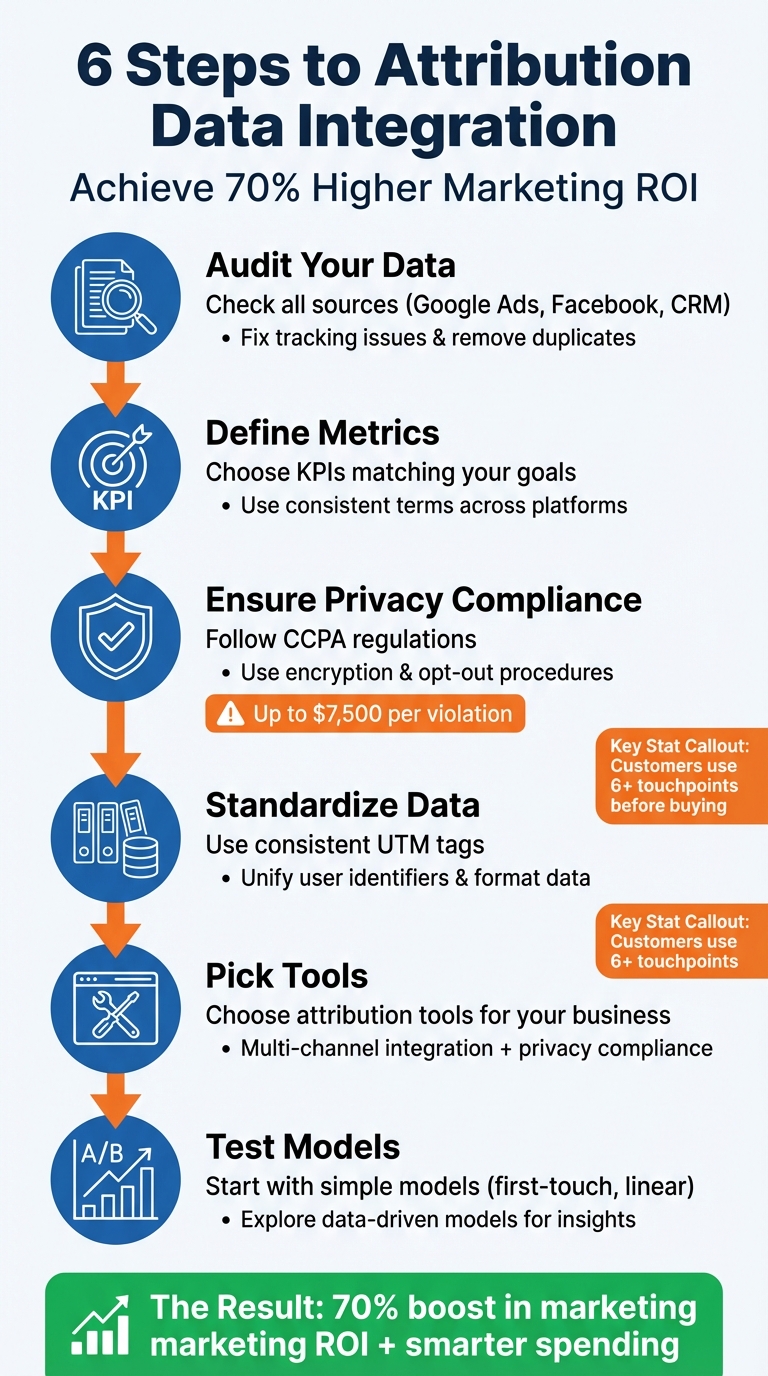
6-Step Attribution Data Integration Process for Marketing ROI
Digital Marketing Attribution in 2025: Challenges and Solutions
Preparing for Attribution Data Integration
Getting ready for attribution data integration involves a few key steps: auditing your systems, defining metrics, and ensuring compliance with privacy regulations. Start by examining your data sources to identify and resolve any inconsistencies.
Audit Your Data Sources
Take stock of all customer touchpoints, such as Google Ads, Facebook Ads, CRM systems, email campaigns, organic search traffic, and offline interactions. According to research, 68% of customers prefer using the telephone for major purchases like cars or health insurance.
"Marketing attribution is built upon data from all channels, campaigns, and messages deployed by your marketing team." – Jane Irene Kelly, Invoca
Check whether your data is siloed across departments or platforms, and confirm that tracking tools like pixels, UTM parameters, and codes are properly set up. For example, a real estate developer’s PPC audit revealed that restructuring a complex ad account into logical groupings based on conversion rates reduced cost-per-click by 64%. Performing audits quarterly can help you adapt as consumer behaviors shift.
Before integration, clean up your data by addressing gaps, removing duplicates, and discarding irrelevant records. A complete picture often requires pulling from multiple sources, such as software-based tools like Google Analytics, self-reported customer surveys, and event data like clicks and conversions.
Define Your Key Metrics and KPIs
Choose metrics that align with your business objectives and ensure consistency across platforms. Standardize terms like "conversion" so they mean the same thing everywhere.
Different stages of the customer journey call for different metrics. For top-of-funnel awareness, track measures like impressions and reach. For bottom-of-funnel conversions, focus on revenue and return on ad spend. Companies that personalize their messaging effectively see 40% higher revenue than those that don’t. Use consistent formatting for financial data, such as $1,234.56 for revenue and 12.5% for conversion rates.
Set a lookback window that matches your industry’s sales cycle. For instance, if your customers typically take 90 days to make a decision, a 30-day window won’t capture the entire journey. In industries like travel, where research phases are lengthy, a 60- or 90-day window is often more appropriate. Establishing high-quality data frameworks can result in up to a 70% increase in marketing ROI.
Once you’ve defined your metrics, you’ll be ready to integrate and analyze your data with confidence.
Ensure Data Privacy Compliance
Follow U.S. privacy regulations, such as the CCPA, which applies to businesses with annual revenue over $25 million or those handling personal data for 100,000 or more California residents.
Make sure your website includes a clear "Do Not Sell or Share My Personal Information" link, and treat user-enabled Global Privacy Controls as valid opt-out requests. Consumers have rights to access the data you collect, request its deletion, and limit the use of sensitive information like precise geolocation.
Secure personal data with encryption and similar protections. Non-compliance can lead to fines of up to $7,500 per violation if not addressed within 30 days. Keep detailed records of your privacy policies and procedures to show compliance, and use sandbox environments when testing attribution queries.
Data Collection and Standardization
Once you've defined your key metrics, the next step is to collect and standardize your data to ensure smooth integration across platforms. Consistency in formatting is the backbone of reliable attribution models and effective marketing strategies. This groundwork must be in place before configuring tools or optimizing models.
Use Consistent Tracking Parameters
Uniformly applying UTM parameters across campaigns is essential for accurately tracking user interactions. The three must-have parameters include:
utm_source: Identifies the traffic source, such as "google" or "newsletter."utm_medium: Specifies the channel, like "cpc" or "email."utm_campaign: Labels the campaign, such assummer-sale-2025.
Always stick to lowercase values to avoid data fragmentation - analytics tools treat "Facebook" and "facebook" as separate entities. Use hyphens (product-launch) instead of spaces (product launch) in UTM values to prevent broken links. Importantly, do not apply UTM tags to internal links, as this can overwrite original session data.
"Without proper tracking, marketers are flying without a compass. UTM parameters solve this problem by providing precise attribution data for every marketing channel." – Sam Hollis, Writer & Strategist, Rebrandly
For recurring campaigns like monthly newsletters, standardized templates can help maintain consistency in source and medium. Branded short links, for example, can boost click-through rates by up to 39%. Before launching a campaign, test all UTM-tagged links to ensure they direct users to the right destination and capture parameters correctly.
Unify User Identifiers
Tracking customer journeys across devices and channels requires a unified approach, such as using UUIDs or hashed email addresses. Assigning a UUID to each user allows you to monitor their activity across the funnel while safeguarding their personal identity. Tools like Google Ads leverage enhanced conversions, which use hashed email signals to improve cross-device measurement accuracy. When integrating with your CRM, rely on pseudonymized keys instead of personally identifiable information.
"We assign every user a UUID. That anonymizes users so we can track full-funnel performance without exposing identity - while staying HIPAA compliant." – Michelle Jennette, BI Specialist, Wheelhouse DMG
Pulling data at the ID level instead of by name reduces the risk of errors caused by changes in naming conventions. To keep datasets accurate, implement a 7-day rolling backfill to regularly update the last week's data. This approach accounts for changes in attribution windows and conversion updates.
Normalize Data Formats
Standardization is key to ensuring your data tells a clear and consistent story. Use the MM/DD/YYYY format for timestamps and convert all currency values to USD for uniform reporting. Synchronize timestamps to a single time zone to avoid regional discrepancies. Maintain consistency in text formatting - use Title Case for event names and snake_case for properties - to prevent fragmentation. Define stable join keys (like combining an ID with a date) to ensure data uniqueness during integration.
"Normalization translates all those dialects into one clear language so business decisions can be made without confusion." – Michelle Jennette, BI Specialist, Wheelhouse DMG
Leverage tools like dbt to organize data into four structured layers:
- Source: A mirror of raw data.
- Staging: Initial normalization steps.
- Intermediate: Unified datasets.
- Mart: Reporting-ready data.
Ensure numeric values are stored as numbers to avoid calculation errors, and run regular validation checks on metrics like spend, clicks, and conversions before finalizing your reports. A well-structured and unified data setup lays the foundation for selecting and configuring integration tools in the next stages.
Choosing and Setting Up Integration Tools
To ensure your data flows smoothly across platforms, selecting and configuring the right integration tools is essential. With standardized data as your foundation, these tools will help improve attribution accuracy and streamline your processes.
Select Compatible Attribution Tools
The first step in choosing an attribution tool is understanding your business model and technical needs. A key feature to prioritize is data integration - your tool should connect effortlessly with systems like your CRM (e.g., HubSpot, Salesforce), ad networks (Google Ads, Meta, TikTok), and marketing automation platforms. This can be achieved through native integrations or standardized APIs.
Your choice should align with your sales cycle and technical resources. For example, if your sales cycle lasts longer than 90 days, a first-touch attribution model may not effectively capture early top-of-funnel campaigns. Businesses with complex, multi-month sales cycles, such as B2B companies, might consider tools like Dreamdata or Demandbase, which specialize in account-based marketing. Meanwhile, mobile-first companies may benefit from AppsFlyer or Adjust, which support SKAdNetwork for better mobile attribution.
"Choosing the right software distinguishes effective spend from waste." – Pawan Kumar, Marketing Author, Salesmate
Before committing to a tool, evaluate your technical capabilities. Some tools may require advanced development resources for SDK implementation and custom event tracking. Look for software that offers customizable lookback windows (30 to 180 days) to match your customer journey. Privacy compliance is equally important; ensure the tool meets GDPR and CCPA standards with features like data anonymization and consent management. Interestingly, 53% of marketers report challenges in tracking live chat conversions, and 45% feel their current attribution software doesn’t provide actionable insights.
Once your tools are selected, the next step is to formalize data movement using automated ETL pipelines.
Set Up ETL Pipelines
ETL (Extract, Transform, Load) pipelines simplify the process of moving and transforming data from multiple sources into a centralized data warehouse. A modern approach to this is orchestration as code, where pipelines are defined programmatically using tools like Apache Airflow. This method enables version control, dynamic scaling, and reusable workflows. Notably, 90% of Apache Airflow users employ the platform for ETL and ELT purposes, and 68% use it to orchestrate data critical to business operations.
To ensure efficiency, design ETL tasks to be atomic and idempotent, incorporating sensors and failure callbacks to streamline troubleshooting.
"Coding ETL pipelines offers greater control and reusability." – Armaan Khan, Data Engineer
Organize your data using the Medallion Architecture, which includes three layers:
- Bronze: Raw data ingestion
- Silver: Cleaned and validated data
- Gold: Aggregated, business-ready data
This structure ensures data quality and traceability. Additionally, implement Change Data Capture (CDC) to track updates, appends, and deletes from source databases, avoiding resource-heavy bulk data loads. When working with sensitive attribution data, test queries on sandbox datasets first to speed up iteration and avoid privacy concerns.
| Tool Name | Key Features | PPC Integration Support | Pricing (USD) |
|---|---|---|---|
| Apache Airflow | Open-source, Python-native, DAG-based orchestration | High (via Provider Packages) | Free (Open Source); Managed versions vary |
| Panoply | Cloud platform with automated, no-code ETL pipelines | High (80+ connectors) | 21-day free trial available |
| Pandas (Python) | Data manipulation library for small-to-medium tasks | High (via custom API scripts) | Free (Open Source) |
| dbt | SQL-based transformations for data warehouses | High (via Snowflake/BigQuery) | Free tier; Paid starts ~$300/month |
| Segment | Customer Data Platform for unified pipelines | Google, Meta, TikTok | Free tier; Paid starts ~$120/month |
Connect Data Warehouses
Data warehouses like BigQuery and Snowflake serve as the central hub for all your attribution data. To keep your data current, configure automated refresh schedules and backfill historical data as needed. For example, the BigQuery Data Transfer Service can automate recurring imports from platforms like Google Analytics 4, ensuring your data is always up-to-date. While the transfer service itself is free, standard BigQuery storage and query costs apply.
Store data in date-partitioned tables to improve query performance and manage costs when analyzing long-term attribution trends. To create a complete view of the customer journey - from online ad clicks to offline sales - centralize offline conversion data and CRM signals using APIs or tools like Google Data Manager. Instead of performing joins within privacy-restricted environments (like Ads Data Hub), export focused datasets to your warehouse for final processing. This approach minimizes data loss caused by privacy filters.
For added security, use Customer-Managed Encryption Keys (CMEK) when setting up data transfers. If migrating from legacy systems, follow an iterative migration framework:
- Prepare: Conduct a discovery phase
- Plan: Prioritize use cases
- Execute: Migrate schema, data, and pipelines
Establish clear policies for data integrity, security, and access controls to ensure compliance with privacy regulations. Keep in mind that conversions in Google Analytics 4 can be reattributed for up to seven days after the initial event. This should influence how often you refresh or query recent data in your warehouse.
sbb-itb-89b8f36
Optimizing Attribution Models After Integration
Once your data pipelines and warehouses are up and running, the next step is to fine-tune your attribution models. This process helps you make smarter marketing decisions by identifying the insights that matter most to your business. Testing different models is key to understanding how each touchpoint in the customer journey contributes to conversions.
Test Single-Touch Models
Single-touch models are straightforward - they assign 100% of the conversion credit to either the first or last touchpoint. These models are simple to implement and provide a baseline for comparison. First-touch attribution focuses on the channels that introduce customers to your brand, while last-touch attribution emphasizes the channels that close the deal. However, if more than half of your customers engage with three or more channels before converting, single-touch models may fail to capture the full picture of mid-funnel interactions.
Deploy Multi-Touch Models
Multi-touch models offer a more nuanced view by distributing credit across multiple touchpoints. Here are some common approaches:
- Linear: Divides credit equally among all touchpoints, giving you a broad view of the entire customer journey.
- Time-Decay: Assigns more credit to touchpoints closer to the conversion event, making it ideal for short sales cycles or time-sensitive campaigns.
- Position-Based (U-Shaped): Allocates 40% of the credit to both the first and last touchpoints, with the remaining 20% spread across the middle interactions. This approach balances the importance of early brand awareness and final conversion.
You can use tools like Python libraries (e.g., ChannelAttribution) to automate these calculations or build custom models in your data warehouse using SQL for greater control and transparency. Starting with pre-built models is often a good idea before venturing into custom solutions.
| Model Type | Credit Distribution | Best Use Case | Implementation Notes |
|---|---|---|---|
| Single-Touch | 100% to first or last touchpoint | Simple customer journeys; limited resources | Easy to understand but overlooks mid-funnel interactions |
| Linear | Equal credit to all touchpoints | Comprehensive view of the journey | Assumes all touchpoints are equally important |
| Time-Decay | More credit to recent touchpoints | Short sales cycles or promotional events | Highlights recency but may undervalue earlier efforts |
| Position-Based | 40% to first/last; 20% to middle | Balanced focus on awareness and conversion | Acknowledges both introductory and closing roles |
| Algorithmic | Dynamic, ML-based weighting | Complex data environments | Highly accurate but requires significant expertise |
As you refine your models, you can start with simpler heuristic methods and gradually transition to algorithmic approaches for more complex customer journeys.
Apply Data-Driven Models
When your marketing channels become too intricate for manual analysis, data-driven attribution models can step in. These models use machine learning to dynamically allocate credit based on historical performance. For example, they measure the "removal effect" of each touchpoint - how much the likelihood of conversion drops when a particular channel is excluded.
A retail case study from Zigpoll demonstrates this in action. By building an ELT pipeline with Fivetran and Snowflake and using Python to automate time-decay multi-touch attribution, the company gained 35% more insight into touchpoint effectiveness and sped up decision-making by 20%.
To achieve similar results, consider implementing Markov Chain models with Python libraries like ChannelAttribution. Keep in mind that these models require a significant amount of data and technical expertise. If you're just starting, stick to simpler heuristic models and use them to test specific hypotheses. For instance, an Inverse J-shaped model - where 60% of the credit goes to the first touchpoint - can help verify the impact of your initial marketing efforts.
Tie your attribution model's performance to meaningful financial metrics like Return on Ad Spend (ROAS), Customer Acquisition Cost (CAC), and Customer Lifetime Value (LTV). Avoid focusing solely on vanity metrics like impressions, which may not provide actionable insights.
"Good attribution means testing, iterating, growing, and testing again. There's no finish line that you need to run towards." – AdRoll
Validation and Continuous Optimization
Attribution models aren’t a one-and-done effort - they need regular validation and updates to ensure decisions are based on accurate, up-to-date data.
Run Data Quality Audits
Performing regular data audits is essential for catching issues before they snowball. Focus on seven key areas: accuracy, completeness, conformity, consistency, coverage, timeliness, and uniqueness.
For example, monitor critical fields like customer IDs, zip codes, and phone numbers for missing data - but skip optional ones like memo notes. Keep an eye on your transformation error rate during ETL processes to spot fields that fail due to null values or unexpected formats. Also, check for orphan records, such as sales transactions linked to deleted customer IDs, which can disrupt your data structure.
Use automated anomaly detection tools that rely on moving averages of historical data. This helps distinguish between actual issues, like API failures, and normal occurrences, such as campaign pauses.
"Deploying automated data collection, harmonization, and validation ensures that our data goes beyond comprehensive. It's also credible and compliant." – Roman Vinogradov, VP of Product, Improvado
Companies that adopt strong marketing data quality frameworks report a 70% average increase in marketing ROI. Once data quality is under control, move on to testing your attribution models through A/B experiments.
A/B Test Attribution Models
A/B testing is a practical way to evaluate how attribution models affect campaign performance. Compare metrics like "Conversions" and "Conversions (current model)" to see how credit shifts between campaigns, networks, and keywords when a new model is applied.
When switching models, give it time - wait for your average conversion window to pass, typically excluding the most recent 14 days, to avoid skewed results caused by the delay between clicks and conversions. If the new model improves cost-per-conversion, adjust your campaign bids by the percentage change you observe.
Start simple. Test multi-touch models like Linear, Time Decay, or Position-Based before diving into more complex algorithmic approaches. Rule-based models can also help validate specific theories. For instance, applying an Inverse J-shaped model (giving 60% credit to the first touch) can confirm whether your first-touch channels drive more impact than last-touch channels. To keep things fair, establish governance protocols so departments don’t tweak models to unfairly boost their channel budgets.
Monitor and Iterate
After testing, keep a close eye on performance metrics. Use real-time dashboards to track key indicators like ROAS, CAC, and LTV, and review your model’s effectiveness quarterly to adapt to shifts in strategy or new customer behaviors. Automating data harmonization and normalization can save 20–30% of the time spent on manual preparation.
Make small, incremental adjustments and test their impact with forecasting tools. Ensure your reporting systems handle decimal values properly, especially since multi-touch models split credit across multiple interactions. For industries with longer decision cycles, like travel, consider extending your look-back window to 60 or even 90 days instead of the standard 30.
Effective data governance doesn’t just improve marketing - it can also cut legal risks related to data privacy regulations by up to 70%. Plus, leveraging detailed demographic, geographic, and behavioral data can boost conversion rates by as much as 50%.
The bottom line? Attribution models thrive on continuous testing and refinement - there’s always room to improve.
Conclusion
Integrating attribution data is a game-changer for making smarter PPC decisions. By bringing together information from search, social, email, and even offline interactions into one centralized system, you gain a complete view of how customers move through your funnel. Without this, you're left guessing - assigning credit to the wrong channels and wasting money on campaigns that don’t deliver real results.
Consider this: companies with strong data quality frameworks see an average 70% increase in marketing ROI, while those adopting multi-touch attribution models often achieve a 50% boost in marketing effectiveness. These aren't just minor improvements - they're the difference between throwing darts in the dark and confidently knowing where your budget delivers the most impact.
Start with the basics: audit your data sources, standardize tracking parameters, and unify user identifiers. From there, you can move toward advanced strategies like algorithmic models and bidirectional API integrations that adjust bids in real time based on actual attribution insights. The goal is to move beyond outdated, last-click models that oversimplify customer journeys.
Keep in mind, attribution models aren’t a one-and-done solution. They need regular audits, A/B testing, and quarterly reviews to stay accurate as customer behaviors evolve. Automating data harmonization can free up 20-30% of the time typically spent on manual prep work, giving your team more time to focus on strategy.
The takeaway? Proper attribution data integration doesn’t just make PPC campaigns more efficient - it turns them into a growth engine. When you know exactly which touchpoints drive conversions, you can allocate your budget with precision, optimize campaigns based on facts, and fuel meaningful growth.
FAQs
How can I ensure my attribution data integration aligns with U.S. privacy regulations?
To make sure your attribution data integration aligns with U.S. privacy laws, start by mapping all your data sources. Verify that each dataset is either first-party data or has been collected with clear user consent. Using first-party data is one of the safest ways to comply with regulations like the CCPA and CPRA.
After that, focus on minimizing and anonymizing your data. Remove or hash any personally identifiable information (PII) before storing it, and only keep the fields absolutely necessary for your attribution modeling. Always use secure transfer protocols, such as HTTPS, and implement role-based access controls to restrict who can access sensitive information.
Make sure to document consent records and set up automated systems to manage deletion requests, as required by "right-to-be-forgotten" laws. Regularly audit your processes to ensure they meet the latest state-level privacy standards. By combining secure data handling, anonymization, and thorough consent tracking, you can integrate attribution data while staying on the right side of compliance.
What advantages do multi-touch attribution models have compared to single-touch models?
Multi-touch attribution models provide a broader understanding of the customer journey by assigning credit to all the touchpoints that contribute to a conversion. This method helps businesses gain clearer insights into how their campaigns are performing, making it easier to pinpoint which channels and strategies deliver the greatest impact.
Unlike single-touch models - where only the first or last interaction gets the credit - multi-touch models show the complete picture. By revealing the true influence of each marketing effort, businesses can make smarter decisions about how to allocate their budgets and maximize their return on investment. These models are a powerful way to refine attribution accuracy and enhance overall marketing outcomes.
What are the best practices for selecting tools to integrate attribution data?
To pick the right tools for integrating attribution data, start by defining your business goals and pinpointing the key metrics you need to track - like revenue, lead quality, or customer lifetime value. Then, outline all the marketing channels driving these outcomes and identify the raw data sources you’ll need, such as ad platforms, CRM systems, or web analytics tools.
Focus on solutions that can connect with these data sources using APIs or exports. Prioritize tools that support both rule-based models (like first-click or last-click) and algorithmic models (like machine learning). This gives you the flexibility to start with straightforward models and adjust as your data and requirements evolve.
When assessing tools, think about your budget, how scalable the solution is, how easy it is to set up, and whether it offers user-friendly reporting dashboards. Before fully committing, test the integration on a smaller scale to confirm data accuracy and ensure the attribution logic works as expected. For extra help, check out resources like the Top PPC Marketing Directory to compare options and find the best match for your marketing strategy.