This case study explores how Akorn Media helped an e-commerce client overcome challenges like rising ad costs, product feed issues, and intense competition. The PPC agency team achieved standout results by starting early, using data-driven bidding strategies, and leveraging automation. Key takeaways include:
- Early Preparation: Campaign groundwork began in September, ensuring Google's algorithms had time to stabilize before the holiday rush.
- Data-Driven Insights: Historical performance data shaped smarter keyword and budget strategies using specialized PPC tools.
- Automated Bidding: Smart Bidding and real-time triggers optimized ad spend and ROAS during peak hours.
- Dynamic Adjustments: Real-time monitoring and hourly updates kept campaigns agile and effective.
The result? A ROAS of up to $70:1, conversion rates up 258%, and triple the sales compared to the previous year. This success highlights the importance of early planning, automation, and real-time adjustments for Black Friday campaigns.
Preparing the Campaign with Data
Using Past Black Friday Data
To craft a winning strategy, the team dug into last year’s Black Friday performance to uncover what worked and what didn’t. They compared the effectiveness of generic ads versus product-specific ones, pinpointing which messaging drove the most conversions. On top of that, they calculated the bids required to secure the top spot for priority keywords and identified underperforming product categories. These insights informed smarter bidding strategies for the current campaign.
This dive into historical trends revealed key patterns, such as spikes in search activity for specific product categories. Using this data, the team established conversion rate benchmarks based on past sales periods. These benchmarks became their guide for making real-time decisions - like when to ramp up or scale back spending. As Yousaf Yunes, CEO of YRV Dynamics, put it:
"Use benchmarks to your advantage as an indicator to accelerate or slow down spending".
One tactical move was downloading current bids a week before Black Friday. This gave them a solid baseline to quickly revert to after the holiday rush, avoiding overspending caused by Google’s automated systems reacting to inflated conversion rates. All these steps ensured that the budget and bidding adjustments were based on solid data rather than guesswork.
How Budgets Were Allocated
The budget strategy unfolded in three phases: a warm-up period in early November, the main Black Friday event, and Cyber Monday. To manage funds effectively, the team adopted a 70-20-10 split: 70% went to core campaigns, 20% to emerging tactics, and the remaining 10% to experimental approaches.
High-inventory products were prioritized, while bids on low-stock items were reduced to avoid wasting ad spend on out-of-stock pages. To stay agile, the team set up pre-approved budget increase rules tied to specific ROAS thresholds. For instance, if ROAS hit 1,100% by 1:00 PM, the budget automatically increased by a set amount. This approach eliminated delays in decision-making during the high-pressure event window.
With the budget framework in place, the next step was fine-tuning keyword strategies to capture the surge in high-intent traffic.
Targeting Black Friday Keywords
For keyword targeting, the focus shifted to long-tail, high-intent phrases rather than broad, generic terms. Instead of relying solely on the expensive "Black Friday" keyword, they used it as a modifier for specific products, such as "smartphone Black Friday deals" or "toy Black Friday sales".
Search query reports from previous years played a crucial role in identifying terms that drove actual conversions. Additionally, competitive intelligence tools helped uncover keyword gaps - opportunities where competitors were capturing traffic that the brand had missed. Negative keywords were also added throughout the preparation phase to filter out irrelevant or low-intent traffic. These carefully crafted keyword strategies laid the groundwork for precise, dynamic bidding during the event.
sbb-itb-89b8f36
Bidding Strategies Used in the Campaign
Automated Bidding Methods
The team centered their bidding strategy on Google's Smart Bidding, which uses years of historical Black Friday data to predict spikes in conversion rates. This approach aligned with their goals for target ROAS and customer acquisition. Campaigns were segmented based on objectives: high-margin products utilized Target ROAS to ensure profitability, while clearance inventory relied on Maximize Conversions to drive higher sales volume.
To expand their reach, they launched Performance Max campaigns with Black Friday–specific asset groups designed to amplify seasonal signals. Additionally, top-performing social campaigns were transitioned to Meta Advantage+, enabling automated targeting and budget allocation using tools like AdEspresso.
Interestingly, the team avoided Google's Seasonality Adjustments to prevent inflated CPCs and reduced ROAS. As Anu Adegbola from Search Engine Land pointed out:
"Smart Bidding handles major retail holidays better than most advertisers. Seasonality adjustments usually introduce more volatility than value".
In contrast, Adrianna Papell, a fashion brand, opted for seasonality bid adjustments paired with Performance Max asset groups in November 2023. Their strategy paid off, leading to a 74.04% increase in Black Friday revenue and a 77.04% year-over-year jump in total revenue.
Real-Time Bid Adjustments
To complement their automated strategies, the team made quick, data-driven adjustments throughout Black Friday. pre-approved real-time rules allowed them to act swiftly without delays during the high-pressure event.
Early in the day, they closely monitored ad positions, aiming for spots 2–3. When competition pushed them lower, they increased bids just enough to regain visibility without overspending. A similar strategy was employed by YRV Dynamics for a high-end fashion client in 2023. By scaling early in September when competition was lighter, they hit a daily high of 20 ROAS and maintained close to 10 ROAS on Black Friday.
The team also updated their Google Merchant Center feed multiple times during the day to reflect real-time price changes and out-of-stock products. This ensured that ad spend wasn't wasted on items that were unavailable. After the event, they manually reset pre-holiday bids for two weeks to prevent the algorithm from overbidding during the post-Black Friday dip in conversion rates.
Location and Device Bid Modifiers
To fine-tune their bidding strategy, the team optimized for geographic and device-specific performance. Rather than applying aggressive manual modifiers, they relied on Smart Bidding's ability to optimize automatically, leveraging its training on years of Black Friday data. Bid caps were used as a safeguard to prevent overspending during spikes while still allowing for conversion-focused adjustments.
Creative optimization was also tailored to devices. For mobile placements, they used dedicated 1x1 vertical format assets instead of relying on auto-cropped desktop creatives. As Yousaf Yunes, CEO of YRV Dynamics, explained:
"By using 1x1 in vertical format, advertisers are not matching the right creative to the right placement".
This strategy delivered results: Smart Bidding identified conversion rate increases of 17.5% in 2022 and 11.9% in 2023, all without manual intervention.
Monitoring and Adjusting During Black Friday
Metrics Monitored Throughout the Day
On Black Friday, the campaign team relied on a custom dashboard to keep tabs on key performance metrics in real time. Hourly updates on conversions, cost-per-result trends, and ROAS (Return on Ad Spend) allowed them to make immediate budget adjustments when necessary. They aimed to maintain a ROAS between 4:1 and 5:1, a noticeable improvement over their usual 2:1–3:1 benchmark. Conversion rates were also closely tracked, with a target range of 4% to 8%, well above their typical 2%–3%.
The team also kept a close eye on competitive metrics like Impression Share and Average Position. Their goal was to maintain ad placements in positions 2–3, balancing high visibility with cost efficiency. Another critical metric was cart abandonment rates, which they aimed to keep below 50% to address any potential issues during traffic surges. These metrics informed automated bid triggers that enabled real-time campaign adjustments.
Setting Up Automated Bid Triggers
Using the real-time data they gathered, the team implemented automated bid triggers to make swift adjustments. These pre-set rules, established ahead of Black Friday, allowed for quick decision-making without manual intervention. For instance, if a campaign hit its daily budget by 1:00 PM but maintained a ROAS above 1,100%, an automated trigger increased the budget by a set percentage. To ensure smooth transitions, rules were clearly labeled - "Evergreen" ads were automatically paused at midnight, while "BF-2026" ads went live without delay.
The team also set triggers to pause underperforming ad sets when CPM (Cost Per Thousand Impressions) exceeded $25, minimizing wasted spending during periods of inflated costs. Black Friday often sees CPM rates double, jumping from $8–$12 to $18–$25. Mason Boroff, Founder & CEO of Dancing Chicken, highlighted the importance of this approach:
"Data-driven decisions are crucial during high-stakes campaigns like Black Friday. Tracking performance metrics in real-time allows advertisers to pivot strategies quickly".
These automated adjustments worked seamlessly alongside earlier bid strategies, ensuring the campaign stayed on track throughout the day.
Adjusting for High and Low Traffic Periods
Continuous monitoring allowed the team to adapt their budget dynamically based on traffic patterns. Historical data showed that conversion rates peaked during the 8:00 PM to midnight window, so spending was concentrated during these hours. In contrast, during slower morning periods, bid caps were lowered to conserve budget for the evening rush.
When inventory ran out, the team lowered bids on related keywords and reallocated the budget to broader, generic promotions. This flexible approach ensured that every dollar was used effectively, regardless of whether traffic was surging or slowing down. By staying agile, the team maximized results and minimized waste during one of the busiest shopping days of the year.
Stop Guessing Your Black Friday Bid Adjustments (script included)
Results and What We Learned
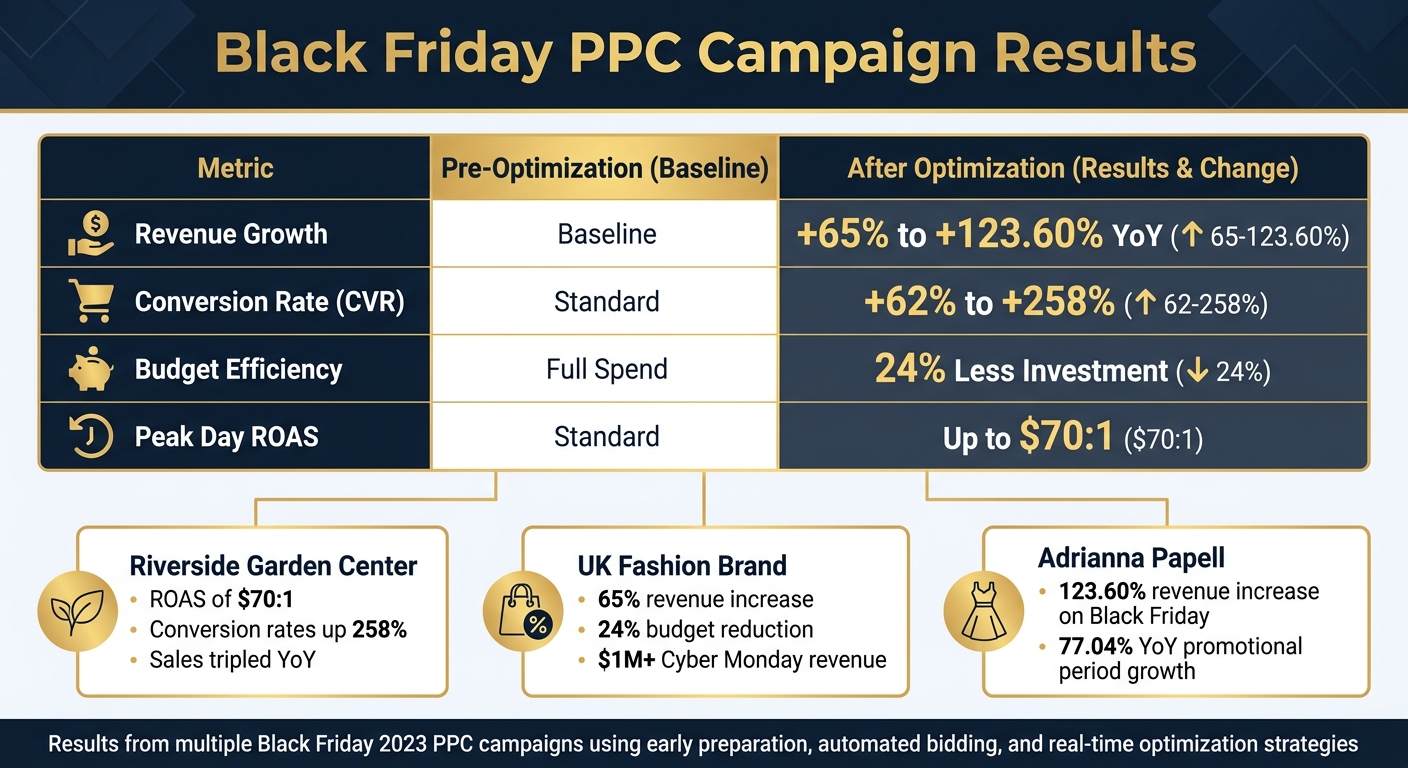
Black Friday PPC Campaign Results: Performance Metrics Before and After Optimization
Performance Numbers
The campaign results surpassed expectations. Riverside Garden Center, in collaboration with Honcho PPC Agency, achieved a ROAS of over $70:1 on Black Friday. Conversion rates soared by 258%, and sales tripled compared to the previous year.
Similarly, a major UK fashion brand partnered with Crealytics and saw a 65% revenue increase year-over-year while cutting their budget by 24%. Their conversion rate jumped by 62% YoY, and Cyber Monday alone generated over $1 million in revenue, marking their strongest single sales day ever. Adrianna Papell, managed by AdVenture Media, also had a stellar Black Friday, with revenue increasing by 123.60% on a 47.72% rise in spend. Overall, their promotional period revenue climbed by 77.04% YoY.
| Metric | Pre-Optimization | After Optimization | Change |
|---|---|---|---|
| Revenue Growth | Pre-Optimization | +65% to +123.60% YoY | +65% to +123.60% |
| Conversion Rate (CVR) | Standard | +62% to +258% | +62% to +258% |
| Budget Efficiency | Full Spend | 24% Less Investment | -24% |
| Peak Day ROAS | Pre-Optimization | Up to $70:1 | $70:1 |
These remarkable outcomes highlighted the strategies that drove such success.
What Worked and Why
Three key strategies played a pivotal role in these results:
-
Early Preparation
Success began with well-planned groundwork. Campaign infrastructure and real-time revenue monitoring were set up early. Annie Lee, Founder of Akorn Media, noted:"Most online retailers are still adjusting their bids in November. The ones that win peak season built their infrastructure in September".
-
Automated Bidding
Leveraging Google's Smart Bidding algorithms proved highly effective, especially for predictable events like Black Friday. This approach avoided the 2x CPC inflation that often affects manual adjustments. Automated bid triggers, configured in advance, allowed systems to adapt instantly to traffic changes without delays. -
Hourly Promotions
Hourly tactics kept campaigns dynamic and engaging. Riverside Garden Center’s strategy of unveiling new limited-time offers every hour encouraged impulse purchases. As Honcho PPC Agency explained:"Big events like January sales, Black Friday and Cyber Monday are extremely competitive periods in retail. In order to succeed you have to set yourself apart with a unique offer - the hourly twist for Riverside kept the campaigns fresh, engaging and more successful than ever".
These strategies can serve as a blueprint for future campaigns.
Applying These Lessons to Your Campaigns
To replicate these results, follow these steps:
- Start Early: Begin campaign prep at least 8 weeks in advance. By mid-October, finalize your product feed structure and bidding framework to give algorithms time to stabilize. Use custom labels to group products by performance (e.g., Winners, Bleeders, Untested) and focus on high-margin items.
- Automate Bid Triggers: Set up bid triggers with clear thresholds before your event. Define budget increases for exceeding ROAS targets and establish rules for pausing underperforming ads. Save pre-event bids to restore them after the sale, avoiding overspending on temporary spikes.
- Leverage Real-Time Tools: Use platforms like the Top PPC Marketing Directory (https://ppcmarketinghub.com) to manage bid automation and performance tracking. Look for tools that integrate real-time revenue data from your CRM or analytics platform, enabling budget adjustments based on actual sales rather than clicks.
- Create Urgency: In the final 48 hours, test urgency-driven ads with phrases like "Ends soon" or "Final hours." This type of creative can significantly boost conversions. Hourly or wave-based promotions, rather than flat discounts, not only drive volume but also help maintain engagement and protect margins.
These strategies are designed to help you maximize results during high-stakes promotional periods.
Conclusion
Achieving Black Friday PPC success requires months of careful planning and fine-tuning. Recent campaigns have shown impressive results, delivering strong ROAS and higher conversions while keeping spending under control - highlighting the impact of starting early. Key to this success were early infrastructure setup, automated bidding systems, and real-time monitoring.
Annie Lee, a Google Ads Architect at Akorn Media, captured this well:
"Most online retailers are still adjusting their bids in November. The ones that win peak season built their infrastructure in September".
By stabilizing algorithms with clean data for 6–8 weeks, businesses can avoid the pitfalls of last-minute adjustments.
The strategies shared in this case study - such as automated bid triggers, CLV-based targeting, hourly promotions, and real-time budget adjustments - demonstrate a winning formula. These tactics not only boosted revenue but also secured the brand's competitive edge by performing a competitor budget analysis during the high-stakes sales period. Success was built on thorough preparation, smart automation, and tools designed for quick decision-making.
To replicate these results, you'll need platforms that offer bid management, real-time tracking, and campaign automation. The Top PPC Marketing Directory is a great resource, providing access to PPC tools, expert agencies, and services tailored for major promotional events.
Start building your infrastructure now - your next peak season depends on it.
FAQs
When should I start prepping Black Friday PPC bids?
Experts suggest kicking off your Black Friday PPC bid preparations as early as October. Why? Starting early allows you to focus on essential tasks like building and warming up your target audiences, testing creative assets, setting up proper tracking, and organizing your promotions. By getting a head start, you can ensure your campaigns are fully optimized and ready to deliver strong results during the highly competitive Black Friday and Cyber Monday season.
How do I set ROAS-based budget rules safely?
To manage ROAS-based budget rules without risk, start by establishing clear ROAS targets. These should be grounded in your historical performance data or aligned with your profit objectives. Once you have these targets, leverage automated rules to take action - like adjusting bids or pausing campaigns - if performance dips below your set threshold.
Keep a close eye on these rules, especially during high-traffic events like Black Friday, when performance can fluctuate significantly. Using bid management tools can streamline this process, helping you stay on track with your budget while ensuring your ad spend delivers the best possible returns.
How do I prevent Smart Bidding from overspending after Black Friday?
To keep your budget in check after Black Friday, avoid using seasonality adjustments during high-traffic times. Why? These adjustments can drive up your CPCs, making your campaigns less efficient. Instead, trust Smart Bidding to naturally adapt to changing conversion trends - it's designed to handle fluctuations without manual interference.
That said, don't just set it and forget it. Keep a close eye on your campaigns and implement strict budget caps or bid limits. This approach ensures your spending stays tied to actual performance, rather than inflated estimates caused by unnecessary manual tweaks.