Long-tail keywords are precise, multi-word phrases that reflect specific search intent, like "women's waterproof hiking boots size 8." They may have lower search volumes but often result in higher conversions due to reduced competition and strong user intent. This article explores how businesses across industries have used long-tail keyword strategies to improve PPC campaign results, including boosting conversions, lowering costs, and increasing ad relevance.
Key Insights from Case Studies:
- Higher Conversions: A chiropractic campaign saw a 74% increase in leads by targeting precise, location-based keywords.
- Lower Costs: Syndacast reduced average cost-per-click to $0.56 for a Krabi hotel campaign.
- Improved ROI: Amazon's long-tail strategy helped add $8M in sales and 125,000 new customers for a nutraceutical brand.
- Niche Success: More Yoga achieved a 99.4% jump in conversions by focusing on comparison-based long-tail searches.
Quick Benefits of Long-Tail Keywords:
- Less Competition: Lower cost-per-click due to fewer advertisers bidding on specific terms.
- Higher Intent: Users searching for detailed terms are often closer to making a purchase.
- Better Ad Relevance: Matching ad copy with user queries improves click-through rates and Quality Scores.
This approach works across industries, from e-commerce to local services, and delivers measurable results when paired with ongoing keyword optimization and precise targeting.
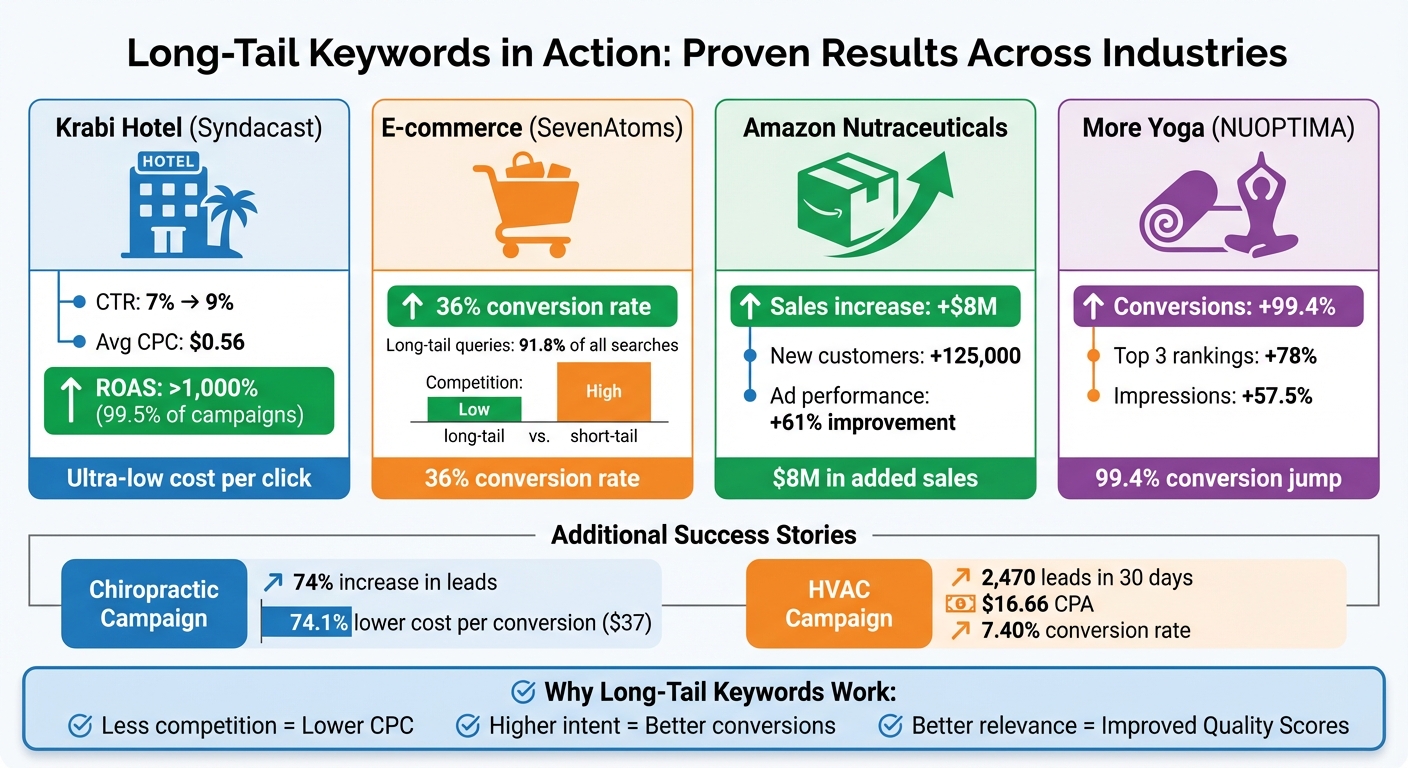
Long-Tail Keywords Case Study Results: Conversions, Costs, and ROI Across Industries
Case Study: Krabi Hotel PPC Campaign
Campaign Goals and Strategy
Syndacast joined forces with a 4-star hotel in Krabi, Thailand, to improve direct bookings and OTA (Online Travel Agency) reservations through a more refined PPC (Pay-Per-Click) strategy. The first step was to review the hotel's previous Google PPC campaign, which had been managed by another agency, to pinpoint areas for improvement.
Rather than relying on broad demographic filters, Syndacast took a more personalized approach. As Managing Director Tom Nguyen explained:
The Death of Demographics – From Mass Assumptions to Individual Truths.
By leveraging big data and machine learning, the team focused on high-intent travelers, using long-tail keywords tailored to the 4-star hotel niche. This strategic pivot laid the groundwork for measurable gains in performance.
Key Results Achieved
The revamped campaign delivered an average cost-per-click of just $0.56 and increased click-through rates (CTR) from 7% to 9%. This demonstrated the power of precise keyword targeting in driving better outcomes.
| Metric | Pre-Campaign Performance | Post-Campaign Performance |
|---|---|---|
| Click-Through Rate (CTR) | 7% | 9% |
| Average Cost Per Click | N/A | $0.56 |
| Booking Volume | Baseline | Increased (Direct & OTA) |
On top of these results, 99.5% of Syndacast's hotel campaigns in 2023 achieved a Return on Advertising Spend (ROAS) exceeding 1,000%. This case study highlights how shifting focus from generic keywords to more specific, long-tail terms can significantly improve both cost-effectiveness and conversion rates.
sbb-itb-89b8f36
Case Study: E-commerce Long-Tail Targeting Strategy
Long-Tail Keywords in E-commerce
In March 2025, SevenAtoms Marketing Inc. introduced a focused e-commerce PPC strategy led by Social Media Ads Expert Tina Bahadur. Instead of competing for costly, broad keywords like "shoes" or "headphones", the campaign zeroed in on specific three-word (or longer) phrases that attracted searchers with clear buying intent. Keywords were categorized into three tiers: high-intent (e.g., "buy wireless headphones online"), medium-intent, and low-intent (e.g., "best wireless headphones"). A critical part of the strategy was deploying a negative keyword list to filter out irrelevant traffic. For instance, an online jewelry store would exclude terms like "cheap", "fake", or "DIY" to avoid wasting ad spend on users unlikely to convert.
Performance Metrics and Insights
By focusing on long-tail keywords, which make up 91.8% of search queries, the campaign achieved an impressive average conversion rate of 36%. Tools like Google Keyword Planner and SEMrush were instrumental in identifying high-intent keywords with less competition and lower cost-per-click. Tina Bahadur, Social Media Ads Expert at SevenAtoms, highlighted the value of this approach:
"These long-tail keywords not only lower competition but also enhance ad relevance and boost conversion rates."
Here’s a side-by-side comparison of how short-tail and long-tail keywords performed:
| Metric | Short-Tail Keywords | Long-Tail Keywords |
|---|---|---|
| Search Volume | High | Low (per keyword) |
| Competition | High | Low |
| Cost-Per-Click (CPC) | Expensive | Cheaper |
| Conversion Rate | Lower (Research phase) | Higher (36% average) |
| User Intent | Vague/Browsing | Specific/Ready to Purchase |
Case Study: Amazon's SEM Long-Tail Keyword Approach

Amazon's Strategy for Targeting Long-Tail Keywords
Amazon has refined its strategy for long-tail keywords by starting with data from its own search bar. By analyzing autocomplete suggestions, Amazon identifies specific phrases that shoppers type when they’re ready to make a purchase. Utilizing top PPC tools can further streamline this discovery process. This method uncovers highly targeted, bottom-funnel search terms that broader search engines might miss.
The process doesn’t stop there. Amazon employs match type layering to control ad spend effectively. Sellers often begin with Sponsored Products automatic campaigns to gather data using Search Term Reports. From there, top-performing queries are shifted into manual campaigns. For highly specific terms like “Dell XPS 13 9310 laptop,” Amazon uses exact match targeting to drive conversions. To further refine their campaigns, sellers exclude irrelevant traffic with negative keywords, such as “cheap” or “used”.
Amazon also taps into customer feedback through review mining and uses an auto-suggest feature to uncover keyword variations. By appending letters of the alphabet to search terms, sellers can find additional long-tail keywords. These phrases typically have monthly search volumes ranging between 100 and 2,000, making them ideal for targeted campaigns. This layered and data-driven approach is the backbone of Amazon’s search engine marketing (SEM) strategy.
Results and Key Takeaways
The results of Amazon’s long-tail keyword strategy speak for themselves. Between 2021 and 2022, Straight Up Growth applied this method for a nutraceutical brand struggling with rising costs and declining returns. By focusing on exact match long-tail keywords instead of broader terms, they achieved a 61% improvement in ad performance, added $8,000,000 in incremental sales, and gained 125,000 net new customers in just one year.
The numbers highlight the power of this approach:
- 65% of all product searches happen on Amazon, with 69% being unbranded searches - showing that shoppers often look for specific features rather than brand names.
- 70% of purchases occur on the first page of search results, making it essential to dominate long-tail keyword rankings.
- Sellers who ran Sponsored Products campaigns continuously for 12 months saw an average 11.2% higher return on ad spend compared to their first month.
| Keyword Type | Example | Search Volume | Competition | Use |
|---|---|---|---|---|
| Seed (Broad) | Laptop | Very High | Very High | Brand awareness and reach expansion |
| Mid-Tail | Dell XPS Laptop | Moderate | High | Consideration phase targeting |
| Long-Tail (Exact) | Dell XPS 13 9310 laptop | Low to Moderate | Low | High-intent targeting and ROI focus |
Case Study: Niche Market Yoga Products Campaign
Targeting Keywords in a Niche Market
From August 2024 to April 2025, More Yoga faced challenges in ranking within a competitive market, starting with a domain rating of 48. To address this, they shifted their focus to comparison-based long-tail keywords. Led by NUOPTIMA's Alexej Pikovsky and Saba Gül, the team created 10 competitor comparison pages, such as "More Yoga vs [Competitor Name]", to attract traffic from users in the evaluation stage.
This strategy was built on a key insight: roughly 70% of search traffic comes from highly specific four-to-six-word phrases. Despite their potential, these phrases are often overlooked by advertisers who instead target broader, high-competition terms. To capitalize on this, the team implemented a dual-campaign approach - one aimed at high-volume, specific long-tail phrases and another using broad match settings to capture emerging queries.
This focused approach laid the groundwork for measurable improvements in performance.
Campaign Results and Analysis
Between Q4 2024 and Q1 2025, More Yoga saw impressive results: conversions jumped by 99.4%, keywords ranking in the top 3 positions rose by 78%, and impressions increased by 57.5%. The use of long-tail keywords kept cost-per-click low due to reduced competition, while comparison-focused content attracted users with strong purchase intent. Optimized landing pages and tailored ad copy further boosted ad relevance .
Here’s a breakdown of how broad terms and long-tail keywords differ in performance:
| Feature | Broad Head Terms | Long-Tail Keywords |
|---|---|---|
| Competition | High; targeted by most advertisers | Low; often overlooked by competitors |
| Cost-Per-Click (CPC) | High due to strong demand | Lower thanks to reduced competition |
| Conversion Intent | Generally low; users in research phase | High; searchers closer to purchase |
| Search Volume | High | Lower, but traffic is highly qualified |
This case study highlights how focusing on long-tail keyword strategies - especially comparison-based searches - can help brands with lower domain authority achieve better conversions and attract more qualified traffic in niche markets.
Key Takeaways from Long-Tail Keyword Case Studies
Best Practices for Long-Tail Keyword Success
In September 2025, RealTop ran a chiropractic campaign targeting location-specific terms like "chiropractor for back pain Tempe." The results? A 74% increase in conversions and a 74.1% reduction in cost per conversion, bringing it down to just $37.00.
"By refining campaign targeting and optimizing spend allocation, this chiropractic PPC campaign achieved a rare trifecta - more conversions, lower CPC, and reduced total cost." – RealTop
Daily management of negative keywords proved critical for success. For instance, RealTop's HVAC campaign in November 2025 generated 2,470 leads in just 30 days. By focusing on high-intent phrases like "AC repair near me" and "emergency HVAC service" and updating negative keywords daily, the campaign achieved a cost per acquisition of $16.66. With a $41,200 monthly budget, the campaign also delivered a 7.40% conversion rate.
In the same chiropractic campaign, A/B testing played a key role. By testing different ad formats and tailoring ad copy to match different user intents - such as urgent care versus holistic wellness - and adjusting bids for high-performing zip codes and mobile devices, the campaign cut total ad spend by 54.9% while improving overall performance.
These case studies highlight the importance of ongoing refinement to maintain and grow long-tail keyword success.
Final Thoughts on Long-Tail Keywords
The campaigns above demonstrate how long-tail keywords can deliver lower competition, reduced costs, and higher conversion intent. They show that businesses can achieve the rare combination of more conversions, lower cost-per-click, and reduced overall ad spend - something broad keyword strategies often struggle to deliver. However, the key to sustained success lies in constant optimization. Regularly reviewing Search Terms Reports helps uncover new opportunities and weed out irrelevant traffic. At the same time, precise conversion tracking - whether through form submissions or well-aligned calls-to-action - ensures decisions are based on reliable performance data.
For businesses with limited budgets or those in competitive industries, long-tail keywords provide a practical way to stay profitable. Success depends on treating optimization as an ongoing process - continuously refining keywords, ad copy, and landing pages to ensure long-term results.
DO THIS to Find Long Tail Keywords for Amazon PPC
FAQs
How do I find high-intent long-tail keywords for my PPC ads?
Finding high-intent long-tail keywords starts with thorough keyword research that zeroes in on specific queries your audience is searching for. These terms often reflect clear purchasing intent, making them valuable for driving conversions.
Here’s how to get started:
- Dive into search term reports: These reports can reveal the exact phrases people use, helping you spot high-intent keywords tied to your niche.
- Leverage keyword tools: Use tools like Google Keyword Planner or SEMrush to uncover long-tail terms that align with specific products or services.
- Understand search behavior: Study how people search within your niche. Look for patterns that indicate intent, like phrases including "buy", "best", or "near me."
Don’t forget to track performance metrics like click-through rates and conversions for these keywords. Regular monitoring helps you refine your strategy and stay aligned with what your audience is actively looking for.
When should I use exact match vs broad match for long-tail keywords?
When precision is crucial - like targeting highly specific searches to boost relevance and conversions - use exact match for long-tail keywords. On the other hand, broad match works well for reaching a larger audience and uncovering new keyword opportunities. The best approach depends on your campaign goals: choose exact match for focused accuracy and conversions, and broad match for testing and expanding your reach.
How often should I update my negative keywords list?
Keeping your negative keyword list up-to-date is essential for running effective campaigns. Search queries and campaign objectives evolve over time, so regular reviews are key. By maintaining this list consistently, you can ensure your ads stay relevant while managing costs efficiently.