When running app install campaigns, your bid strategy determines how effectively you attract the right users while managing costs. Using top PPC agencies to manage these strategies - tCPI (target cost-per-install), tCPA (target cost-per-action), and tROAS (target return on ad spend) - align with distinct goals:
- tCPI: Focuses on driving install volume at a set cost, ideal for new app launches or building a user base.
- tCPA: Targets users likely to perform specific in-app actions, such as making a purchase or starting a subscription.
- tROAS: Optimizes for revenue generation by targeting high-value users, perfect for apps with in-app purchases or subscriptions.
Your choice depends on factors like campaign objectives, budget, and available data. For example, if you're launching a new app, start with tCPI to gather data quickly. Once you have enough conversions (10+ per day), shift to tCPA to focus on quality actions. If your app generates varied revenue, tROAS becomes the best option.
To avoid common pitfalls:
- Ensure your tracking setup is accurate.
- Allocate sufficient budget (e.g., 50x target CPI for install campaigns or 10-15x target CPA for action-based campaigns).
- Monitor performance weekly and make small, incremental bid adjustments (5-10%) to maintain stability.
Platforms like Google Ads, Apple Search Ads, and TikTok each have unique bidding models. For instance, Google’s Maximize Conversions works well for iOS campaigns due to Apple’s tracking limitations, while TikTok’s oCPM heavily relies on engaging ad creatives.
Define Your Campaign Goals and Key Metrics
Clarify Your Campaign Objectives
Before setting bids, it’s essential to define what you want your campaign to achieve. App install campaigns usually revolve around four core objectives:
- Building a user base: Focuses on gaining installs at the lowest sustainable cost. This is ideal for apps that are new to the market and need to establish a presence.
- Driving in-app actions: Targets users who are likely to take specific actions, such as registering, starting a trial, or making a purchase.
- Maximizing revenue: Prioritizes users who are likely to generate the most profit, making it perfect for apps with in-app purchases or subscription tiers.
- Pre-registration: Helps to create an audience ahead of an app’s official launch.
Choosing the wrong objective can lead to wasted resources. For instance, if you optimize for installs but your actual goal is to drive subscriptions, you might attract users who download the app but never engage further.
Key Metrics to Track
Each campaign objective aligns with a specific performance metric:
| Objective | Primary Metric | Typical U.S. Benchmark |
|---|---|---|
| Build user base | Cost Per Install (CPI) | $0.72–$4.80 (Android, varies by category) |
| Drive in-app actions | Cost Per Action (CPA) | $8.00–$80.00 depending on event |
| Maximize revenue | Return on Ad Spend (ROAS) | Varies; 15–30% higher LTV vs. tCPA |
| Long-term health | Retention Rate (Day 1, 7, 30) | Benchmark varies by category |
- CPI measures the cost of acquiring each new user.
- CPA dives deeper, tracking the cost tied to a specific post-install event, like starting a trial or making a purchase.
- ROAS becomes critical when purchase values vary, ensuring that Lifetime Value (LTV) surpasses Customer Acquisition Cost (CAC) for sustained success.
Once you’ve outlined your metrics, make sure your budget and data strategy align with your goals.
Assess Budget and Data Availability
Your budget and historical data play a huge role in determining the best bid strategy. To avoid entering a "Learning Limited" state - which can lead to wide CPA fluctuations (40% to 60%) - aim for at least 70 conversions per week.
Budgeting guidelines vary based on your campaign type:
- For tCPI campaigns, your daily budget should be at least 50 times your target CPI.
- For tCPA campaigns, allocate 10 to 15 times your target CPA. For example, if your target CPA is $20, you’d need a daily budget of $200–$300.
If you’re working within tighter constraints, such as $100 per day or $3,000 per month, start with tCPI or Maximize Conversions campaigns. These approaches help you gather valuable data before moving to more advanced strategies.
sbb-itb-89b8f36
How To Run Paid Ads For Mobile Apps and Get 10,000+ App Installs In The Next 30 Days
Match Campaign Goals to Bid Strategies
To get the most out of your campaigns, it’s crucial to align your bid strategies with your specific goals and key performance metrics.
Types of Bid Strategies Explained
Once your goals and budget are set, you’ll need to choose from three main categories of bid strategies, often utilizing PPC advertising tools to manage them:
- Install-focused strategies: These aim to drive the highest number of app installs. For example, Maximize Conversions uses Google’s AI to push for maximum installs within your daily budget, making it a great choice for app launches or limited-time promotions. On the other hand, Target CPI (tCPI) adds a cost cap, ensuring your average cost per install doesn’t exceed a set amount - ideal for maintaining control over acquisition costs.
- Action-focused strategies: These prioritize post-install actions rather than just installs. Target CPA (tCPA) works to find users who are likely to complete specific actions, like starting a free trial or making a purchase. This strategy focuses on quality over sheer volume, making it perfect for campaigns aimed at driving meaningful engagement.
- Value-focused strategies: These are all about maximizing revenue. Target ROAS (tROAS) optimizes for the total value generated from in-app events, rather than the number of events. This approach works particularly well for apps with varying purchase amounts, such as e-commerce or subscription-based apps.
"tCPI drives volume, tCPA drives quality actions, and tROAS drives revenue." - RocketShip HQ
Bid Strategies by Platform
Different platforms handle bidding in their own way, so your approach should adapt depending on where your ads are running.
- Google Ads: With its App Campaigns, Google offers a lot of flexibility. For Android installs, Target CPI is a solid starting point. For iOS, Maximize Conversions is often better, as Apple’s App Tracking Transparency (ATT) rules make precise targeting tricky. If your goal shifts to post-install actions, Target CPA becomes useful - but only if the in-app action happens at least 10 times per day to provide enough data for the algorithm to optimize effectively.
- Apple Search Ads: This platform uses a Cost Per Tap (CPT) model, targeting users based on high-intent search terms in the App Store. While CPIs tend to be higher here, campaigns often yield 10–15% better Day 7 retention compared to Google App Campaigns, making it a good choice for acquiring high-quality users.
- TikTok: TikTok relies on oCPM (optimized Cost Per Mille), which aligns ad delivery with a specific conversion goal. Success on TikTok often depends on strong creative assets, as the platform’s algorithm heavily favors content performance when determining ad visibility.
Bid Strategy Comparison Table
| Platform | Bid Strategy | Optimization Focus | Best Campaign Goal |
|---|---|---|---|
| Google Ads | Maximize Conversions | Install Volume | New launches, iOS campaigns, promotions |
| Google Ads | Target CPI (tCPI) | Install Volume at Set Cost | Scaling while controlling acquisition cost |
| Google Ads | Target CPA (tCPA) | In-App Actions | Subscription starts, first purchases |
| Google Ads | Target ROAS (tROAS) | Revenue Value | Tiered subscriptions, e-commerce apps |
| Apple Search Ads | Cost Per Tap (CPT) | Keyword Intent | High-quality, high-retention user acquisition |
| TikTok | oCPM | Conversion Goal | Creative-driven growth campaigns |
When transitioning from one strategy to another - like moving from Target CPI to Target CPA - it’s best to run both strategies in parallel for 7–14 days. This gives the algorithm time to adjust and ensures a smoother shift in performance. From here, you can follow a structured framework to implement your chosen strategy effectively.
How to Select a Bid Strategy: A Step-by-Step Framework
App Install Bid Strategy Framework: From Launch to Scale
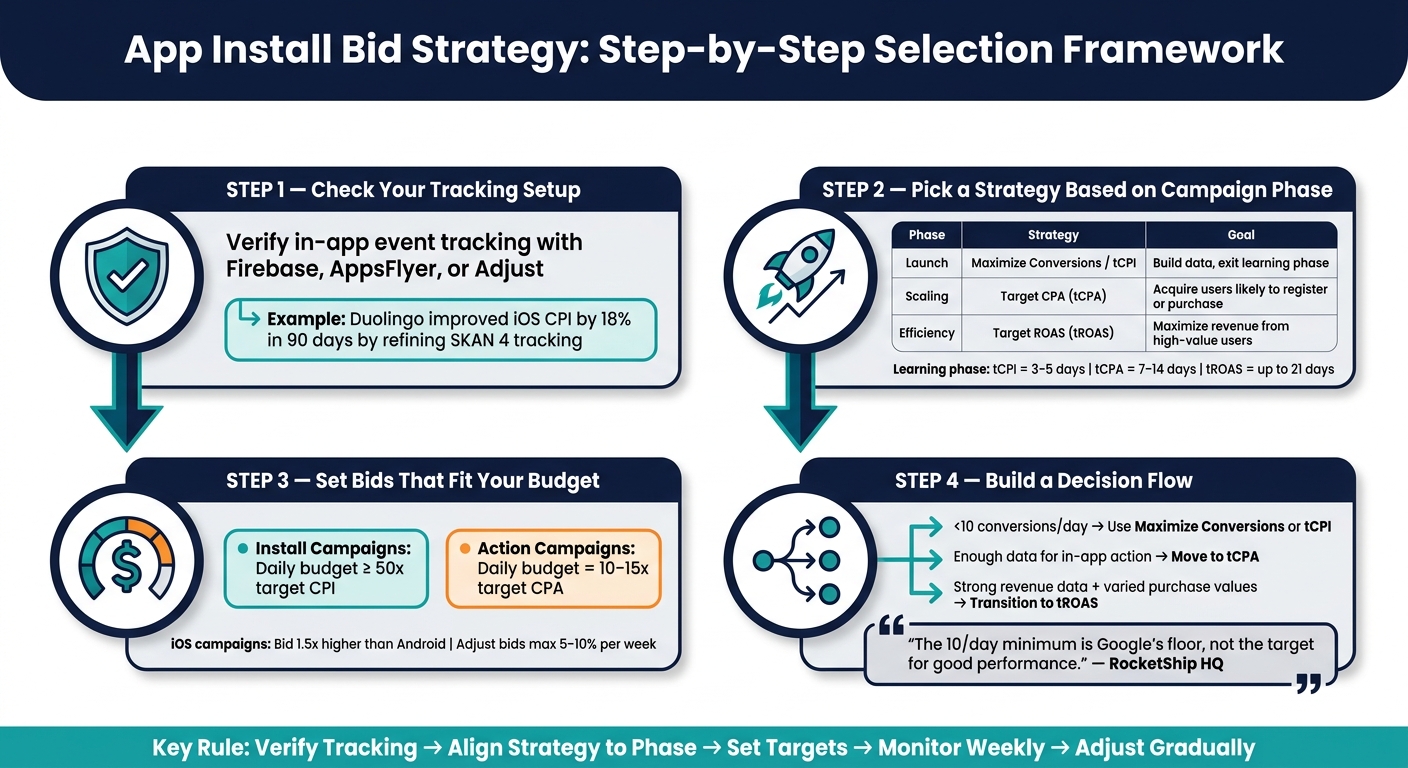
Understanding the available bidding strategies is one thing - knowing when and how to use them is a different challenge. This four-step framework will guide you through choosing the right bid strategy for your campaign. Let’s dive into the details.
Step 1: Check Your Tracking Setup
Before you start bidding, make sure your tracking setup is solid. Accurate data is the backbone of automated bidding strategies like Target CPA (tCPA) or Target ROAS (tROAS). Without it, these strategies won’t deliver the results you’re aiming for. Tools like Firebase or reliable Mobile Measurement Partners (MMPs) such as AppsFlyer or Adjust can help ensure in-app events are tracked correctly.
Here’s a real-world example: In 2024, Duolingo revamped its SKAN 4 conversion schema using AppsFlyer. They shifted their focus from raw installs to "streak-completion" events, which resulted in an 18% reduction in iOS CPI over just 90 days. The lesson? Better tracking leads to smarter bidding decisions.
Step 2: Pick a Strategy Based on Campaign Phase
Your campaign’s phase plays a key role in determining the right bidding strategy. During the launch phase, focus on gathering data quickly with strategies like Maximize Conversions (Google) or Lowest Cost (Meta). Once you’re consistently hitting 10+ conversions per day, shift to Target CPA during the growth phase to optimize for specific actions like registrations or purchases. Finally, when your app has reliable revenue data and varied purchase values, Target ROAS becomes the go-to strategy in the efficiency phase.
Here’s a quick reference table:
| Campaign Phase | Recommended Strategy | Goal |
|---|---|---|
| Launch | Maximize Conversions / tCPI | Build data and exit the learning phase |
| Scaling | Target CPA (tCPA) | Acquire users likely to register or purchase |
| Efficiency | Target ROAS (tROAS) | Maximize revenue from high-value users |
Keep in mind that learning phases vary by strategy. tCPI typically stabilizes in 3–5 days, tCPA in 7–14 days, and tROAS may take up to 21 days. Plan your campaign timelines accordingly, and use this phase-based approach to guide your next steps.
Step 3: Set Bids That Fit Your Budget and Risk Level
Starting with bids that are too low can hurt your campaign’s performance. For tCPA campaigns, it’s a good idea to set your initial target about 20% higher than your observed baseline CPA. This gives the algorithm enough flexibility to secure conversions without restricting delivery.
When it comes to budgets, here’s a simple rule of thumb:
- For install campaigns, allocate at least 50 times your target CPI.
- For action-based campaigns, allocate 10–15 times your target CPA.
If you’re running iOS campaigns, consider bidding 1.5 times higher than on Android to remain competitive, especially with SKAN 4 reporting delays. Adjust bids cautiously - tighten them by no more than 5–10% per week to avoid resetting the learning phase.
Step 4: Build a Simple Decision Flow
When in doubt, follow this straightforward decision flow:
- If you’re getting fewer than 10 conversions per day, stick with Maximize Conversions or tCPI.
- If you have enough data for a specific in-app action, move to tCPA.
- If you have strong revenue data and varied purchase values, transition to tROAS.
"The 10/day minimum is Google's floor, not the target for good performance." - RocketShip HQ
If your campaign gets stuck in a "Learning Limited" state, try consolidating ad groups or targeting a higher-funnel event to improve performance.
Monitor and Adjust Your Bids Over Time
Setting Your Initial Bids and Budget
For tCPI campaigns, aim for a daily budget that's at least 50 times your target CPI. For tCPA campaigns, allocate 10–15 times your target CPA, and start with a tCPA target that's about 20% higher than your goal to prevent early delivery issues. These ratios are based on proven campaign setup practices and give the algorithm enough room to optimize effectively. If you're running iOS campaigns, keep your bids about 1.5 times higher than Android campaigns - not just at the beginning but throughout the campaign. This accounts for SKAdNetwork's limited data reporting capabilities. After setting these initial bids, it's essential to monitor and adjust as performance data comes in.
Tracking Performance Regularly
The best way to gauge campaign performance is by reviewing a 7-day rolling average instead of relying on daily data. Conversion data often lags - sometimes by as much as 10–20% - as the attribution window fills up. Overreacting to daily fluctuations can lead to poor decisions.
Take advantage of Google Ads automation platforms and the Bid Strategy Report to compare your target costs with actual performance. Here's a quick look at the key metrics to focus on:
| Bidding Strategy | Metric to Monitor |
|---|---|
| Target CPI | Avg. target cost per install vs. Actual cost per install |
| Target CPA | Avg. target cost per in-app action vs. Actual cost per in-app action |
| Target ROAS | Avg. target ROAS vs. Actual ROAS |
Also, watch for a "Limited by budget" status in your campaign dashboard. This indicates your ads aren't being shown as frequently as they could, which directly limits the number of installs or conversions you can achieve. Regularly tracking these metrics allows you to make informed decisions about adjustments, as covered in the next section.
When and How to Adjust Bids
A campaign that consistently struggles to meet its goals is often bid-constrained. This happens when your actual CPI or CPA keeps hitting or exceeding your target, or when your actual ROAS falls short of your target. In such cases, consider slightly increasing your bid or lowering your ROAS target to unlock more auction opportunities.
"A higher ROAS target will narrow the pool of potential installs, whereas a lower ROAS target will typically enable the campaign to have more potential to scale." - Google Ads Help
When making adjustments, avoid major changes that could disrupt the campaign's learning phase. Stick to small, incremental updates - no more than 5–10% every 3–5 days. Sudden budget increases can cause a sharp rise in CPA, so it's better to proceed gradually.
One crucial guideline to remember:
"Making changes to your in-flight campaign before the first 100 conversions have registered may disrupt learning and result in poorer performance." - Google Ads Help
In the early stages, patience isn't just about waiting - it's part of a smart, measured strategy.
Tools and Expertise for Managing Bids at Scale
When External Tools Make Sense
Once you've refined your bid strategies, scaling up introduces a whole new set of challenges - challenges that external tools are often built to handle. Managing bids manually might work when you're running one or two campaigns. But when you're juggling platforms like Google, Meta, TikTok, and Apple Search Ads, things get messy fast. Data silos, unreliable attribution, and the sheer time it takes to adjust bids manually can slow you down.
Here’s a simple guideline: if your monthly ad spend surpasses $30,000–$100,000 or you’re managing campaigns across more than two platforms, it’s time to consider external tools and expert support. The same applies if you’re struggling with iOS measurement. For example, SKAdNetwork’s 64-conversion-value limit demands precise mapping - something that requires more than just a basic campaign setup.
And don’t forget about creative demands. To keep algorithms performing and avoid ad fatigue, modern app campaigns often need 30–40 fresh creative variants every month.
How Top PPC Marketing Directory Can Help
Finding the right tools or experts to handle tasks like SKAdNetwork configuration, MMP integrations, or Google App Campaign optimization isn’t easy. That’s where Top PPC Marketing Directory comes in. This resource simplifies your search by offering a curated list of vetted PPC agencies, bid management tools, and performance tracking solutions - all in one place.
Whether your focus is campaign scaling, retargeting, or app install growth, the directory connects you with specialists who align with your goals. It’s a time-saver, especially when you’d otherwise spend hours - or even days - researching options on your own.
Connecting Tools to Your Bid Strategy
Once you’ve determined that specialized support is needed, the next step is integrating tools that enhance your bid strategy. Third-party tools are most effective when they solve problems your platform dashboards can’t - like centralized cross-platform reporting. For example, Google’s self-reported install numbers can be 15%–30% higher than what independent MMPs like AppsFlyer, Adjust, or Kochava record. Without an independent MMP to rely on, you risk making decisions based on inflated data.
These tools don’t just improve measurement. Automated reporting tools can free up 15+ hours per week - time you can redirect to creative testing, audience analysis, and refining your bid strategy. Additionally, tools with automated rules can handle routine bid adjustments, so you don’t have to spend your day micromanaging.
"The algorithm learns only as well as the data it receives." - Admiral Media
The impact of combining tools with strategy is clear. Take NeuroNation, for example. By partnering with Admiral Media and shifting from install-volume bidding to Target ROAS bidding, while also using structured creative testing, they saw ROAS jump by 117% and CPI drop by 39%. The tools didn’t replace the strategy - they amplified it, making large-scale execution possible.
Conclusion: Choosing the Right Bid Strategy
Selecting the best bid strategy requires consistent tracking, aligning strategies with campaign phases, and making thoughtful adjustments. It’s not a one-and-done decision but an ongoing process. Start with Maximize Conversions or tCPI until you achieve a steady flow of at least 10 daily conversions. When setting initial targets, aim for 10–20% above your observed performance, and resist the urge to make changes during the first 7–14 days.
The quality of your data plays a huge role in how well algorithms perform. As Google Ads Strategist Slobodan Jelisavac explains:
"The difference between accounts achieving 4x ROAS with Smart Bidding and those burning budget without results isn't the strategy itself - it's how it's set up, when it's applied, and how well you understand what's happening under the hood."
For more advanced scaling or managing complex setups - like iOS measurement, MMP integrations, or multi-platform campaigns - resources like the Top PPC Marketing Directory can connect you with trusted tools, agencies, and solutions to streamline your efforts.
To keep your campaigns on track and avoid overspending, stick to this framework: verify tracking → align strategy with your campaign phase → set achievable targets → monitor weekly performance → make gradual adjustments. By following this structured approach, you can optimize each phase of your app install campaigns and ensure steady progress without unnecessary budget waste.
FAQs
How do I choose between tCPI, tCPA, and tROAS?
Choosing between tCPI, tCPA, and tROAS hinges on your campaign objectives, app's stage of development, and the data at your disposal.
- tCPI: Best for newer apps or when your primary goal is increasing install volume, especially if you lack post-install performance data.
- tCPA: Ideal for enhancing user quality. However, it requires a minimum of 10 conversions per day to function effectively.
- tROAS: Suited for well-established apps with at least 300 conversions per week, focusing on maximizing revenue rather than just volume.
How many conversions do I need before switching bid strategies?
When it comes to conversion volume, the requirements can differ depending on the platform and strategy you're using. For Google Ads, Target CPA needs a minimum of 30 conversions per month, though hitting 50–80 conversions monthly tends to provide more consistent results. If you're working with Target ROAS, you'll want to aim for 50–100 conversions per month to maintain stability.
On the other hand, Meta app campaigns have higher demands. For strategies like Cost Cap or Lowest Cost, you should target 50 conversions per week per ad set. Falling below these benchmarks can make performance unpredictable.
What should I do if my campaign gets stuck in 'Learning Limited'?
If your campaign status shows as 'Learning Limited' in Google Ads, you can hover over the status to get more details about the issue.
For campaigns limited by budget, consider increasing your budget or redistributing your spending. You can do this by cutting out non-converting keywords or refining your ad schedules to focus on high-performing times.
If the problem lies with your bid strategy, try loosening up your Target CPA or ROAS goals to make them less restrictive.
One key tip: avoid making frequent or drastic changes, as these will reset the learning phase and prolong the time it takes for your campaign to optimize.