Cross-channel PPC connects platforms like Google Ads, Meta, and Microsoft Ads into a unified advertising strategy. Why does this matter? Instead of running campaigns independently, this approach aligns messaging, improves performance, and simplifies management.
Here’s why it works:
- Boost Conversions: Advertisers report a 27% increase in conversions without higher costs.
- Better ROAS: Google’s AI-driven campaigns deliver 8% higher ROAS and 10% better sales efficiency.
- Consumer Interaction: Coordinated efforts can increase engagement by 250%.
Each platform plays a specific role:
- Google Ads: Targets high-intent users with tools like Performance Max and Smart Bidding.
- Meta Ads: Focuses on demand creation through visual storytelling and precise audience targeting.
- Microsoft Ads: Offers lower competition and niche B2B targeting.
- Amazon Ads: Captures shoppers ready to buy.
Success relies on tools for unified budget management, centralized reporting, and automation. Metrics like ROAS, CPA, and customer journey data help optimize campaigns. Attribution models (e.g., first-touch, last-touch) reveal which platforms drive results, while automation enables real-time adjustments.
The takeaway? Synchronizing PPC efforts across platforms maximizes results by leveraging each platform’s strengths while maintaining consistent messaging.
Learn With Optmyzr: Cross Channel Reporting & Data Sources
Major PPC Platforms for Cross-Channel Campaigns
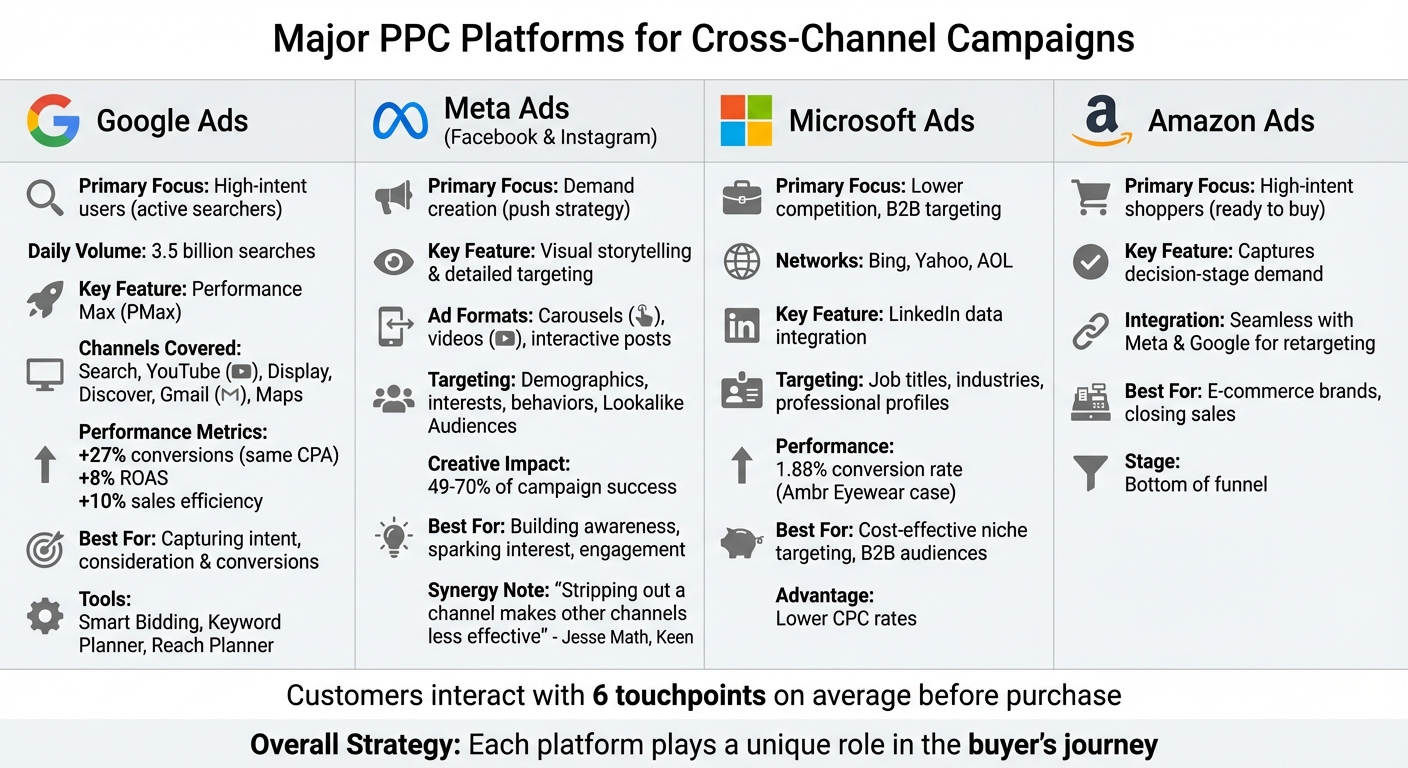
Cross-Channel PPC Platform Comparison: Features, Strengths, and Performance Metrics
A cross-channel strategy involves selecting platforms that connect with distinct audience segments throughout the buyer's journey.
Google Ads
Google Ads is a go-to for capturing high-intent users - those actively searching for what you offer. With over 3.5 billion searches happening daily, it’s a central piece of most cross-channel strategies. One standout feature is Performance Max (PMax), which lets advertisers manage campaigns across multiple channels - Search, YouTube, Display, Discover, Gmail, and Maps - all from one place. On average, advertisers using PMax have seen a 27% boost in conversions without increasing their cost per acquisition. Other perks include an 8% better return on ad spend and a 10% improvement in sales efficiency.
Google’s Smart Bidding uses AI to fine-tune bids across channels, automatically reallocating budgets to areas likely to drive conversions. Tools like Keyword Planner, Reach Planner, and Google Ads Editor make it easier to manage these campaigns, even when they’re complex.
Take the example of Ambr Eyewear, a Dublin-based brand that teamed up with UAWC in 2023. They zeroed in on high-intent keywords like “computer glasses” and “blue light filtering” while using cross-platform remarketing to target Google users on Facebook. The result? A 235.69% increase in their Google Ads conversion rate.
Next, let’s look at how Meta Ads bring a different angle to the table with their focus on creating demand through visual storytelling.
Meta Ads (Facebook and Instagram)
While Google Ads focuses on capturing intent, Meta Ads are all about creating it. These ads act as a push strategy, introducing your brand to people who might not even realize they need your product yet. This makes Meta Ads great for building awareness and sparking interest, complementing Google’s focus on driving consideration and conversions.
Meta Ads shine with formats like carousels, videos, and interactive posts designed to grab attention in users’ feeds. They link directly to your business page, encouraging instant engagement through comments, reactions, or profile visits. Plus, Meta’s audience targeting is incredibly detailed, using demographics, interests, and behaviors to reach the right people. Even as Google phased out its "similar segments" feature in 2023, Meta’s Lookalike Audiences remain a strong tool for finding new prospects.
The synergy between Google and Meta is undeniable. As Jesse Math from Keen puts it:
If you stripped out a channel from your plan, conversions in other channels would also go away because those other channels are now less effective.
There’s plenty of evidence to back this up. Meta’s visual storytelling plays a crucial role in cross-channel campaigns, especially since high-quality creatives can make or break performance - accounting for 49% to 70% of a campaign’s success.
Together, Meta’s engagement and Google’s intent-driven approach create a solid foundation. But platforms like Microsoft Ads and Amazon Ads can further enhance your strategy.
Other Platforms (Microsoft Ads, Amazon Ads)
Adding platforms like Microsoft and Amazon Ads can take your cross-channel efforts to the next level.
Microsoft Advertising (formerly Bing Ads) stands out with lower competition, often leading to better cost-per-click rates. It reaches users across Bing, Yahoo, and AOL - audiences that might not be as active on Google. Microsoft also taps into LinkedIn data, offering precise B2B targeting options based on job titles, industries, and professional profiles. As Oleksii Chychyrko, CEO of UAWC, explains:
Microsoft Advertising... is a gem for certain demographics. Often, advertisers find lower competition.
In the Ambr Eyewear example, Bing Ads played a role too, contributing a 1.88% conversion rate and complementing the broader strategy that drove revenue growth.
Amazon Ads, on the other hand, is perfect for e-commerce brands. It targets shoppers who are already in the buying mindset, making it an effective way to capture demand at the decision-making stage. Amazon Ads also integrate seamlessly with platforms like Meta and Google, letting you retarget high-intent shoppers across multiple touchpoints.
Building an omnichannel presence is key - on average, customers interact with six touchpoints before making a purchase. Each platform brings something unique to the table: Google captures intent, Microsoft offers cost-effective niche targeting, Meta leverages detailed audience insights, and Amazon seals the deal with high-intent shoppers.
Required Features for Cross-Channel PPC Tools
When managing campaigns across platforms like Google and Meta, having the right tools is essential. These tools turn scattered data into actionable insights, allowing you to focus on strategy instead of spending time on manual tasks.
Unified Budget Management
The best tools allow you to dynamically reallocate your budget based on performance. Funds can be shifted weekly - or even daily - to the channels driving the most conversions. Jesse Math from Keen emphasizes that channels often rely on each other for effectiveness, creating a "halo effect" where spending on one channel (like social media) can improve results on another (like search).
Advanced techniques like Media Mix Modeling (MMM) and Bayesian modeling make it possible to forecast the impact of budget shifts with precision, sometimes down to a 4% margin of error. These methods support testing reallocations of 10–20% between platforms to measure the incremental impact on conversions.
Centralized dashboards play a key role here by integrating these dynamic budgets and providing real-time insights.
Centralized Reporting and Analytics
Metrics can vary widely across platforms, making it hard to compare performance. Centralized dashboards solve this by standardizing metrics, enabling you to make true apples-to-apples comparisons. These dashboards also show how different channels work together, helping you understand whether high engagement rates are actually leading to conversions.
The results can be impressive. For example, advertisers using cross-channel Performance Max campaigns have reported an average 27% increase in conversions and an 8% boost in ROAS compared to search-only strategies. Adding universal conversion tracking and integrating offline CRM data further enhances these insights. Automated dashboard updates ensure you’re always working with the latest data.
Automation Capabilities
Automation in cross-channel PPC goes far beyond simple bid adjustments. Tools that support value-based bidding use predicted Lifetime Value (LTV) or qualified pipeline data to focus on conversion value rather than just the number of conversions. Features like automated "kill-switches" can pause campaigns when CPA spikes, helping to prevent wasted budget. Other automation options include budget ramps, daily alerts, and minimum data thresholds to balance short-term results with long-term goals.
Standardizing UTM parameters and conversion naming across platforms is another critical step for seamless optimization. Here’s how some major platforms handle automation:
| Platform | Automated Bidding Mode | Key Value Driver | Control Levers |
|---|---|---|---|
| Google Ads | Smart Bidding (tROAS, Max Value) | Revenue or predicted LTV | Portfolio targets, value rules, seasonality |
| Meta Ads | Advantage+ with value optimization | Purchase or deal value | Cost caps, creative iteration, exclusions |
| LinkedIn Ads | Conversion optimization | Qualified lead/pipeline value | Bid controls, audience granularity, form type |
With the right tools, guesswork is replaced by data-driven decisions. For instance, simulating a 15% budget shift from search to YouTube can help forecast profit impact. This kind of automation enables continuous fine-tuning across your entire cross-channel strategy.
sbb-itb-89b8f36
Best Practices for Cross-Channel PPC Synchronization
Consistent Campaign Naming Conventions
Having a clear and consistent naming system for your campaigns is key to running effective cross-channel PPC efforts. When you standardize campaign labels across platforms, it becomes much easier to analyze performance and track results accurately. Plus, this consistency ensures your campaigns are ready to adapt to newer channels as they emerge.
For example, as platforms like TikTok, OTT, and retail media continue to grow, a unified naming structure helps simplify management and highlights how success in one channel can influence others. This approach not only cuts down on confusion but also uncovers the connections between channels, setting the stage for smarter, data-driven decisions.
Measuring and Optimizing Cross-Channel Performance
Key Performance Indicators (KPIs)
Tracking the right metrics is the backbone of any successful campaign. Start with the basics: Click-Through Rate (CTR), Conversion Rate, Cost Per Click (CPC), and Cost Per Acquisition (CPA). For a more detailed view, calculate Return on Ad Spend (ROAS) by dividing your revenue by ad costs. To take optimization a step further, focus on Incrementality and iROAS (Incremental ROAS) - these help measure the true value a channel brings that wouldn't exist without its contribution.
Instead of relying solely on averages, track Marginal CPA and Marginal ROAS. These metrics reveal the value of each additional dollar spent, helping you avoid overextending on channels that have already reached their peak. On Google, keep an eye on Impression Share to spot campaigns limited by budget, while on Meta, monitor Frequency to identify ad fatigue before it drags down performance.
Customer journey data is another critical piece of the puzzle. Organizations that leverage this data are three times more likely to succeed compared to those that don’t. With customers typically interacting with six touchpoints before converting, focusing on a single metric risks missing the bigger picture.
These metrics lay the groundwork for understanding how credit is distributed across touchpoints - an essential step for accurate attribution.
Cross-Channel Attribution Insights
Attribution is all about understanding which channels deserve credit for conversions. Combining multiple attribution models is key here. First-touch attribution highlights which channels drive awareness, while last-touch attribution reveals what seals the deal. For longer sales cycles, linear attribution - which gives equal credit to all touchpoints - can be particularly useful.
Data-driven attribution takes things further by using machine learning to assign credit based on historical patterns. These models analyze your unique customer journeys to reflect how each channel truly contributes to conversions.
"If you stripped out a channel from your plan, conversions in other channels would also go away because those other channels are now less effective." - Jesse Math, Keen
This concept, often called the "halo effect", explains why investing in one channel (like social media) can indirectly boost another (like search ads).
To make sense of these insights, you need a unified data layer. Tools like Google BigQuery or Snowflake centralize data from all platforms, solving the issue of inconsistent metrics - such as Facebook’s "Cost-Per-Result" versus Google’s "CPA" - by normalizing everything into shared KPIs.
Using Reporting Tools for Optimization
Once you’ve nailed attribution, reporting tools can help turn data into actionable strategies. Automated tools streamline the process, converting raw numbers into clear optimization opportunities. Unified dashboards bring together performance data from platforms like Google and Meta, making it easier to identify cross-channel synergies and adjust budgets on the fly. For example, balanced scorecards compare a channel’s spend share to its revenue share. If a channel generates 10% of your revenue but only gets 5% of your budget, you’ve likely found a prime opportunity for reallocation.
Set up automated alerts to catch performance issues early - whether it’s a sudden drop in conversion rates or a budget threshold breach. This allows you to act quickly before minor problems escalate.
Another key tactic is post-click analysis, which connects your PPC data with web analytics. High bounce rates, for instance, might point to landing page issues rather than poor targeting, shifting your optimization strategy entirely. Also, track budget pacing daily to avoid overspending due to loose caps or underspending that could derail your business goals.
For tools and resources that simplify cross-platform reporting, check out the Top PPC Marketing Directory (https://ppcmarketinghub.com). It centralizes performance tracking tools, saving you from logging into multiple platforms individually.
"Time is your most scarce resource. Every minute you save from logging into different networks or manual reporting is a minute you can spend on more valuable things, such as campaign optimization." - Supermetrics
Conclusion
Running PPC campaigns across platforms like Google and Meta isn’t just about showing up - it’s about creating a cohesive strategy that taps into each platform’s strengths while keeping your messaging consistent and aligned with your business goals.
Advertisers using cross-channel Performance Max campaigns have seen a 27% increase in conversions while maintaining comparable CPA and ROAS. On top of that, AI-driven strategies have delivered 8% higher ROAS and 10% greater sales effectiveness. Take the example of Ambr Eyewear: their synchronized campaigns led to a significant boost in conversions across all platforms.
At the heart of this synchronization are automation tools. These tools handle the complexities of auctions and real-time optimizations that manual management simply can’t match. This frees up your time to focus on creative strategy and fine-tuning conversion efforts. As Laili Shalom from AdScale puts it:
"Manual campaign management can't compete in today's auction-driven ad landscape. If you're still adjusting budgets manually, you're not optimizing – you're just chasing performance drops."
Automation lays the groundwork for effective campaign management. To build on this, start with the basics: use unified UTM parameters for tracking, adopt consistent naming conventions, and centralize your reporting. From there, refine your strategy with cross-platform remarketing, align messaging across channels (while tailoring formats to each platform), and focus on maximizing marginal ROI instead of average performance. These steps reinforce the idea that strategic integration leads to unified growth.
Shifting from a multi-channel to a cross-channel strategy is no longer optional if you want to remain competitive. For tools that make managing and reporting across platforms easier, check out the Top PPC Marketing Directory. It’s a great resource for finding solutions tailored to coordinating campaigns across multiple networks.
FAQs
How does cross-channel PPC help boost conversion rates without increasing costs?
Cross-channel PPC takes your paid media strategy to the next level by treating it as a unified system rather than a collection of isolated campaigns. By analyzing performance across platforms like Google, Meta, and Amazon, you can allocate your budget more strategically. This means channeling the bulk of your funds into what’s already working, setting aside some for testing new ideas, and making weekly adjustments based on the latest results. The payoff? Less wasted spend and more consistent costs.
AI-powered tools, such as Smart Bidding, make this process even better. These tools optimize bids in real-time across multiple platforms, focusing on conversions rather than platform-specific metrics. This way, you can capture more leads or sales while maintaining the same cost per acquisition. The added bonus? A smoother user journey with consistent messaging across all touchpoints, which translates into stronger results - without needing to stretch your budget.
If you're looking to streamline your campaigns, platforms like the Top PPC Marketing Directory can help you find the right tools for effective management and optimization.
How do automation tools help manage PPC campaigns across multiple platforms?
Automation tools have become essential for simplifying cross-channel PPC campaigns, giving marketers the ability to oversee platforms like Google Ads, Meta Ads, TikTok, and LinkedIn from one centralized dashboard. These tools take care of tasks like adjusting bids, managing budgets, and refining audience targeting in real time. The result? Better ROI without overspending.
Beyond managing bids and budgets, these tools also align creative assets and audience segments, ensuring your messaging stays consistent across all platforms. This cohesive strategy helps cut down on wasted ad spend, streamlines performance tracking, and saves time by automating repetitive tasks. For marketers in the U.S. aiming to simplify their cross-channel PPC efforts, the Top PPC Marketing Directory offers a handpicked list of tools and services to help you run campaigns more effectively.
Why is consistent messaging crucial for cross-channel PPC campaigns?
Keeping your messaging consistent across platforms like Google and Meta is key to delivering a seamless brand experience. It builds trust, minimizes confusion, and ensures your audience gets the same clear message no matter where they see your ads.
When your campaigns align with your audience's expectations at every interaction, it not only boosts engagement but also enhances ad performance and helps you get the most out of your investment.