Struggling with low CTR? Here's the deal: Click-through rate (CTR) measures how often people click your ad after seeing it. A higher CTR isn’t just about better engagement - it can lower your costs and improve ad placements.
Key Takeaways:
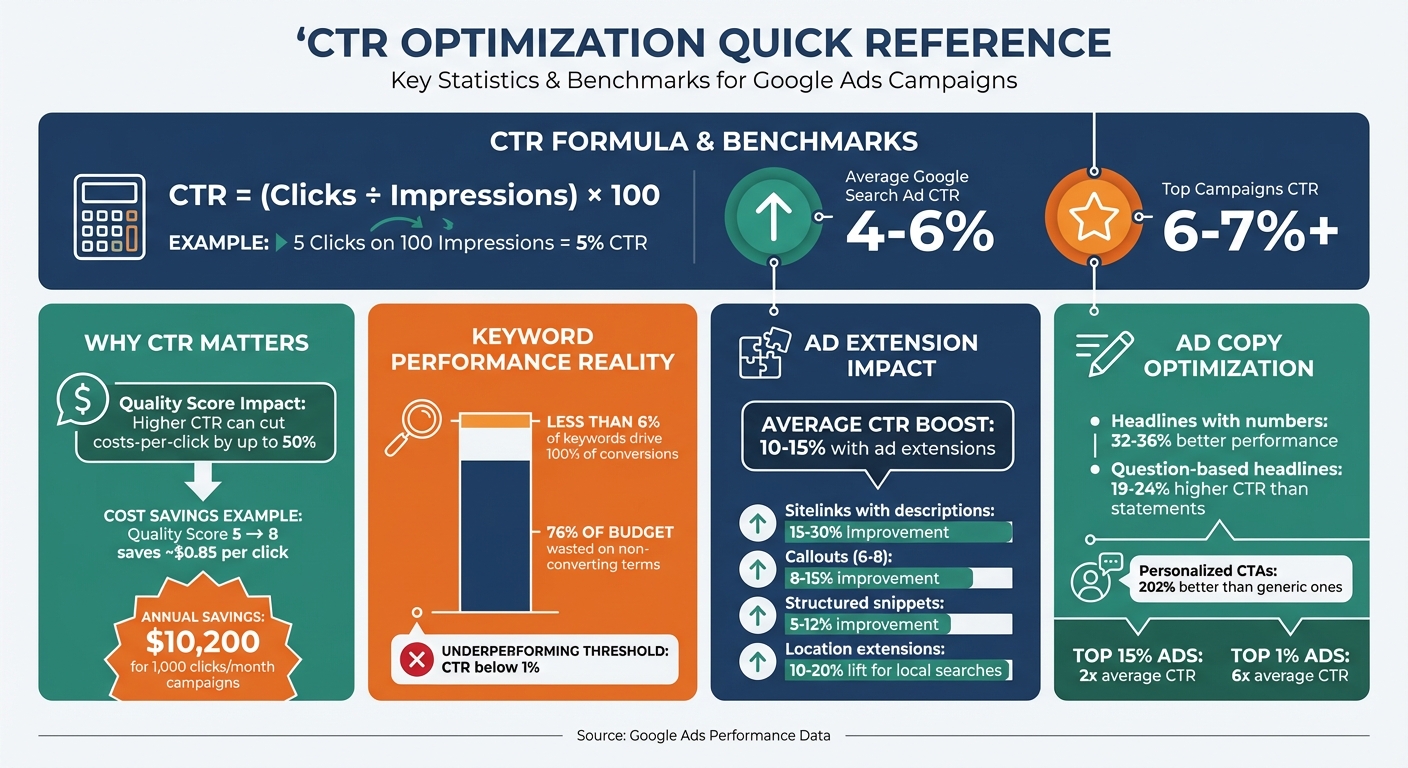
- CTR Formula: (Clicks ÷ Impressions) × 100. Example: 5 clicks on 100 impressions = 5% CTR.
- Why CTR Matters: A higher CTR boosts Google’s Quality Score, cutting costs-per-click by up to 50%. Poor CTR? Expect costs to rise.
- Benchmarks: Average Google Search ad CTR is 4–6%, with top campaigns hitting 6–7%+.
Common Problems:
- Poor Keywords: Broad matches trigger irrelevant searches; generic terms like "shoes" lack intent.
- Weak Ad Copy: Generic headlines, no clear call-to-action (CTA), or feature-heavy messaging.
- Ignoring Ad Extensions: Missing sitelinks, callouts, or structured snippets makes your ad less clickable.
- No Monitoring: Campaigns left unchecked miss critical insights, wasting budget.
Quick Fixes:
- Refine keywords; add negatives like "free" or "used."
- Write specific, benefit-driven headlines (e.g., "Save $125 Today").
- Use ad extensions (e.g., sitelinks, callouts) to boost CTR by 10–15%.
- Regularly review performance and pause underperforming ads.
CTR optimization isn’t a one-time task - it’s about constant tweaks to keywords, ad copy, and targeting. Ready to improve? Let’s dive into the details.
CTR Optimization Quick Reference: Benchmarks, Problems & Impact Statistics
How to Improve Your CTR in Google Ads
sbb-itb-89b8f36
Common CTR Problems
Recurring issues can drag your CTR down, and getting a handle on them is the first step to improving your campaigns. Let’s break down some of the most common problems that hold ads back from performing their best.
Poor Keyword Selection
One major issue is the misuse of broad match keywords. Without modifiers, broad match can make your ads show up for irrelevant searches, leading to lots of impressions but very few clicks. Another mistake is keyword stuffing, where an ad group contains over 20 keywords. Using PPC tools for keyword research can help you identify more relevant, high-intent terms instead. This muddles the ad’s focus, making its message less relevant. On top of that, skipping negative keywords can cause your ads to appear for unrelated searches like "free", "jobs", or "recipes".
Here’s a surprising stat: in a typical Google Ads account, less than 6% of keywords drive 100% of conversions, while a whopping 76% of the budget gets wasted on terms that never convert.
Another common problem is search intent mismatch. For example, targeting informational keywords like "what is..." when your ad is meant to sell a product (e.g., "buy now") often results in poor engagement. Why? Because the ad doesn’t align with where the user is in their decision-making process. Similarly, focusing on generic, high-volume terms like "shoes" instead of more specific phrases like "red ladies running shoes" lowers CTR due to stiff competition and less relevance.
"The more your keywords, ads, and listings relate to each other and to your business, the more likely a user is to click on your ad or listing." - Google Ads Support
Beyond keyword problems, the way you craft your ad copy plays a huge role in capturing attention.
Weak Ad Copy
Vague headlines like "We Offer Great Services" don’t give users a reason to click - they just keep scrolling. And if your ad lacks a clear call-to-action (CTA), users won’t know what to do next, leading to missed opportunities.
"Your headline is your first impression. If it's vague, boring, or too broad, people will scroll right past it." - Ads with Finesse
Another trap is focusing on features instead of benefits. For instance, an ad that highlights "Bluetooth 5.0 and 10-hour battery life" might not resonate as much as one that says, "Enjoy Seamless Streaming All Day - No Charging Needed". Ads also lose impact when they’re filled with industry jargon or repetitive keywords that don’t add value.
Here’s how you can make your ad copy more specific and engaging:
| Instead of this (Generic)... | Try this (Specific)... |
|---|---|
| Buy Now and Save | Save $125 Off Your First Order |
| Used Text Books for Sale | Buy Used Text Books for $30 |
| Sale Ends Soon | Claim Offer Before 9/25 |
| Learn More | Book a 30-Minute Call Today |
Unused or Poorly Used Ad Extensions
Ad extensions are a simple way to make your ad larger and more noticeable. If you skip them, your ad appears smaller and less prominent, making it easy for competitors to outshine you. Plus, Google factors extensions into its Ad Rank calculations, so ignoring them can hurt your position or increase costs.
Extensions like click-to-call buttons, price displays, or specific page links reduce friction for users, giving them clear next steps. Without these, users might hesitate, lowering the chances of a click. According to Google, using ad extensions can boost CTR by 10–15% on average.
"Simply writing good ad copy and bidding on the right keywords isn't enough to stand out on the search engine results page (SERP) anymore." - Reflect Digital
But even with great keywords, ad copy, and extensions, your campaign needs regular monitoring to stay on track.
Lack of Monitoring and Data Analysis
Even if you fix initial issues like keyword misuse or weak ad copy, neglecting regular monitoring can undo your efforts. Many advertisers set up campaigns and then leave them untouched for weeks or months, missing out on critical insights. Without reviewing search term reports, it’s impossible to catch and exclude irrelevant or costly terms that don’t convert.
Regular analysis and adjustments are key to ensuring your campaigns stay effective and efficient. By keeping a close eye on performance, you can identify and address weak spots before they drain your budget.
How to Fix CTR Problems
Here’s how you can tackle CTR issues with practical and effective strategies.
Refine Keywords and Negative Keyword Lists
Start by sharpening your keyword management. Dive into your Search Terms Report to discover which queries are triggering your ads. If you spot irrelevant terms, add them as negative keywords. On the flip side, turn high-performing queries into new keywords.
"Keywords are assumptions. Search queries are actions."
- Allen Finn, Co-founder, Toasted Collective
Be specific with your targeting. For example, instead of using a broad term like "waxing", go for something more precise, such as "wood floor waxing services". Data shows that top-performing ads - those in the top 15% - achieve a CTR that's double the average. Those in the top 1%? Their CTR is six times higher.
Build a master negative keyword list at the account or campaign level. Add terms like "free", "used", "jobs", or competitor names to avoid wasting your budget. Keep in mind, negative keywords don’t match close variants like misspellings, and they won’t block ads if the term appears after the 16th word in a long query.
Next, identify underperforming keywords - those with a CTR below 1%. Either refine these keywords or pause them altogether. Shift your match types from broad to phrase or exact matches to prevent irrelevant queries from triggering your ads.
Improve Ad Copy and Creative
Your ad copy needs to do more than just describe your product or service - it should sell the outcome. Use the feature–benefit–feeling framework to highlight what your product does, the benefit it offers, and how it makes users feel. For instance, instead of saying "Bluetooth 5.0 and 10-hour battery life", try "Enjoy Seamless Streaming All Day - No Charging Needed".
Replace generic CTAs like "Click Here" with more specific ones. Ads with precise numbers in headlines (e.g., "Save $125 Off Your First Order") can boost CTR by up to 32%. Similarly, question-based headlines like "Want to Rank #1 on Google?" often outperform standard statements by 19–24%.
"Writing exceptional ad copy is the most important thing you can spend your time on in paid search."
- Kristen McCormick, Head of Marketing, Hatch
Dynamic Keyword Insertion (DKI) can help personalize your ads, but always include default text to avoid awkward phrasing. Tap into psychological triggers like urgency ("Sale Ends Tonight"), scarcity ("Only 3 Spots Left"), and social proof ("Trusted by 50,000+ Teams") to encourage immediate action.
For mobile users, front-load critical benefits and keywords in your headlines since they tend to skim. This adjustment ensures your ad grabs attention quickly.
Use Ad Extensions Properly
Ad extensions, now called assets, are an easy way to enhance your CTR without additional costs. They make your ad more prominent on the search results page and can even improve your Ad Rank, which may lead to better ad positions and lower costs-per-click.
"Extensions are factored into Ad Rank calculations and can improve your ad's performance at no extra cost."
Focus on sitelinks, callouts, and structured snippets, as these work well for most businesses. Adding sitelinks with descriptions can improve CTR by 15–30%. Aim for at least four sitelinks with two-line descriptions for optimal mobile performance.
Use 6–8 short, non-clickable callouts like "Free Shipping" or "24/7 Support" to build trust. Google typically displays up to four callouts, which can lead to an 8–15% CTR improvement. For structured snippets, list at least four values under each header, which can boost CTR by 5–12%.
Other extensions, like image and location assets, can also make a difference. High-quality image extensions (1:1 aspect ratio) can increase CTR by 6–12%. Meanwhile, location extensions are perfect for local businesses, offering a 10–20% CTR lift for location-based searches.
Adjust Audience and Location Targeting
Even the best ad won’t perform well if it reaches the wrong audience. Narrow your geographic targeting - especially if you’re a local business. Focus on specific cities, zip codes, or nearby areas instead of covering an entire state or country.
Segment your audience to tailor campaigns for different groups. For example, create separate campaigns for first-time visitors and returning customers, or segment by demographics like age, income, or interests. This allows you to craft messages that resonate with each group.
Regularly review your location performance reports. If certain areas consistently show low CTR or high costs with minimal conversions, consider excluding them or lowering your bids. On the other hand, allocate more budget to high-performing locations.
Set Up Regular Monitoring
Fixing CTR issues isn’t a one-time task - it requires constant attention. For many businesses, partnering with top PPC agencies can ensure this level of ongoing optimization. Conduct daily checks for sudden changes, like drops in impressions or CTR, and dive deeper into performance data weekly or bi-weekly.
Break down your CTR data by device, location, time of day, and ad group to spot trends. For instance, if mobile CTR lags behind desktop, tweak your mobile ad copy or improve the landing page experience. If certain ad groups underperform, examine their keywords and copy to find the problem.
Review your Search Terms Report weekly to catch irrelevant terms before they drain your budget. Use automated PPC alerts to notify you if CTR drops below a certain threshold so you can act quickly.
How to Implement These Fixes
To get the best results, tackle improvements in two stages: start with quick-impact actions for immediate gains, then focus on long-term strategies to maintain and enhance performance over time.
Quick Fixes (First 2 Weeks)
Kick things off with changes that deliver fast results:
- Audit your Search Terms Report: Add 50–100 negative keywords to filter out irrelevant traffic. Terms like "free" or "refurbished" often waste budget without bringing in quality clicks.
- Revamp your ad copy: Use action-oriented calls-to-action (CTAs) such as "Get Started", "Download Now", or "Claim Your Discount." Headlines with numbers perform about 36% better, so replace generic phrases like "Save Money" with something specific, like "Save $125 Off Your First Order". Include your primary keyword in at least one headline and try using a power word like "Proven", "Instant", or "Free" in another.
- Enable all ad extensions: Make sure every ad group includes at least four sitelinks and four callout extensions. Sitelink extensions alone can boost click-through rates (CTR) by up to 20%. Also, add your main keyword to the display URL path (e.g., yoursite.com/keyword) to improve relevance.
- Pause underperforming ads: Identify and pause the bottom 30% of ads based on CTR. This allows you to reallocate budget to higher-performing ads, improving overall efficiency.
Once these adjustments are in place, shift your attention to strategies that create sustainable growth.
Long-Term Changes
After achieving quick wins, focus on building a solid foundation for ongoing optimization:
- Leverage audience demographics: Use data like age, gender, and income to target prospects with higher potential value.
- Set up A/B testing for ad formats: Use the "Rotate indefinitely" setting in Google Ads to gather unbiased data. Test one variable at a time - like headlines, CTAs, or visuals - and keep a detailed test log. Personalized CTAs, for example, can outperform generic ones by up to 202%.
- Optimize landing pages: Ensure your landing pages align with your ad messaging. Slow load times can hurt conversions - each second beyond a 2-second load time can reduce conversions by 4.42%. Use tools like Google PageSpeed Insights to ensure fast load times, especially on mobile devices, which account for over 60% of web traffic.
- Refine your bidding strategy: Wait until you have at least 30 manual conversions in a month before switching to Smart Bidding strategies like Target CPA or ROAS. Analyze performance by time of day and adjust bids to capitalize on peak engagement hours (e.g., 9–11 a.m.) while reducing spend during low-intent periods.
"Optimization is never 'done.' ... growth comes from steady iteration - not one-time fixes."
- Konstantin Vashkevich, Head of Marketing, RedTrack
- Evolve your keyword strategy: Gradually shift from broad research terms to long-tail, high-intent keywords. These are more resilient to competition and often outperform generic terms. Regularly review geographic performance and use bid multipliers to focus on high-performing areas, even down to specific zip codes.
Using the Top PPC Marketing Directory
Once you've tackled quick fixes and started planning for long-term improvements, tapping into specialized resources can take your CTR performance to the next level. Addressing CTR challenges often requires tools and expertise that go beyond what your in-house team can provide. The Top PPC Marketing Directory is a one-stop resource that connects you with vetted agencies and platforms designed to optimize campaigns - saving you time and reducing guesswork.
This directory is thoughtfully organized by function, making it simple to find exactly what you need. For example:
- Competitor intelligence: Platforms like Semrush and SpyFu let you analyze rival ad strategies, uncovering the headlines and keywords that drive clicks in your industry.
- Ad copy creation: AI tools like ChatGPT can generate multiple ad copy variations for A/B testing in just minutes.
- Automated monitoring: Tools such as Adalysis and Optmyzr perform over 100 audits to identify budget leaks and underperforming ads before they impact your ROI.
What sets this directory apart is its focus on results. As Loomo Marketing highlights:
"Working with an agency local to Vancouver offers unique advantages. They understand the local market dynamics, cultural nuances, and seasonal trends that might elude broader agencies".
This concept applies across the board - specialized partners listed in the directory are equipped to align CTR improvements with actual business outcomes, not just surface-level metrics.
Additional tools in the directory include negative keyword automation to block irrelevant traffic and heatmap platforms like Hotjar, which pinpoint landing page elements that users overlook. For those managing campaigns across multiple platforms, analytics tools like Improvado consolidate data from Google Ads, Facebook, and GA4 into one streamlined dashboard. Pricing varies widely, from free options like ChatGPT to $249/month for tools like Optmyzr tailored to smaller accounts.
The directory also simplifies the process of finding the right agency by organizing them based on expertise - whether you're focused on B2B lead generation, e-commerce, or cybersecurity. Whether you’re looking for a quick fix or a long-term optimization partner, the curated listings help you move from identifying issues to implementing solutions much faster than trying to patch things together on your own. By leveraging this resource, you'll be well-positioned to boost CTR and drive better overall campaign results.
Conclusion
Optimizing your CTR is a continuous process that has a direct impact on your bottom line. As Robin Dhanwani, Founder of Parallel, explains:
"CTR isn't a single magic trick - it's the result of many small, deliberate choices across creative, targeting and experimentation".
Every small improvement contributes to a higher Quality Score, which lowers your CPC, improves ad positioning, and increases visibility and clicks. The financial benefits are clear: moving from a Quality Score of 5 to 8 can save you about $0.85 per click. For campaigns generating 1,000 clicks per month, that's an annual savings of $10,200.
Start with the basics to see immediate results. Quick wins like adding negative keywords and using proper ad extensions can make a noticeable difference. From there, dive into deeper strategies like A/B testing and refining your audience targeting. The key is relevance - every element of your ad, from the search query to the landing page, needs to align with user intent.
Don’t hesitate to tap into expert resources. The Top PPC Marketing Directory is an excellent starting point, connecting you with tools and agencies that specialize in solving CTR challenges. Whether you’re looking for competitor analysis platforms, AI-driven ad copy tools, or automated monitoring systems, the directory helps you find solutions tailored to your goals and budget.
The digital advertising world is constantly evolving. AI-powered search, banner fatigue, and increasing click fraud require ongoing adjustments. By prioritizing CTR optimization and utilizing specialized tools and expertise, you’ll create campaigns that deliver consistent and meaningful ROI.
FAQs
What’s a “good” CTR for my industry?
A "good" CTR can vary depending on your industry and the platform you're using. As a general rule, anything above the median or platform-specific benchmarks is seen as strong. For example, Meta tends to average around 1.5%, YouTube falls between 0.4% and 0.6%, and TikTok often stays below 1%. These figures aren't set in stone, so it's important to measure your performance against industry-specific standards to get a clearer picture.
Why is my CTR low but my conversions are fine?
A low click-through rate (CTR) paired with strong conversions often indicates that your ads are attracting fewer, but more qualified, clicks. This could point to a disconnect between your ad messaging and your landing page. When these two elements are properly aligned, the clicks you get are more likely to come from the right audience. On the flip side, overly broad ad content might draw in clicks from users who aren’t genuinely interested. While this can boost your CTR, it may not impact conversions if only the right audience finds your landing page relevant.
How long should I test changes before judging CTR?
To get a clearer picture of how changes impact your click-through rate, it's important to test them over a period of one to two weeks. This allows enough time to gather sufficient data and account for any fluctuations in user behavior, ensuring a more reliable evaluation of performance.