LinkedIn Ads are a top choice for B2B marketers, delivering 80% of all B2B leads from social media. With precise targeting options like job title, company size, and industry, LinkedIn helps businesses connect with decision-makers who have twice the purchasing power of the average internet user. This case study breaks down how companies like Rivery and MobyCap achieved standout results using LinkedIn Ads:
- Rivery: Generated $1.1M in revenue with a 3.29x ROAS on a $30,000 monthly budget.
- MobyCap: Boosted conversions by 1,733% while cutting costs by 82%.
Key strategies include:
- Targeting: Narrowing audiences by job roles, seniority, and company size.
- Ad Formats: Using Lead Gen Ads, video testimonials, and Sponsored Content.
- Copywriting: Highlighting measurable outcomes and tailoring messages to specific roles.
- Testing: Running A/B tests with 20–30 ad variations to optimize performance.
- Budget Allocation: Focusing on high-intent users and retargeting warm leads.
Campaign Background
Company Profile and Market
This case study dives into how three different B2B SaaS companies used LinkedIn ads to ramp up lead generation. Let’s start with Rivery, a company that provides end-to-end ELT (Extract, Load, Transform) solutions for data pipelines. Their sweet spot? Mid-market businesses with 50–1,000 employees, particularly targeting roles like data operations teams, business intelligence managers, and analytics leaders.
Next up is Pimly, a Salesforce-native Product Information Management (PIM) platform designed for small to midsize manufacturers. Their sales cycles are lengthy, often tied to annual product lifecycles, with deals climbing into six-figure territory. Finally, there’s a compliance automation SaaS provider that zeros in on compliance managers, CISOs, and legal teams at mid-market to large enterprises.
What ties these companies together is their focus on LinkedIn as a platform to reach decision-makers. This shared audience laid the groundwork for the highly targeted ad strategies we’ll explore.
Campaign Goals and Early Obstacles
Each company faced its own set of challenges, prompting strategic pivots. Rivery initially aimed for brand awareness but quickly pivoted to direct lead generation. Pimly struggled with sky-high CPCs (over $30.00) and low CTRs, while the compliance automation provider needed to refine overly broad targeting. Despite these hurdles, the goal was the same across the board: generate high-quality leads that could be nurtured into demos and, eventually, closed deals.
For instance, Pimly’s Head of Growth, Brian Collins, set an initial benchmark of just five qualified leads per month. To meet these goals, all three companies leaned into a more precise audience targeting strategy.
Audience Targeting Approach
Instead of focusing solely on job titles, these campaigns started by analyzing their ideal customer profiles (ICPs) using data from web traffic and existing clients. Rivery, working closely with strategist Tanner Stolte, honed in on nine specific job titles, including Senior Business Intelligence Analyst, Data Operations Manager, Data Quality Manager, and VP of Analytics. They also applied company size filters (50–1,000 employees) to keep their targeting sharp.
The targeting strategy didn’t stop there. It layered multiple factors like job function, seniority (Manager, Director, VP, CXO), company size, and industry verticals. Budgets were split strategically, with 60% allocated to cold prospecting aimed at broader ICP segments and 40% reserved for retargeting website visitors and high-intent users.
This detailed segmentation allowed the ad copy to act as a "gatekeeper", using highly specific language to pre-qualify prospects before they clicked. The result? Lower acquisition costs and more efficient campaigns.
The Most Effective LinkedIn Ad Strategy In 2026 (3 case studies)
Ad Copy Strategy and Execution
After meticulous audience targeting, the next step zeroed in on crafting ad formats and copy designed to maximize engagement. These efforts tackled the initial hurdles of securing high-quality lead interaction.
Ad Formats Used
Many companies adopted a full-funnel strategy, leveraging a mix of ad formats to connect with prospects at various stages of their buying journey. For instance, Rivery allocated 35% of their $30,000 monthly budget to Lead Generation Ads promoting gated content like whitepapers and case studies. Meanwhile, 20% of the budget went toward social proof retargeting through video testimonials and customer success stories. The remaining budget was channeled into Sponsored Content aimed at educating audiences with industry-specific materials.
Each format was carefully aligned with the buyer's journey. Lead Gen Forms simplified the process by auto-filling profile data, boosting conversion rates compared to external landing pages. Video Ads were employed to tell compelling stories, as LinkedIn video ads reportedly generate 300% more engagement than static formats. Conversation Ads, previously known as Message Ads, added an interactive element with multiple call-to-action buttons, making them six times more likely to convert.
This balanced mix of formats created a strong foundation for ad copy tailored to resonate with distinct audience segments.
High-Performing Copy Components
Once the formats were in place, the ad copy was crafted to grab attention instantly. Clarity and relevance were the driving forces behind effective messaging. Jack Cantú Stampfl from Blackbird PPC emphasized, "We have less than a second to tell users what they can expect by clicking the ad. Ambiguity confuses users and lowers ad performance". To establish immediate relevance, ads were tailored to specific roles, such as Data Architects or VPs of Analytics.
Intro text, limited to 150 characters before truncation, was written with a focus on benefits. Instead of listing features, the copy highlighted measurable outcomes like "20% higher profits" or "Save $37,000 on design." These results-oriented messages resonated particularly well with LinkedIn's B2B audience. The "Big Text" strategy was also used, placing concise, high-impact messaging directly on images to ensure the offer was immediately visible.
Visual and Copy Integration
The visuals were designed to complement and amplify the ad’s message. According to Ryder Meehan, Co-CEO of Upgrow, native ad designs - ads that mimic articles or memes rather than traditional polished advertisements - achieved a 4X higher click-through rate and a 78% lower cost-per-lead. This approach ensured the ads blended naturally into users’ feeds, reducing "ad blindness."
"The primary job of the ad is to 'sell the click,' not the conversion. This gets the user to stop and pay attention to the offer, which can then sell the conversion."
– Ryder Meehan, Co-Founder and Co-CEO, Upgrow
Text overlays reinforced key benefits, making the message impossible to miss. For example, CA Technologies personalized ads by using Dynamic Ads that paired LinkedIn member profile images with brand visuals, achieving a 68% reduction in cost-per-lead.
sbb-itb-89b8f36
Testing and Optimization
Once the ad formats and copy were finalized, the next step was testing. The approach? Change one element at a time to pinpoint exactly what drove performance.
A/B Testing and Copy Variants
Testing started with 3–5 visual variations, followed by intro text and then headlines. This method helped isolate what worked best. High-performing campaigns often launched with 20–30 ad variations, allowing marketers to compare different combinations.
Take Databricks, for example. In August 2020, they tested two subject lines and three different messaging styles for a virtual conference. Led by Justin Epstein, Senior Manager of Paid Media, the team found that a variation starting with a hyperlink and event details upfront delivered a 2x higher conversion rate and cut the cost per acquisition by 50% compared to versions that opened with a question.
"Whenever we run any campaign, we always integrate some sort of experiment or A/B test and really let the data decide."
– Justin Epstein, Senior Manager of Paid Media, Databricks
LinkedIn's ad rotation settings also played a key role. Marketers could choose "Optimize for performance" to let the algorithm prioritize high-performing creatives or "Rotate ads evenly" to gather balanced data for manual analysis. While initial reviews could start after as few as 30 impressions per variation, campaigns typically ran for at least two weeks to ensure meaningful data. Ads with 30+ impressions and zero clicks were paused early to avoid wasting budget.
The results? Marketers who implemented A/B testing in lead generation campaigns saw a 49% increase in qualified leads. Testing four or more image variations on LinkedIn ads led to a 12% higher conversion rate on average. Corporate Visions, a B2B training company, used LinkedIn's Carousel Ads and Conversion Tracker to discover their audience preferred quick, actionable tips. By fine-tuning their approach based on audience behavior, they achieved a 116% year-over-year increase in qualified leads.
These insights became the foundation for more accurate conversion tracking and smarter budget allocation, often supported by top PPC marketing tools.
Conversion Tracking and Data Analysis
With testing insights in hand, the focus shifted to tracking deeper funnel performance. Instead of stopping at surface metrics, marketers measured down-funnel conversions like Sales Qualified Leads or Opportunities. This required robust systems like LinkedIn Conversion Tracking and CRM data to evaluate lead quality, not just quantity.
Custom columns in LinkedIn Campaign Manager were set up to track specific goals. For external landing pages, metrics like CTR, CPC, and Conversion Rate were monitored. For Lead Gen Forms, the focus was on Lead Form Completion Rate and Cost Per Lead.
A great example is Rivery, an ELT data pipeline company. Between 2022 and 2023, they partnered with LinkedSelling to run a full-funnel LinkedIn ads campaign. Managed by Tanner Stolte (Lead Strategist) and Alexander Nelson (Rivery's Director of Marketing), the campaign operated with a $30,000 monthly budget.
"Enhanced granularity in tracking funnel metrics and campaign ROAS has provided Rivery with deeper insights into LinkedIn's comprehensive impact on revenue and pipeline."
– Alexander Nelson, Director of Marketing, Rivery
Through iterative testing, the campaign achieved a 3.29x ROAS and generated $250,000 in potential revenue in just seven months. Additionally, marketers boosted organic engagement by liking and commenting on their top-performing ads, which helped improve click-through rates.
Budget and Bid Changes
Budget allocation and bidding strategies were fine-tuned based on performance data. Testing budgets ranged from $500 to $1,500 per variant, depending on the ad format. Marketers typically started with manual bidding at lower rates to identify top-performing copy, then increased bids once they found a performance "sweet spot".
| Bid Type | Best For | Control Level | Charging Basis |
|---|---|---|---|
| Maximum Delivery | Maximizing results with full budget delivery | Low (Automated) | Impressions (CPM) |
| Cost Cap | Balancing CPL and maintaining volume | Medium (Target-based) | Clicks (CPC) or Impressions (CPM) |
| Manual Bidding | Precision control over maximum bids | High (Manual) | Clicks (CPC) or Impressions (CPM) |
For instance, Rivery allocated 35% of their budget to lead generation, 45% to educational content, and 20% to social proof. Once they identified high-performing ad copy, they scaled their budget by nearly 60%.
"This work took months of testing and optimizations (and still does). You can see early signals of what is working but you need persistence and time to see the bigger effect of your strategy."
– Tanner Stolte, Lead Strategist, LinkedSelling
Another example is VistaVu Solutions, which targeted leaders in the oilfield industry using Message Ads to promote an ebook. By leveraging LinkedIn's audience filters and testing the Message Ad format, they achieved a 23.8% conversion rate and reduced ad spend by 75%. These adjustments transformed initial experiments into scalable, revenue-generating campaigns.
Performance Results
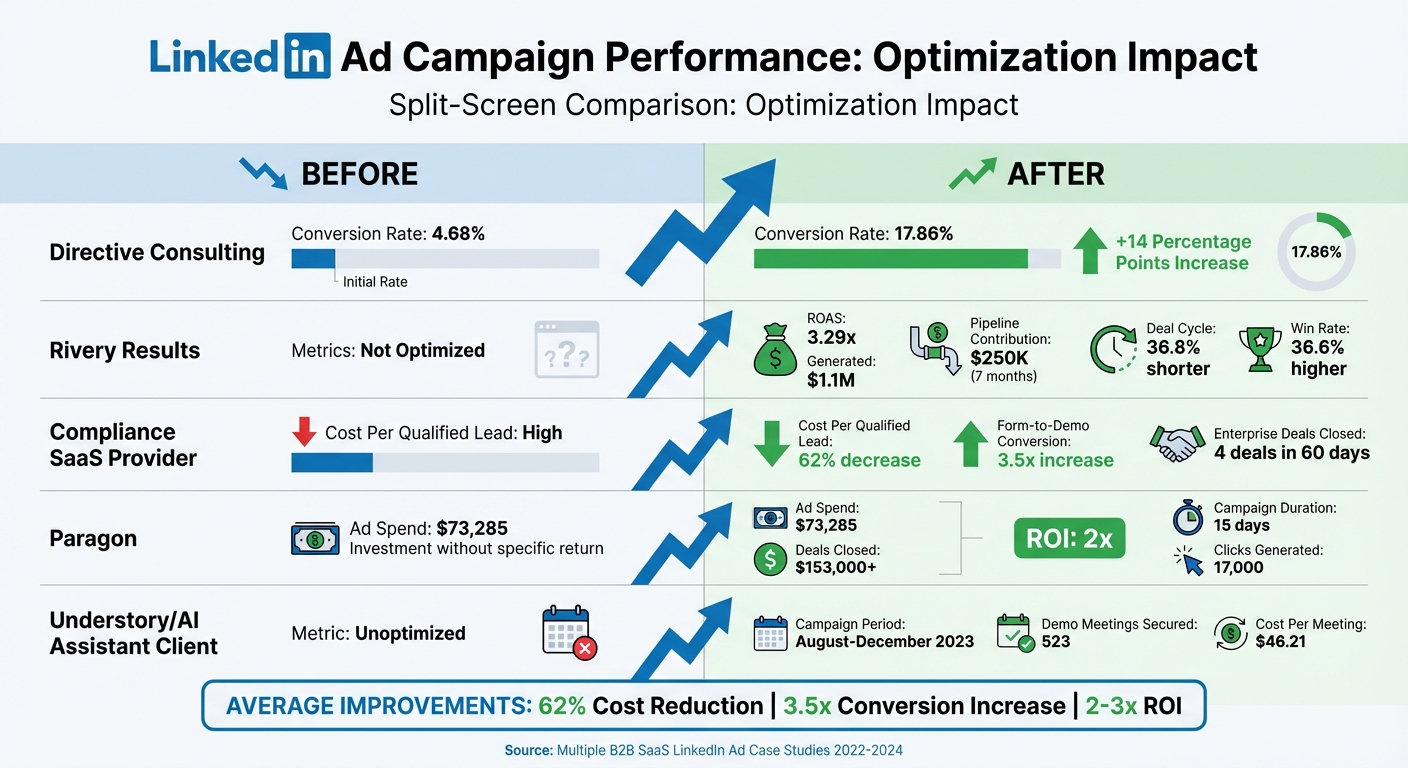
LinkedIn Ad Campaign Performance Results: Before vs After Optimization
The following data demonstrates how the testing and optimization strategies discussed earlier translated into measurable success.
Metrics Before and After
Key performance metrics saw substantial improvement. For example, Directive Consulting, under the leadership of Director of PPC Brady Cramm, ran an ebook campaign aimed at marketing decision-makers. Initially, the campaign achieved a conversion rate of 4.68%. By refining the audience to focus on "VP of Marketing" and conducting A/B testing on landing pages, the conversion rate skyrocketed to 17.86% - a jump of 14 percentage points.
Rivery adopted a full-funnel approach with a $30,000 monthly budget, leading to a 3.29x return on ad spend (ROAS). This strategy contributed $250,000 to the pipeline over seven months and generated $1.1 million in revenue within a year.
Paragon, an embedded integration platform, spent $73,285 on LinkedIn ads in just 15 days during June 2024. By targeting website visitors with customer success stories, the campaign delivered 17,000 clicks and closed over $153,000 in deals, yielding a 2x ROI.
Lead Quality and Business Impact
The quality of leads saw a significant boost. Rivery reported that deals influenced by LinkedIn ads closed 36.8% faster than those from other channels. Additionally, win rates for prospects exposed to their LinkedIn content increased by 36.6%.
"Deals close faster when exposed to our LinkedIn ads compared to other media."
– Tanner Stolte, Lead Strategist, LinkedSelling
A compliance automation SaaS provider revamped its LinkedIn strategy with intent-driven targeting. Within 90 days, they reduced their cost per qualified lead by 62%. This improvement in lead quality resulted in four enterprise deals closed within 60 days and a 3.5x increase in conversion rates from form fills to scheduled demos.
Understory also collaborated with a B2B SaaS company offering an AI assistant from August to December 2023. Using hyper-targeted creatives and a $50 gift card incentive, they secured 523 demo meetings at an average cost of $46.21 per meeting.
The table below summarizes these results:
Results Comparison Table
| Metric | Before Optimization | After Optimization | Company |
|---|---|---|---|
| Conversion Rate | 4.68% | 17.86% | Directive Consulting |
| Deal Cycle Length | Baseline | 36.8% Shorter | Rivery |
| Win Rate | Baseline | 36.6% Higher | Rivery |
| Return on Ad Spend | N/A | 3.29x | Rivery |
| Cost Per Qualified Lead | High | 62% Decrease | Niche SaaS Provider |
| Form-to-Demo Conversion | Baseline | 3.5x Increase | Niche SaaS Provider |
| Campaign ROI | $73,285 Spend | $153,000+ Closed | Paragon |
Key Takeaways and Recommendations
Core Principles of Successful LinkedIn Ad Copy
Successful LinkedIn ad campaigns rely on three key elements: clear offers, precise targeting, and value-driven messaging. The offer must be crystal clear - users need to grasp what’s being presented in less than a second. Ads should focus on targeting specific job titles to ensure they reach the right audience and avoid unqualified clicks. Messaging should highlight measurable benefits, like boosting engagement or cutting costs, rather than vague features.
The "Four Cornerstones" framework provides a solid foundation for LinkedIn ads: define your customer personas, craft ad copy that stirs emotion, present a compelling offer (like a free ebook or demo), and implement in-house conversion tracking. For instance, a SaaS company used this approach and achieved a 20.47% conversion rate, generating 439 leads in just one month.
Repeatable Framework for Marketers
To simplify ad creation, marketers can follow a repeatable framework built on these principles. Start by addressing your audience directly in the headline or opening sentence. Phrases like "Attention VP of Marketing" or "For SaaS Founders" immediately filter for qualified prospects, cutting down on wasted ad spend and improving conversions.
Use the AIDA structure to organize your copy:
- Attention: Begin with a bold headline under 70 characters.
- Interest: Highlight unique features and supporting data.
- Desire: Emphasize the value or benefit.
- Action: End with a clear call-to-action (CTA) like "Download Now" or "Request Demo".
Position your CTA within the first 150 characters of the text to ensure it’s visible before the "...see more" button.
For visuals, opt for high-contrast colors like orange, red, or green to stand out against LinkedIn’s blue and gray interface. Add text overlays to emphasize the offer - LinkedIn doesn’t enforce strict text-to-image ratios, so take advantage of this. Test at least five different ad designs at the same time, as performance can vary widely between versions.
When optimizing, focus on the elements that matter most. Start with the content offer, then refine the text within the image, the visual style, and the color palette. Allocate 20–30% of your ad budget to retargeting users who interacted with top-of-funnel content - these warm leads often convert at much higher rates.
Using the Top PPC Marketing Directory
To maximize your framework’s effectiveness, consider using specialized tools like the Top PPC Marketing Directory (https://ppcmarketinghub.com). This resource connects marketers with expert agencies and tools tailored for LinkedIn ad campaigns. It includes templates like "Big Text" ads and native designs that have been shown to achieve click-through rates up to four times higher.
The directory also features agencies skilled in A/B testing, helping marketers refine content offers, messaging, and visuals. With tools for performance tracking and conversion optimization, it aligns perfectly with the Four Cornerstones framework. For LinkedIn campaigns with budgets ranging from $5,000 to $30,000 per month, these curated listings help marketers find the right agency for specific needs, whether it’s landing page optimization, retargeting strategies, or full-funnel campaign management.
FAQs
How can I improve the quality of leads from LinkedIn Ads?
To get better leads from LinkedIn Ads, the first step is to sharpen your audience targeting. Tools like the LinkedIn Insight Tag can help you dive into your website traffic, revealing the job titles, industries, and seniority levels that match your ideal customer profile. You can then use LinkedIn’s filters - like company size or specific skills - to zero in on the most relevant prospects, ensuring your ads reach the right people.
Next, craft ad copy that speaks directly to your audience's challenges while showcasing a clear benefit. Keep the language short, action-driven, and focused on value. For example, offer something enticing like a free demo or an ebook. Pair this messaging with LinkedIn’s ad formats, such as Sponsored Content or Text Ads, to present your offer in a way that grabs attention.
Lastly, don’t forget to track and optimize your campaigns continuously. Use tools like LinkedIn Lead Gen Forms or well-designed landing pages to capture leads effectively. Run A/B tests on key elements like headlines, visuals, and calls-to-action. Regularly analyze performance metrics - like cost-per-lead and conversion rates - to fine-tune your approach and double down on what’s working.
What are the best LinkedIn ad formats for B2B marketing?
For B2B marketing on LinkedIn, some of the most effective ad formats include Sponsored Content, Sponsored Messaging, Dynamic Ads, and Text Ads. Sponsored Content, particularly native ads that seamlessly integrate into users' feeds, is excellent for grabbing attention and showcasing visuals like videos or carousels. Sponsored Messaging, which lands directly in users' inboxes, is great for driving engagement through personalized offers. Dynamic Ads take personalization to the next level by automatically tailoring content to individual viewers, making them perfect for account-based campaigns. Meanwhile, Text Ads offer a cost-effective way to test your copy and targeting strategy before scaling your efforts.
To craft a winning LinkedIn strategy, consider starting with Sponsored Content to capture attention and build awareness. Then, incorporate Sponsored Messaging for direct, personalized outreach. Dynamic Ads can help you engage specific accounts with relevant content, while Text Ads are ideal for early-stage testing or generating leads on a budget. For additional insights on crafting effective ad copy and creative assets, check out the resources on the Top PPC Marketing Directory to help you get the most out of your campaigns.
How does targeting the right audience improve LinkedIn ad performance?
Targeting the right audience on LinkedIn can make a huge difference in how well your ads perform. It’s all about connecting your message with the professionals who are most likely to engage and take action. By narrowing your focus to criteria like job titles, seniority levels, industries, company sizes, and locations, you can craft ad copy that speaks directly to the needs and goals of specific, high-value groups. The result? Better click-through rates (CTR), lower cost-per-click (CPC), and more qualified leads filling your pipeline.
LinkedIn also offers advanced targeting options that let you go even deeper. You can filter your audience based on specific roles, job functions, or even skill sets, ensuring your ads land in front of decision-makers who have real purchasing power. Plus, tools like the LinkedIn Insight Tag let you track performance in real time, so you can make precise adjustments to improve engagement and maximize your return on ad spend (ROAS).
Looking for more ways to fine-tune your audience targeting and campaign strategy? Check out the Top PPC Marketing Directory for expert tools and insights to take your LinkedIn advertising to the next level.