Every time you open LinkedIn, a rapid auction happens in the background - lasting just 120 milliseconds. This process, known as real-time bidding (RTB), determines which ad appears in your feed. But it’s not just about the highest bid. LinkedIn uses a Composite Score that combines your bid and your ad's predicted relevance. Here’s the key takeaway:
- Relevance matters as much as your bid: A lower bid with a higher relevance score can win over a higher bid with poor targeting.
- Auction mechanics: LinkedIn uses a generalized second-price auction, meaning you pay only $0.01 more than the next highest bid.
- Bid types: CPC (cost per click), CPM (cost per thousand impressions), and CPV (cost per video view) are normalized to a single metric: eCPI (Estimated Cost Per Impression).
- Ad quality impacts costs: Strong engagement (e.g., CTR above 0.4%) lowers your costs. Poor-performing ads increase your effective cost.
- Bidding strategies: Choose between Maximum Delivery (automated), Cost Cap (controlled costs), or Manual Bidding (full control).
LinkedIn’s system rewards relevance, creative quality, and proper targeting. To succeed, focus on improving your ad’s engagement metrics and aligning your campaign goals with the right bidding strategy.
LinkedIn Ads Bidding Strategies
How LinkedIn's Real-Time Auction Works
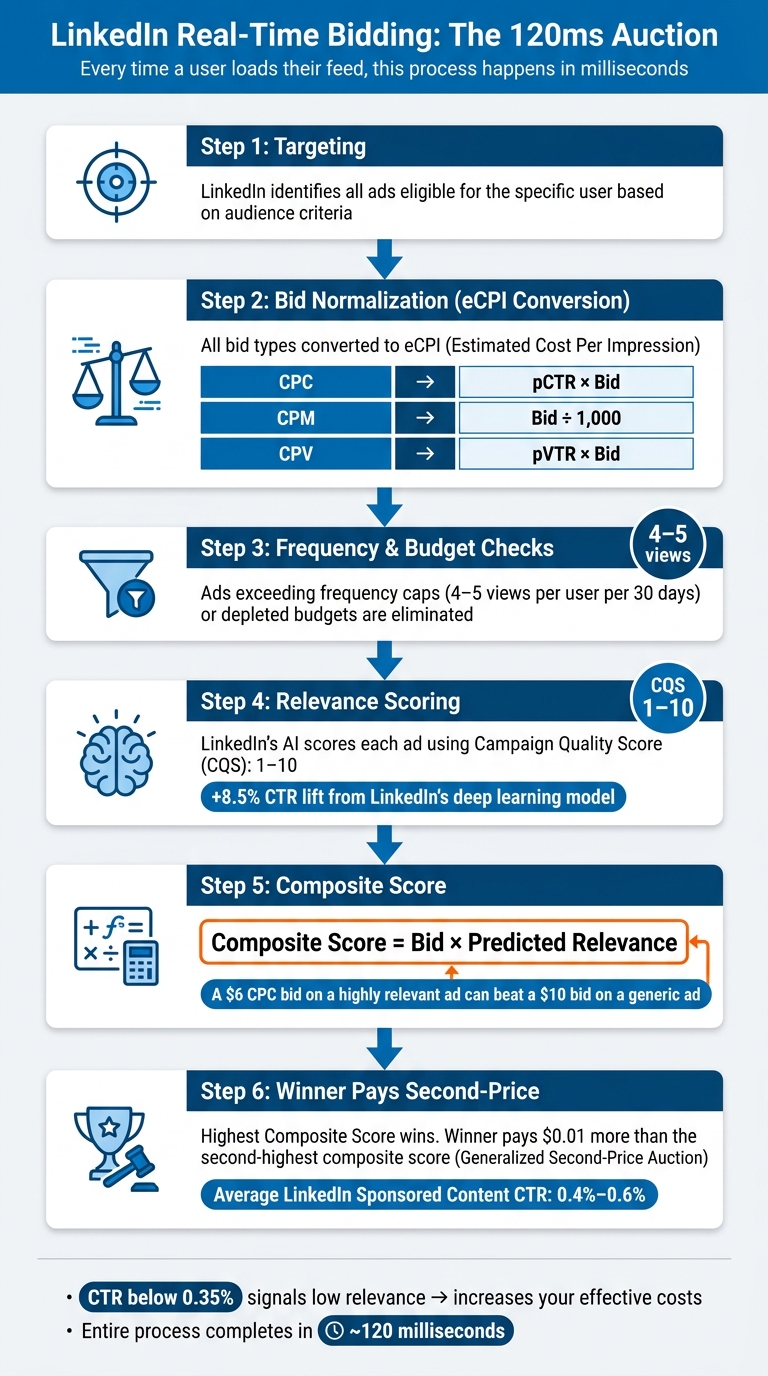
How LinkedIn Real-Time Bidding Works: The 120ms Auction Process
Real-Time Bidding Overview
Every time a LinkedIn member loads their feed, a lightning-fast auction determines which ad gets displayed. This entire process - evaluating eligible ads, scoring them, selecting a winner, and serving the ad - happens in milliseconds, all before the page fully loads.
LinkedIn uses a generalized second-price auction system. What does that mean? The winning advertiser doesn’t pay their maximum bid. Instead, they pay just $0.01 more than the next highest competing bid's composite score. This setup encourages advertisers to bid their true maximum value since they’ll often pay less than their top limit.
Key Auction Components
LinkedIn’s auction brings together three main bid types: CPC (cost per click), CPM (cost per thousand impressions), and CPV (cost per video view). Since these bid types aren’t directly comparable, LinkedIn converts them into a single metric called eCPI (Estimated Cost Per Impression).
| Bid Type | eCPI Calculation |
|---|---|
| CPC | Predicted CTR (pCTR) × Bid |
| CPM | Bid ÷ 1,000 |
| CPV | Predicted View-Through Rate (pVTR) × Bid |
Here’s how it works: pCTR (predicted click-through rate) and pVTR (predicted view-through rate) are AI-driven predictions of how likely users are to engage with your ad. By normalizing bids into eCPI, LinkedIn ensures that all campaigns, regardless of payment method, compete on equal terms.
But that’s not all. Other factors like campaign objectives, budget pacing, and frequency caps (which limit how often the same user sees an ad) also influence the auction process.
Auction Flow and Scoring
The auction process follows a structured four-step flow: Targeting → Bidding/Frequency/Budget checks → Relevance scoring → Ad ranking. First, LinkedIn identifies ads eligible for a specific user. Then, it eliminates ads that exceed frequency caps or run out of budget. This ensures only viable ads move forward.
Next comes scoring. LinkedIn uses a Composite Score formula: Bid × Predicted Relevance. This formula balances ad quality with spending power, so the highest bid alone doesn’t guarantee a win.
Predicted Relevance is LinkedIn’s AI-powered estimate of how likely a user is to engage with your ad. It draws on factors like historical performance, user engagement patterns, and contextual signals. The platform measures this using its Campaign Quality Score (CQS), which ranges from 1 to 10.
Here’s an example: Imagine your ad has a 1.2% CTR and a lower bid, while a competitor’s ad has a higher bid but only a 0.4% CTR. Thanks to the relevance multiplier, your ad could still win the auction. With average CTRs for LinkedIn Sponsored Content hovering between 0.4% and 0.6%, even small creative tweaks can make a big difference in your ad’s performance.
How LinkedIn Ranks and Calculates Bids
Bid Normalization Process
LinkedIn uses a process called bid normalization to level the playing field among advertisers using different bid types - CPC, CPM, and CPV. This process converts all bids into a single metric: estimated cost-per-impression (eCPI). By doing this, LinkedIn ensures that every campaign competes fairly, no matter how the bids are structured.
What’s interesting is that your predicted engagement rate plays a big role in determining your eCPI. For example, a CPC advertiser with a high predicted click-through rate (CTR) can achieve a better eCPI than someone with a lower CTR, even if both bid the same amount. This means that the quality of your ad’s creative isn’t just a bonus - it’s central to your success in the auction.
Relevance and Quality Signals
Once bids are normalized to eCPI, LinkedIn evaluates the relevance and quality of each ad. The platform uses predicted relevance to gauge how likely a specific LinkedIn member is to engage with your ad. This prediction is based on historical performance, engagement metrics (like likes, comments, and shares), and how well your targeting matches the audience being served.
To make these predictions, LinkedIn employs a three-tower deep learning architecture (Deep, Wide, and Shallow towers). This system analyzes member profiles, advertiser data, and contextual features all at once. The result? A reported +8.5% lift in CTR relevance for LinkedIn’s ad business. Advertisers can get a glimpse of this relevance score through the Campaign Quality Score (CQS), which ranges from 1 to 10.
Here’s something to keep in mind: if your ad’s CTR falls below 0.35%, LinkedIn’s algorithm interprets it as a sign of low relevance, which increases your effective costs. Ad frequency also matters. When a single ad is shown more than 4 to 5 times to the same user within a 30-day period, CTR tends to decline, negatively impacting your relevance score.
Ad Rank and Pricing Mechanics
After normalizing bids and factoring in relevance, LinkedIn calculates ad rankings to determine which ads win impressions. The platform uses a Composite Score formula: Bid × Predicted Relevance. The ad with the highest composite score secures the impression - not necessarily the highest bid.
"A $6 CPC bid on a highly relevant, well-performing ad can outcompete a $10 bid on a generic ad. You are not just buying eyeballs - you are also competing on creative quality." - Larry, AdLibrary
LinkedIn employs a generalized second-price auction system. This means the winning advertiser pays just $0.01 more than the second-highest composite score. Because of this structure, bidding your true maximum value is always the best strategy. A well-optimized ad with strong relevance can consistently win impressions at a lower cost than a competitor who simply bids higher. These mechanisms allow marketers to focus on improving ad quality while benefiting from LinkedIn’s bid normalization process - a key principle for managing bids effectively, as we’ll explore further in the next section.
sbb-itb-89b8f36
LinkedIn Ads Bidding Strategies
Once you grasp LinkedIn's auction dynamics, the next step is choosing the right bidding strategy to make the most of these mechanics. LinkedIn provides three main bidding options, each offering varying levels of automation and control. These strategies are designed to align with your campaign goals while leveraging LinkedIn's auction process.
Maximum Delivery Strategy
Maximum Delivery is the default bidding option for LinkedIn campaigns. If you don’t adjust the settings, this is what you’ll get. It uses machine learning to automatically adjust your bids in real time, focusing on one primary goal: maximizing results while ensuring your daily budget is fully utilized.
"Maximum delivery leverages machine learning to automatically bid for you to optimize your campaign objectives as efficiently as possible. If you care more about spending your whole budget, we recommend the maximum delivery strategy." - Crystal Shi, Principal Product Manager, LinkedIn
This strategy operates exclusively on a CPM (cost per 1,000 impressions) basis. You won’t have the option to set a manual bid cap, making it a great fit for campaigns aimed at building brand awareness or achieving consistent delivery. To allow the algorithm to adjust and stabilize, plan for a learning period of about 7–15 days.
Cost Cap Bidding
Cost Cap offers a balance between automation and manual control. Here, you set a target cost per result, and LinkedIn adjusts bids dynamically to favor lower-cost opportunities, aiming to keep your average cost below the cap you’ve set.
This strategy also charges by CPM and works well when you need to stick to a specific cost-per-lead or cost-per-click target. To give the algorithm enough flexibility, LinkedIn suggests setting your cost cap 20–30% higher than your target cost. If the cap is too restrictive, the system may struggle to spend your budget effectively.
For best results, run a Cost Cap campaign for at least 15 days before assessing its performance. Avoid making major changes to your audience, creative, or bidding settings during this period, as these adjustments reset the algorithm’s learning phase.
Manual Bidding and Its Use Cases
Manual Bidding gives you complete control over your bids. You set a maximum bid amount, and LinkedIn ensures it won’t exceed that limit in any auction. Unlike the other strategies, manual bidding supports multiple charge types, including CPC, CPM, CPV, and CPS, depending on your campaign objective.
"Manual bidding gives you the most control over your bid amount, but it might not deliver the same ad set results as optimized bidding strategies." - LinkedIn Help Center
This approach is particularly useful for retargeting campaigns or when testing new campaigns. A common tactic is to start with a low bid, monitor performance, and gradually increase the bid once you find the right balance between cost and volume. For certain objectives like Lead Generation, LinkedIn also offers Enhanced Manual Bidding, where the system can tweak your bid to compete for higher-value conversions.
Here’s a quick comparison of the three strategies:
| Strategy | Automation Level | Charge Method | Ideal For |
|---|---|---|---|
| Maximum Delivery | High (fully automated) | CPM | Brand awareness, full budget delivery |
| Cost Cap | Medium (automated with cap) | CPM | Lead generation with strict CPA targets |
| Manual Bidding | Low (advertiser controlled) | CPC, CPM, CPV, or CPS | Retargeting, testing new campaigns |
Up next, we’ll dive into how structuring your campaigns and using auction insights can help you refine your bidding strategy even further.
How to Optimize LinkedIn Real-Time Bids
Campaign Structuring for Better Performance
The way you structure your campaigns can make or break your ad performance on LinkedIn. A mismatch between your campaign objective and creative can lead to higher CPMs and poor delivery. For instance, if you run a brand awareness video under a "Lead Generation" objective, LinkedIn's algorithm will optimize for the wrong signals, driving up costs unnecessarily.
Another key factor is audience size. Targeting fewer than 20,000–50,000 members creates a small pool, which forces advertisers to compete more aggressively, inflating real-time costs. To avoid this, consider broadening your audience or adding exclusions for groups like existing customers, active pipeline accounts, or internal employees. This ensures your budget focuses on reaching new prospects.
Budget consolidation is another smart move. Instead of spreading your budget across several small campaigns, concentrate it into fewer, larger ones. LinkedIn's algorithm needs about 15–20 conversions per week per campaign to exit the learning phase and stabilize delivery. By fragmenting your budget, you make it harder to reach this threshold, which can hurt performance. These foundational adjustments can set you up for smarter bid management.
Using Auction Insights to Set Bids
LinkedIn's auction mechanics provide valuable insights to refine your bidding strategy. The platform suggests a bid range - including a minimum, maximum, and default - based on historical data for your target audience. While helpful, these suggestions often overshoot the actual bid needed to win impressions.
A practical strategy is the step-down bidding method. Start your manual bid about 30% below the lower end of LinkedIn’s suggested range. Monitor performance for 24–48 hours. If your campaign spends less than 80% of its daily budget, increase the bid by 10–15% and wait another 2–3 days before making further adjustments. This approach aligns with LinkedIn’s auction flow and scoring mechanisms. For example, in a March 2026 campaign, Emilia Korckzynska, Userpilot’s VP of Marketing, used this method. LinkedIn suggested a bid range of $12–$28 per click, but she started at $8.50. The campaign achieved an average CPC of $6.40 - saving 68% compared to the midpoint of $20.
"Manual bidding basically covers most cases. It's so good that LinkedIn actually hides it from you." - Maximillian Herczeg, Founder, Kamrat
When using manual bidding, make sure to uncheck "Enable bid adjustments for high-value clicks". This prevents LinkedIn from exceeding your set bid, helping you maintain better cost control.
Tools for Bid Management and Tracking
Once you’ve optimized your bids, advanced tools can help you track and manage campaigns more efficiently. For example, Factors.ai identifies high-intent audiences and highlights company-level engagement, enabling you to focus your budget on accounts actively showing interest. Another tool, ZenABM, provides detailed company-level reporting, showing which target accounts are engaging and progressing through ABM stages, rather than just aggregate metrics.
For advertisers wanting more programmatic control, LinkedIn’s adBudgetPricing API and adSupplyForecasts API are invaluable. The former retrieves minimum, maximum, and suggested bids based on your targeting, while the latter estimates impressions and spend before a campaign launches. These tools are especially handy for agencies managing multiple accounts or advertisers running frequent campaigns.
If you’re still building your toolkit, check out the Top PPC Marketing Directory. It’s a curated resource for finding and comparing bid management tools, performance trackers, and analytics platforms - all designed to help you run more cost-effective LinkedIn campaigns.
Conclusion: Getting the Most Out of LinkedIn's Real-Time Bidding
LinkedIn's auction system focuses on relevance rather than just the size of your bid. This means a well-targeted ad with a strong click-through rate (CTR) can outperform a higher bid from a less relevant competitor, helping you keep costs down.
Choosing the right bidding strategy is just as important. Here’s a quick breakdown:
- Maximum Delivery: Perfect for quickly gathering data when launching a new campaign.
- Cost Cap: Best for advertisers who need to stick to a specific average cost per result.
- Manual Bidding: Offers precise control, making it ideal for Account-Based Marketing (ABM) campaigns or for those wanting to gauge market rates before scaling.
These strategies, combined with LinkedIn’s auction model, can significantly improve your campaign results.
Another key factor? Creative quality. Ads with high relevance scores consistently outperform higher bids, proving that investing in creative assets directly impacts auction efficiency. To keep your CTR high and maintain competitive costs, update your ad creative every 4–6 weeks.
Need extra help managing your campaigns? Check out the Top PPC Marketing Directory for tools that can optimize your bid management and performance tracking, ensuring smarter spending across LinkedIn campaigns.
FAQs
What improves my ad’s predicted relevance on LinkedIn?
To improve your ad’s relevance on LinkedIn, start by honing in on precise targeting. Use criteria like job titles, seniority levels, or other specific attributes to ensure your ad reaches the right audience. Experiment with different elements of your ad - such as images, headlines, calls-to-action, and URLs - to identify what resonates most. Keep a close eye on metrics like click-through rate (CTR), and make adjustments as needed to boost engagement and enhance your campaign’s relevance score.
How does LinkedIn price the winning ad in the auction?
LinkedIn operates using a generalized second-price auction model for feed ad placements. Here's how it works: the winning advertiser doesn't pay their full bid amount. Instead, they pay just enough to outbid the second-highest composite score - usually by a margin of one cent.
The key to success here lies in the composite score, which is calculated by multiplying your bid with your ad's predicted relevance score. This means that even if your bid is lower, a highly relevant ad can still outperform a less relevant one with a higher bid.
When should I use Maximum Delivery vs. Cost Cap vs. Manual Bidding?
Use Maximum Delivery if you want to automate bids, make sure your entire budget is spent, or evaluate a campaign's potential quickly. Go with Cost Cap to get the most results while keeping your average cost per key result under control. Choose Manual Bidding when you need exact control over bid amounts - ideal if you have historical data or specific profitability goals. However, keep in mind that this approach demands regular monitoring to remain competitive.