Running PPC campaigns across platforms like Google Ads, Meta, LinkedIn, TikTok, and Amazon Ads can be challenging without a clear budget strategy. Costs are rising - Google's CPCs are up 15%, Meta's CPMs by 18%, and LinkedIn's ad costs by 22%. At the same time, spreading your budget too thin or relying on one platform can hurt your ROI. To help, here are 10 actionable tips to optimize your PPC budget:
- Analyze Historical Data: Use past metrics (CPC, conversion rates) to spot trends and allocate funds effectively.
- Apply Zero-Based Budgeting: Justify every dollar spent based on current goals and conditions.
- Use the 70/20/10 Rule: Allocate 70% to proven channels, 20% to promising ones, and 10% for testing.
- Segment by Funnel Stage: Split budgets across awareness (10–20%), consideration (30–40%), and conversion (40–60%) stages.
- Run Incrementality Tests: Measure the true impact of ads by comparing exposed vs. unexposed groups.
- Meet Platform Minimums: Ensure budgets are sufficient for algorithms to optimize campaigns.
- Adjust for Geography and Device: Focus spending on high-performing regions and devices.
- Create an Opportunity Fund: Reserve 10–20% of your budget for scaling successful campaigns or testing new ideas.
- Leverage Top PPC Tools: Use software to streamline data analysis and cross-platform adjustments.
- Track Multi-Channel Attribution: Use attribution models to understand how each channel contributes to conversions.
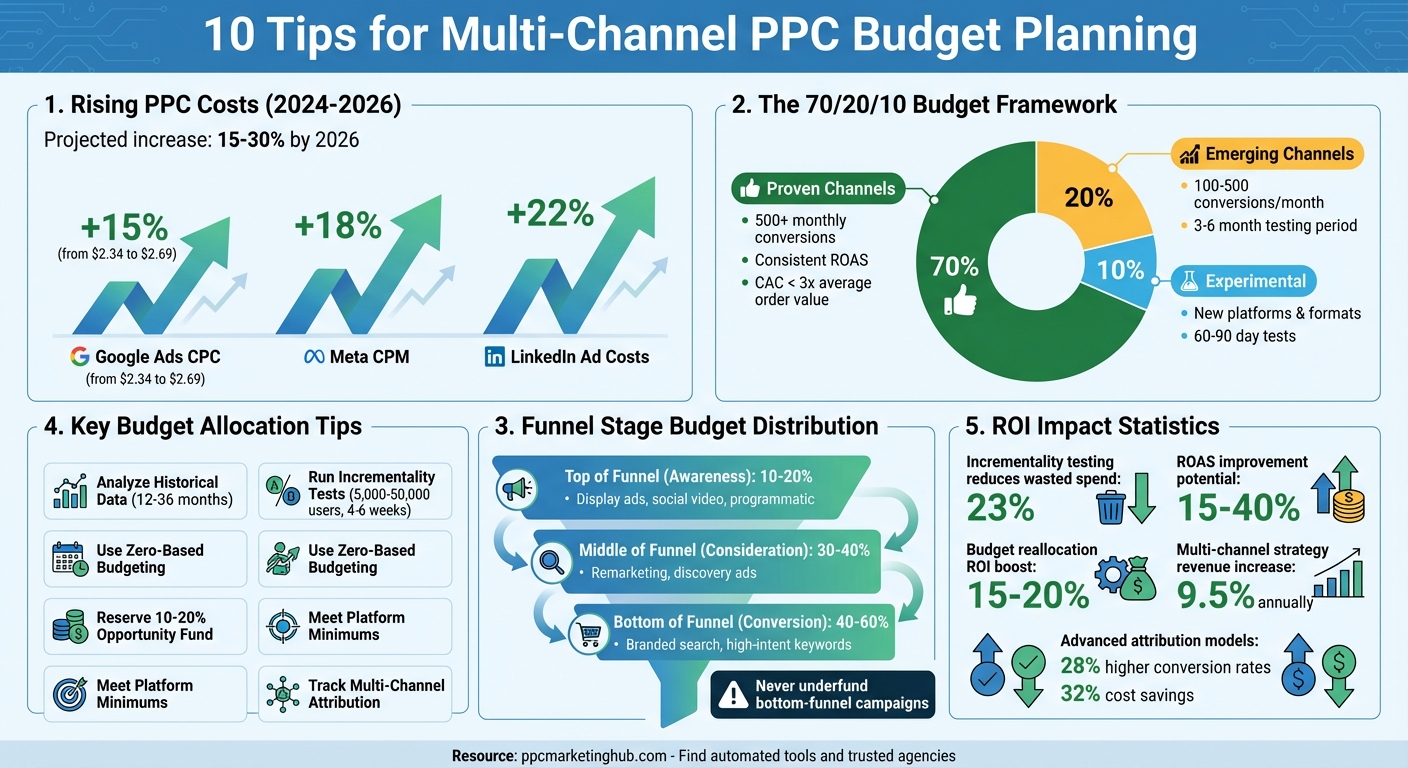
Multi-Channel PPC Budget Allocation Framework: 70/20/10 Rule and Funnel Stage Distribution
1. Start with Historical Performance Data
Historical Performance Analysis
Your previous campaign metrics - like CPC, Conversion Rate, and Search Impression Share - are the foundation for making smart budget decisions. Compare recent 30-day data with the past 12–36 months to identify trends or seasonal patterns, but be sure to exclude outliers, such as data from the pandemic period.
Dig deeper into performance by segmenting data by device, location, and time. For example, if mobile users in California convert at twice the rate of desktop users in Texas, it might make sense to allocate more budget toward mobile campaigns targeting California. Additionally, track key funnel metrics - like form fills, lead qualification rates, sales velocity, and Customer Lifetime Value (LTV) - to get a clearer picture of how much value each dollar is generating.
In 2024, Booyah Advertising addressed inconsistencies across more than 600 client reports by transitioning to Improvado. This move achieved 99.9% data accuracy and cut daily update times in half, allowing for quicker budget adjustments.
"If we don't trust the data, the agency won't trust the reports and won't give them to the client... With Improvado, we now trust the data. It's 99.9% accurate." - Tyler Corcoran, Marketing Analytics Manager, Booyah Advertising
Keep an eye out for diminishing returns in your data. For instance, if a channel like Google Search is already nearing complete impression share, increasing the budget further might not yield proportional results. In such cases, it’s better to redirect funds to channels with growth potential. A good example is VBHC, which conducted a cross-channel audit using RevX. This analysis led to a 150% drop in Cost Per Lead while generating over 2,400 sales-qualified leads. By thoroughly analyzing historical performance and following a PPC campaign optimization checklist, you can lay the groundwork for dynamic, data-informed budget strategies across all channels.
sbb-itb-89b8f36
2. Use Zero-Based Budgeting
Budget Allocation Frameworks
Zero-based budgeting (ZBB) flips the script on traditional budgeting by starting from scratch. Instead of simply reallocating last year’s spending, ZBB requires you to justify every dollar based on current conditions and goals. This approach ensures your budget aligns with today’s market realities. For instance, if your goal is to generate 500 qualified leads or drive $2 million in revenue, you’ll calculate your budget using up-to-date cost-per-click (CPC) rates and conversion data.
The formula to determine your PPC budget is straightforward:
PPC Budget = (Target Revenue ÷ Conversion Rate) × Cost Per Click
Here’s an example: If your revenue target is $500,000, your site converts at 2%, and your average CPC is $8.00, you’ll need to allocate roughly $200,000 to drive the necessary traffic to hit that goal. This ensures every dollar spent contributes directly to achieving your revenue objectives.
Channel-Specific Considerations
Once you’ve calculated your total budget, the next step is to allocate it across channels based on their performance and strategic importance. Each channel should be evaluated individually. For example:
- Google Search campaigns might receive 40–60% of your budget if they consistently deliver high-intent conversions.
- Social platforms like Meta and LinkedIn could take 20–35%, particularly for awareness campaigns or remarketing efforts using top platforms.
- Branded search typically requires 10–15% of your search budget to maintain your share of voice and fend off competitors.
Here’s a critical insight: PPC costs are expected to rise by 15–30% by 2026, driven by economic factors and AI advancements reducing the number of clickable impressions. This makes ZBB even more vital - it forces you to focus on channels that perform and cut spending on underperforming ones.
Finally, always allocate 10–20% of your total budget for testing new platforms or ad formats. This ensures you stay adaptable and aren’t overly reliant on campaigns that may lose effectiveness over time.
3. Apply the 70/20/10 Framework
Budget Allocation Frameworks
The 70/20/10 framework is a simple way to divide your marketing budget into three categories. Here's how it works: 70% of your budget goes to channels that consistently perform well. These are the reliable ones - channels with steady ROAS and at least 500 monthly conversions. 20% is allocated to channels that show promise but aren't fully proven yet, typically bringing in 100–500 conversions per month. Finally, 10% is reserved for experimentation. This is your chance to explore new platforms, test ad formats, or try out AI-driven tools and platforms.
For different business sizes, you can tweak these percentages. Startups earning less than $1M annually might use a 50/30/20 split, while more established companies making $10M or more could lean toward an 80/15/5 approach.
"Remember: every proven channel began as an experiment." - Rodney Warner, Founder & CEO, Connective Web Design
Once you've set your budget, it's crucial to assign channels to the right category based on clear criteria.
Channel-Specific Considerations
In your 70% proven bucket, include channels with a Customer Acquisition Cost (CAC) that's less than three times your average order value. These channels should also have a Marketing Efficiency Ratio (MER) above 3.0.
The 20% emerging category requires patience and a bit of risk-taking. Give these channels 3–6 months to prove their worth. If they perform well, you can move them into your core strategy. If not, you may need to cut them. As for the 10% experimental bucket, keep tests short and focused - run them for 60–90 days. If a test hits your target ROAS or CPA, increase its budget by 15–20%. On the flip side, if performance drops below 50% of your target after eight weeks, it’s time to pause and reassess.
4. Divide Budget by Funnel Stages
Budget Allocation Frameworks
Splitting your budget by funnel stages helps align spending with the intent of your audience. Not all clicks are created equal - someone casually exploring your brand has different needs than a buyer ready to make a purchase. To address this, budget planning often divides spending across three stages: 10–20% for top-of-funnel awareness, 30–40% for middle-funnel consideration, and 40–60% for bottom-funnel conversions.
The largest share - 40–60% - should go to bottom-funnel campaigns. These focus on high-intent searches, such as branded terms, specific services, and active product comparisons. Before diving into experimental awareness campaigns, ensure your bottom-funnel efforts are fully funded.
"The cardinal rule here is simple: never underfund these [bottom-funnel] campaigns." - Nimdalftrsk, Lost and Found Marketing
Once your top- and middle-funnel strategies are in place, shift your attention to fine-tuning bottom-funnel performance with optimization platforms.
Channel-Specific Considerations
For awareness campaigns, only allocate budget if you can sustain 100–200 clicks per day. These campaigns often rely on display ads, social video, and programmatic platforms to boost visibility. Meanwhile, middle-funnel efforts - like remarketing and discovery ads - work to nurture prospects who’ve already engaged with your brand.
When scaling successful bottom-funnel campaigns, increase budgets gradually - around 10–15% at a time - to avoid diminishing returns. Additionally, segment your remarketing audience by engagement level. For example, someone who visited your pricing page should warrant a higher bid than someone who only glanced at your homepage.
Interestingly, top-funnel efforts can indirectly improve bottom-funnel performance. By increasing branded search traffic by 30% through the halo effect, awareness campaigns can enhance overall results. To maintain a cohesive multi-channel strategy, review and adjust your funnel allocations weekly, ensuring you catch any performance changes early.
5. Run Incrementality Tests
Incrementality and ROI Testing
Once you've set up a data-driven budget, the next step is to figure out which ads are actually driving results. That's where incrementality tests come in.
While attribution models assign credit for touchpoints, they often miss the mark when it comes to identifying which ads truly drive sales. In fact, traditional attribution methods can overestimate a channel's contribution by 20–40% on average. They don't account for users who would have converted even without seeing the ad.
Incrementality testing takes a different approach. It uses controlled experiments to compare a group exposed to your ads (the treatment group) with a group that isn't (the control group). This allows you to measure the incremental lift - the conversions that only happened because of your campaign. By 2025, 73% of marketing leaders considered this method essential, a sharp rise from 41% in 2023.
This method doesn't just reveal which ads work; it also helps fine-tune your budget allocation. And the stakes are high - brands that skip incrementality testing risk wasting about 23% of their marketing budget on activities that don't drive incremental results. On the flip side, reallocating spend based on these insights can boost overall ROAS by 15–40%.
Channel-Specific Considerations
Different PPC channels call for different testing methods. Here are the three main approaches:
- Holdout Testing: Exclude a random subset of users from seeing your ads. This is particularly effective for social media and display campaigns.
- Geographic Testing: Run ads in specific regions while withholding them in similar markets. This works well for national brands.
- Switchback Testing: Alternate between "on" and "off" periods in your campaigns to track how conversions change.
For paid search, focus your tests on non-branded keywords. Branded search often captures users already looking for your brand, making it harder to gauge the true impact of your ads. To get reliable results, aim for test groups of 5,000–50,000 users and run the tests for 4–6 weeks to cover a full customer cycle. It’s also a good idea to allocate 10–30% of your campaign budget to control groups for more accurate, long-term insights.
Platforms like Meta, Google (via Ads Data Hub), and TikTok now offer built-in tools to simplify incrementality testing, making it easier to integrate into your campaigns.
6. Account for Channel Minimums
Channel-Specific Considerations
When it comes to digital advertising, every platform requires a minimum investment to function properly. Without reaching this threshold, the platform's algorithms won't have enough data to optimize your campaigns effectively, leading to wasted spend and unreliable results. This aligns with the principle of data-driven decision-making: you need enough data to make informed choices.
"A $1,000 budget is better spent mastering one channel than being invisible on five." Using social media advertising tools can help streamline this process when you are ready to scale. - Improvado
The reality is that digital advertising costs are climbing. For instance, Google Ads' average cost-per-click (CPC) has risen from $2.34 to $2.69, while LinkedIn B2B costs increased by 22% year-over-year, and Meta's CPM jumped 18%. These aren't just temporary fluctuations - they reflect a broader shift in the economics of online advertising. This makes meeting channel minimums even more essential to ensure your campaigns remain competitive and effective.
The industry you're in also plays a big role in determining these minimums. For example, legal services see an average CPC of $47.07, while insurance averages $18.57. If you're operating in a high-competition sector, your budget needs to reflect these realities to achieve meaningful results.
"Establish minimum viable testing budgets by platform to ensure statistical significance while managing risk." - Jason J. Zotara, Ten26 Media
For businesses with limited budgets, focus is key. Allocate 40–60% of your budget to high-intent channels like Google Search, where you’re more likely to see direct returns. Once you've proven ROI on these platforms, you can consider expanding into social or display ads. Additionally, reserve 10–15% of your budget for testing new platforms, ensuring that these tests meet the minimum thresholds for statistical significance. Don't forget to factor in hidden costs like creative production, management fees, and tool subscriptions when calculating your channel minimums.
7. Adjust for Geography and Device
Historical Performance Analysis
When it comes to PPC budgeting, spreading your budget evenly across all locations and devices is not the best approach. Instead, focus on areas and devices that show strong performance. Analyze 12–36 months of historical data to pinpoint the geographic regions and device types that deliver conversions at a lower Cost-Per-Acquisition (CPA). This method builds on earlier strategies that emphasize using data to make informed, channel-specific budget decisions.
In 2025, the average CPC for Google Ads climbed to $2.69, with industries like legal services reaching $47.07 and insurance at $18.57. These rising costs highlight the need to allocate your budget strategically, targeting the locations and devices that yield the best results.
Budget Allocation Frameworks
Be cautious when targeting major cities or high-demand regions, as higher competition often leads to steeper bids. Tools like Google Ads Keyword Planner can provide precise CPC estimates for specific regions, helping you adjust bids to optimize your budget.
If your data shows that desktop users convert better than mobile users, consider reallocating some of your mobile budget to desktop campaigns. Similarly, Google Ads & Microsoft Ads automation tools can help fine-tune your bids, adapting to variables like location, device, time of day, and audience behavior.
"If mobile converts better for your business, allocate a larger share of the budget to mobile users." - Improvado
"Modern platforms use AI to improve PPC campaigns. These strategies use machine learning to adjust your bids automatically based on real-time data like device, location, time of day, and audience behavior." - Nicai de Guzman, Digital Marketing Institute
Incorporating these adjustments into your overall multi-channel strategy can help you maintain cost-efficiency while improving performance.
Channel-Specific Considerations
Use performance data to test and refine how you split your budget among mobile, desktop, and tablet campaigns. For example, review search impression share by geography to see if a high-performing region is nearing saturation or if there’s room to scale up spending. Factor in seasonal trends, such as local holidays or events, that could increase demand in specific areas. Additionally, set up automated spend alerts and review your forecasts regularly to ensure your budget stays on track throughout the month.
7 Steps to a Winning Multi-Channel PPC Strategy - Raluca Radu
8. Set Aside an Opportunity Fund
Creating an opportunity fund within your PPC budget gives you the flexibility to act quickly on emerging trends and winning campaigns.
Budget Allocation Frameworks
Sticking to rigid budgets can limit your ability to capitalize on unexpected successes. By setting aside 10–20% of your overall PPC budget as an opportunity fund, you create a flexible reserve. This fund allows you to scale high-performing campaigns or respond to sudden market changes without waiting for the next budget cycle.
Here’s why it works: reallocating budgets to top-performing channels can improve overall marketing ROI by 15% to 20%. A great example is Nike’s Black Friday campaign. By using a flexible PPC strategy, they boosted membership sign-ups and saw a 32% increase in sales compared to the previous year.
"Your PPC strategy should drive your budget and not the other way around." - Nicai de Guzman, Digital Marketer
Incrementality and ROI Testing
An opportunity fund also allows you to test new platforms or audience segments with minimal risk. Take Converse, for instance. They targeted low-competition keywords tied to teenage searches like "how to kiss." With a $100,000 budget, they attracted over 600,000 unique visitors and achieved an impressive 2,600% improvement in their cost-to-visitor ratio.
When testing campaigns, consider increasing budgets by 15–20% if they achieve a 7:1 ROAS or maintain a low CPA. Keep an eye on PPC performance metrics to avoid diminishing returns.
Channel-Specific Considerations
Not all channels are created equal, and each has its own learning curve and spending thresholds. Spreading your opportunity fund too thinly across multiple platforms can reduce its effectiveness. Instead, focus on channels showing early success or those with a halo effect. Use automated tools to reallocate funds in real time and maximize your returns , such as Opteo,.
An opportunity fund ensures you're ready to seize the moment when the right opportunities arise.
9. Use Automated Tools from Directories
Budget Allocation Frameworks
Automated tools make managing PPC metrics across multiple platforms much easier. By combining data from platforms like Google, Meta, LinkedIn, and TikTok into a single dashboard, these tools eliminate fragmented reporting and allow for quick, informed budget adjustments based on a full picture of performance data. This streamlined approach ensures budgets are allocated more effectively, using insights from all channels rather than relying on incomplete metrics.
Directories such as the Top PPC Marketing Directory (https://ppcmarketinghub.com) are great resources for finding and comparing the best PPC bid management tools tailored to multi-channel budget management. These directories categorize solutions based on their ability to address the "cross-platform blindspot" - a common issue where tools like Google Ads fail to account for performance on other platforms like Meta or LinkedIn. Businesses leveraging multi-channel strategies with these tools often see an average revenue boost of 9.5% annually.
Channel-Specific Considerations
Whether you're a solo advertiser or part of a large agency, automated tools can be tailored to your needs. Solo advertisers might rely on free scripts to set up threshold alerts, while agencies managing dozens of accounts can benefit from automated pacing tools that save over 10 hours of manual work weekly.
Incrementality and ROI Testing
These tools also use AI to simulate "what-if" scenarios, helping marketers predict how budget changes could affect overall revenue. Additionally, they provide real-time anomaly detection to identify unusual trends, like sudden spikes in CPC, which can prevent costly overspending. For example, a B2B telecommunications company used the Keen MMM platform to reallocate its budget based on automated insights. By focusing more on top-of-the-funnel activities, the company increased lead growth by 10% without raising overall spending. Analytical tools like these can optimize marketing budgets by as much as 73.8%. To further refine spending strategies, tracking multi-channel attribution ensures you understand the role each platform plays in driving conversions.
10. Track Multi-Channel Attribution
Budget Allocation Frameworks
Multi-channel attribution turns budget planning into a data-driven strategy. Instead of guessing which channels deserve more investment, attribution models provide clear insights into how each platform contributes to conversions. This is especially important because last-click attribution often undervalues top-of-funnel channels like YouTube or Meta Video, while giving too much credit to branded search and retargeting efforts. By comparing multiple models - like last-click, U-shaped, or data-driven approaches - you can identify which channels are being underfunded and adjust your budget accordingly.
The most effective strategy involves combining three key measurement methods: tactical attribution for day-to-day adjustments, incrementality testing to validate actual lift, and Media Mix Modeling for long-term planning. This "three-legged stool" ensures you avoid the common pitfall of overinvesting in channels that simply capture existing demand rather than driving new customer acquisition.
Channel-Specific Considerations
Different channels require tailored attribution methods to truly capture their contribution. Position-based models work well for top-of-funnel platforms like YouTube and Meta Video, assigning 40% of the credit to the first touchpoint. For middle-funnel channels like Google Search, linear or data-driven models are more effective. Meanwhile, bottom-funnel channels, like branded search, benefit from combining data-driven attribution with last-click insights.
Today’s customer journey is more complex than ever. For instance, the average B2B buyer engages with 7 to 13 pieces of content before making a purchase, and over 60% of online transactions involve multiple devices. Without proper attribution, you’re essentially navigating this intricate process without a clear roadmap.
"Attribution is your PPC GPS - the better the map, the better the journey." - OnlyDeb
Brands that adopt advanced attribution models often see 28% higher conversion rates and up to 32% in marketing cost savings. A great example is a fast-growing DTC apparel brand that used position-based attribution to uncover that 46% of their conversions started on paid social but closed via branded search. By reallocating their budget toward influencer content and refining their retargeting strategies, they boosted their overall conversion rate by 21% while cutting wasted ad spend by 25%.
Incrementality and ROI Testing
While attribution reveals correlation, incrementality testing uncovers causation. This is critical for calculating your True CPA (Cost Per Acquisition). To do this, divide your attributed CPA by the incrementality percentage. For example, if your attributed CPA is $50 and incrementality testing shows a 60% lift, your True CPA is actually $83. This ensures you don’t overinvest in channels that seem effective but don’t provide real incremental value.
This approach is even more critical today, as attribution data directly influences AI bidding algorithms. Poor attribution can mislead tools like Google Smart Bidding or Meta’s AI, leading to wasteful spending within hours. By refining your attribution and incrementality testing, you can guide these algorithms to make smarter decisions, ensuring your ad dollars are spent effectively.
Conclusion
Planning a multi-channel PPC budget is an ongoing process that thrives on constant adjustments and real-time decision-making. A smart way to approach this is by combining historical performance data with strategies like the 70/20/10 rule. This method ensures a balance between reliable campaigns, new opportunities, and experimental projects, helping maintain steady revenue while exploring growth possibilities.
In 2026, adaptability will be more important than ever. With PPC costs rising and AI shaping the landscape, being able to adjust budgets quickly is key. Weekly reviews and daily pacing checks allow for swift reallocations to high-performing channels. Allocating 10–20% of your budget for testing ensures you avoid the "set and forget" mindset, which can hinder long-term returns.
The technical side of PPC management plays a significant role, too. Recent migrations have highlighted how accurate data empowers quick, informed adjustments across campaigns. This precision enables agencies to respond faster and more effectively, optimizing results across various clients and platforms.
To simplify the process, resources like the Top PPC Marketing Directory (https://ppcmarketinghub.com) offer valuable support. This platform connects businesses with trusted agencies, automated bidding tools, and cross-channel analytics - all essential for scaling budgets efficiently. Whether you need tools for keyword research, incrementality testing, or performance tracking, having access to these curated solutions saves time and reduces costly trial-and-error efforts.
Your PPC budget should be a living strategy, not a fixed number. By relying on data, testing consistently, and staying agile, you'll position yourself ahead of competitors who treat budget planning as a one-time task. Focus on tried-and-true methods, embrace experimentation, and adjust swiftly based on results to ensure your budget delivers maximum impact.
FAQs
How do I choose which PPC channels are “proven” vs “emerging” vs “test”?
When sorting PPC channels, think of them in three groups:
- Proven channels: These are the platforms that have a track record of delivering consistent returns. Their historical performance makes them reliable for maintaining steady ROI.
- Emerging channels: These platforms show promise and potential for growth but don’t yet have enough data to fully back their effectiveness. They require careful experimentation and monitoring.
- Test channels: These are the experimental options. With smaller budgets, you can test their performance to see if they’re worth scaling up.
To make the most of this framework, consistently review performance metrics, assess growth potential, and ensure each channel aligns with your goals. Adjust your strategy based on the data to keep things optimized.
What’s the minimum budget I need per platform for the algorithm to learn?
When it comes to setting a daily budget for effective algorithm learning, there’s no one-size-fits-all answer. However, industry experts suggest starting with a daily budget of $10 to $50 per platform. This range allows you to collect enough data to fine-tune performance and give the algorithm the flexibility it needs to adapt and improve.
How do I measure true lift from a channel beyond attribution reports?
Incrementality testing is a reliable way to measure the real impact of your marketing efforts beyond what attribution reports can show. Here's how it works: you set up two groups - a treatment group (those exposed to your campaign) and a control group (those not exposed). Then, compare the outcomes between the two groups. To calculate the percentage lift, take the difference in results between the groups and divide it by the control group's outcomes. This approach provides a clearer picture of your campaign's actual influence, cutting through the noise of attribution data.