96% of website visitors leave without converting on their first visit. That’s a huge missed opportunity. Retargeting helps businesses reconnect with these visitors, turning lost traffic into paying customers by showing tailored ads to people who’ve already visited your site.
Key results from retargeting strategies:
- Higher ROI: Watchfinder achieved a 1,300% return on investment.
- Improved Conversion Rates: Peacock Alley increased conversions by 154%.
- Better Ad Spend Efficiency: Myfix Cycles earned $15 for every $1 spent on Facebook retargeting.
How it works:
- Segment Audiences: Group visitors based on behavior (e.g., cart abandoners, product viewers).
- Choose Platforms: Use tools like Google Ads or Meta Ads or partner with top PPC agencies to reach your audience.
- Personalize Ads: Tailor messages to match the buyer’s stage in the journey.
- Test and Optimize: Regularly refine campaigns to improve performance. You can also explore a directory of PPC tools to find specialized software for optimization.
Retargeting isn’t just about showing ads - it’s about delivering the right message to the right audience at the right time. Done well, it can dramatically boost your ROI and make your marketing dollars work harder.
Facebook Ads Retargeting - A Complete Guide for Small Businesses
sbb-itb-89b8f36
The Challenge: High Visitor Abandonment Rates
Before retargeting strategies became common, businesses struggled with high website traffic but low conversion rates. Visitors were clearly interested but often left without taking action. This pattern was evident across various industries, as shown by real-world examples.
Take Peacock Alley, for instance. By early 2025, they were running generic Meta Ads campaigns that lacked precision. The result? A meager conversion rate of 1.3% and a hefty cost per acquisition of $238. Their broad targeting approach meant they were reaching audiences who needed further nurturing to convert.
Venteon, a professional staffing firm based in Michigan, faced a similar challenge. A marketing audit revealed that new visitors were far less likely to convert compared to returning ones. Despite knowing that staffing decisions typically require multiple interactions, they continued to focus on driving new traffic instead of nurturing existing leads.
The reasons behind these abandonment trends were consistent. In B2B and high-ticket purchase scenarios, potential buyers often left to seek managerial approval, consult family or friends, or wait for their next paycheck. Others turned to comparison shopping, visiting multiple websites before making a final decision. Postano, a social media strategy company, noticed this behavior back in 2014. Their Marketing Director, Scott Huber, explained:
"We have a longer tail sales process because of our price point. We get a lot of traffic to our website, and the process of converting new prospects takes some time".
Without strategies to re-engage these visitors, businesses missed out on valuable conversion opportunities.
Another major hurdle was the use of generic messaging. A mid-sized cosmetics brand, for example, struggled with a conversion rate of only 0.8%, far below the industry average of 2.5%. Their ads failed to address specific customer concerns, leaving potential buyers unmotivated to act. Similarly, a recruitment solutions provider in Pennsylvania saw their email open and click-through rates plummet by 40%. The culprit? A stale database filled with outdated and inaccurate contact information.
These examples underline the need for a more tailored retargeting approach to improve ROI and effectively address visitor abandonment challenges.
The Strategic Approach: Building the Retargeting Campaign
Segmenting Audiences by Behavior
A strong retargeting campaign starts with understanding how to group your website visitors. Treating all traffic the same is a missed opportunity. Instead, divide your audience based on their actions on your site.
One common strategy is funnel depth segmentation. This means separating general visitors from those who viewed specific product pages or abandoned their shopping carts. For instance, Peacock Alley used Triple Whale in June 2025 to segment audiences by product views. This targeted approach boosted their return on ad spend (ROAS) from $1.37 to $3.12 - a 128% increase.
Time-based recency is another key factor. In 2017, Myfix Cycles segmented users based on how recently they visited - like 14-day visitors, cart abandoners, and past buyers. This method matched their product's buying cycle and improved their campaign performance.
Some brands go a step further with exit-intent surveys. A cosmetics company used these surveys at crucial drop-off points to understand why visitors didn’t convert. They then segmented users by concerns like price sensitivity or ingredient preferences. The result? Their conversion rate jumped from 0.8% to 2.9% - a massive 262.5% improvement.
For B2B businesses, vertical targeting can be especially effective. Postano, a social media strategy firm, segmented website visitors by industry (e.g., Sports, Fashion, Ad Agencies). Marketing Director Scott Huber explained:
"We have a longer tail sales process because of our price point. We get a lot of traffic to our website, and the process of converting new prospects takes some time".
By tailoring ads to specific industry needs, Postano achieved a 278% increase in demo conversions within 60 days.
Once audience segments are clearly defined, the next step is selecting the right retargeting platform.
Selecting Retargeting Platforms
The platform you choose should align with where your audience spends their time and how close they are to making a purchase. Utilizing top PPC tools can help streamline this selection and management process. Google Ads (Search, Display, and YouTube) offers broad reach and works well for targeting users actively searching for solutions. On the other hand, Meta Ads (Facebook and Instagram) shine with visually-driven placements like Reels and Stories, ideal for mobile users.
Take Watchfinder, a luxury watch retailer, as an example. They used Google Ads to create 20 tailored retargeting lists based on factors like location, language, and funnel depth. By partnering with Periscopix and leveraging Google Analytics, they distinguished between casual browsers and those ready to book boutique appointments. This strategy delivered a staggering 1,300% return on investment.
Implementing tracking tools early is crucial. Tools like the Meta Pixel and Conversions API ensure accurate data collection and optimization. Corel Software learned this back in 2013 when they used the Google Display Network to segment users into categories like product page visitors and trial downloaders. By adjusting their messaging from "Free Trial" to "Buy Now" as users progressed, they saw a 106% revenue increase year-over-year.
On Meta, start with "Highest Volume" bidding to gather data. Once you have enough insights, shift to "Cost Per Result" goals. Campaign Budget Optimization (CBO) can also help by automatically directing funds to high-performing ad sets.
With the platform set, the next step is crafting ad copy and visuals that resonate with each audience segment.
Creating Ad Copy and Visuals
Your ad creatives should match where your audience is in their buying journey. For instance, early-stage visitors might respond to "Free Trial" offers, while those closer to purchasing may prefer "Buy Now" messages.
Corel Software adjusted their ad copy based on user behavior. Derek Tucker, Senior Global Marketing Manager, emphasized:
"At some point, I am going to go beyond just staying in front of somebody to the point of upsetting them, irritating them, and I could actually get to the point where I could create negative impressions on my brand".
To avoid this, Corel capped ad frequency and tested different approaches, like testimonials versus feature-focused messaging. This strategy for testing ad formats doubled their banner revenue.
Behavioral personalization can take things even further. A cosmetics brand used exit surveys to create ad variations tailored to user concerns. For instance, they highlighted "anti-aging" ingredients for some users and "hypoallergenic" formulas for others. This strategy boosted their click-through rate from 1.1% to 3.5%.
Predictive cross-selling is another effective tactic. Peacock Alley used Triple Whale data to showcase products customers were likely to buy next. By offering a 20% discount on second purchases, they slashed their cost per acquisition by 58%, dropping it from $238 to $101. Amy Lundstram noted:
"Showing the same message to everyone limits growth and wastes spend. Premium brands especially need a smarter, more personalized way to reconnect with buyers".
For luxury brands, high-quality visuals are a must. Pair professional photography with minimalist headlines to maintain a premium feel. Including phrases like "Official Site" in your ad copy can also reinforce brand trust.
B2B audiences often require a different approach. Postano created multiple banner ad variations for the Google Display Network, tailored specifically to CMOs in various industries. Scott Huber explained:
"A customer that has already visited your website is really a unique opportunity for marketing because having a second conversation with them is easier to do".
These targeted adjustments played a major role in Postano's campaign success, proving that precision in retargeting can deliver strong results.
Implementation: Running and Improving the Campaign
Campaign Launch and Early Results
Launching a retargeting campaign starts with a detailed review of your current traffic. The goal is to pinpoint where potential customers drop off. Tools like Google Analytics can help you map out the buying cycle - figuring out how many visits typically lead to a purchase and the time between those visits.
Take Corel Software’s experience in January 2013, for example. Derek Tucker, their Senior Global Marketing Manager, noticed their basic retargeting efforts weren’t cutting it. His team revamped their strategy by creating three audience segments: visitors who spent at least 25 seconds on product pages, users who downloaded a trial, and actual purchasers. Using their analytics platform alongside the Google Display Network, they automated ad updates as users moved through the buying journey. For instance, users who downloaded a trial started seeing “Buy Now” ads instead of “Free Trial” ones. The result? A 106% year-over-year revenue boost from retargeting banners.
This success laid the groundwork for more advanced strategies. In November 2014, Scott Huber, Marketing Director at Postano, launched a campaign on the Google Display Network. Initially, they tracked visitors for 30 days, but after early success, they extended it to 60 days. Within two months, clickthrough conversions jumped by 364%, and product demo requests rose by 278%. Reflecting on the campaign, Scott explained:
"A remarketing campaign was ideal for us because people who had already been to our site showed an initial interest, and we wanted to woo them back".
For e-commerce brands, platforms like Facebook can deliver even quicker results. In 2017, Myfix Cycles, a Toronto-based company, worked with Webrunner Media Group to target three segments using the Facebook Pixel: visitors from the last 14 days, users who added items to their cart in the last 14 days, and past purchasers from the last 180 days. This campaign achieved an impressive $15 in revenue for every $1 spent, equating to a 1,529% return on ad spend.
These examples highlight the importance of launching campaigns with clear segmentation and maintaining momentum through continuous testing and adjustments.
Testing and Budget Adjustments
Early wins are only the beginning. To sustain success, campaigns need constant fine-tuning and strategic budget management. Utilizing a paid media optimization platform can streamline this process by auditing and automating reporting across channels. For instance, Scott Huber at Postano closely analyzed which sites in the Google Display Network were bringing conversions and dropped underperforming placements.
Another key tactic is frequency capping to avoid overwhelming your audience. Derek Tucker from Corel noted:
"At some point, I am going to go beyond the point of just staying in front of somebody to the point of upsetting them, irritating them, and I could actually get to the point where I could create negative impressions on my brand".
To address this, Corel adjusted ad frequency based on how recently a visitor had engaged with their site. Recent visitors saw ads more often, while those who hadn’t returned in weeks saw fewer impressions.
A/B testing is another must. Corel tested testimonials versus feature-focused messaging for different audience segments, which helped double their banner ad revenue. Similarly, Peacock Alley used Triple Whale data to refine cross-selling offers, providing a 20% discount on second purchases during promotional periods. This resulted in a jump in ROAS from $1.37 to $3.12 (a 128% increase) and a rise in conversion rates from 1.3% to 3.3%.
Budget reallocation is also crucial. In September 2023, Karina Zommere, a PPC Specialist at scandiweb, took over Digilent’s underperforming accounts, which had a 0.45 ROAS. Her team launched new Google Search campaigns and expanded to Bing Ads, Performance Max, and Shopping. Through various bidding strategies and device-specific tests, they optimized the campaign structure. Over three months, ad revenue surged by 731%, and ROAS climbed to 4.41.
The formula is clear: start with a solid plan, test rigorously for the first 60 days, and shift your budget toward what works best. This approach ensures that initial wins evolve into long-term profitability.
Results: Campaign Performance Data
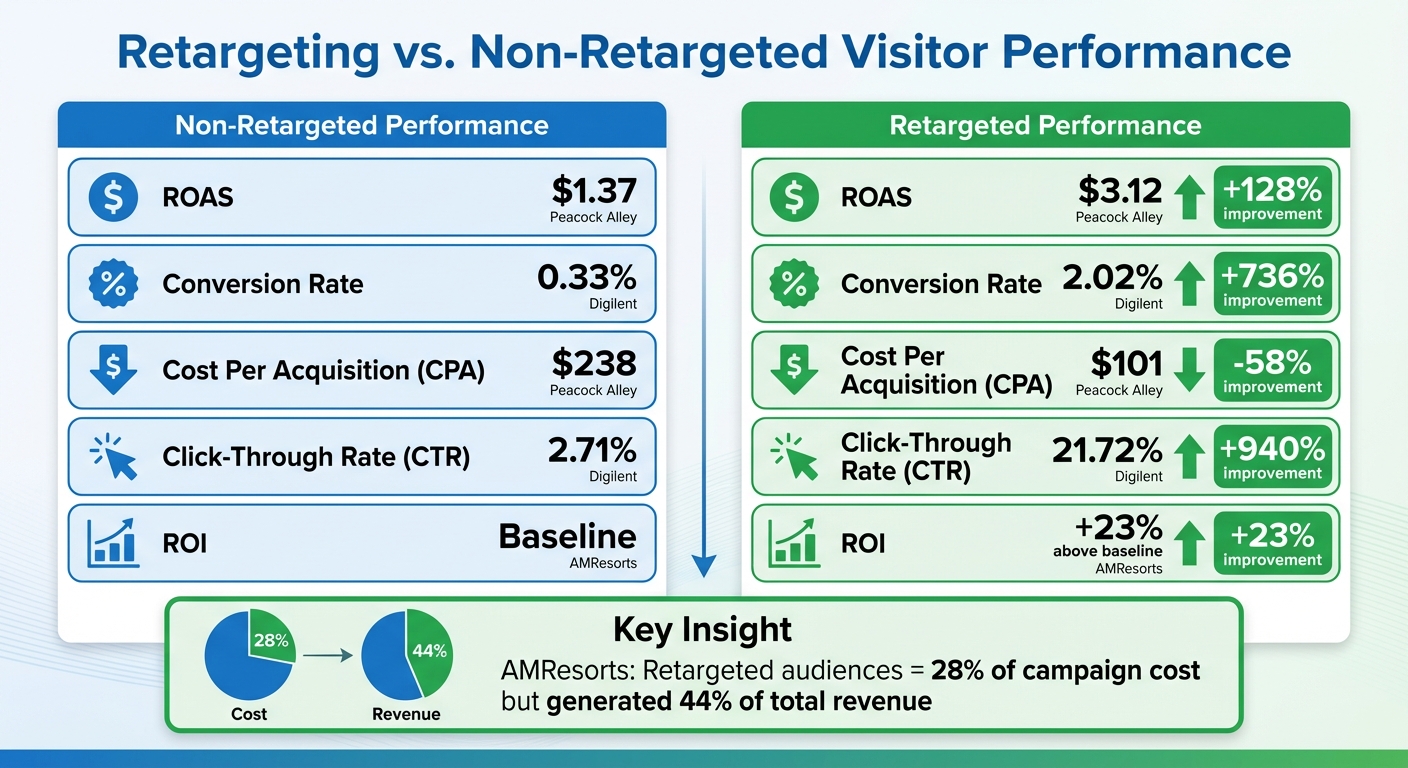
Retargeting Campaign Performance Metrics: Before vs After Results
Performance Metrics
The campaign adjustments brought measurable success, showcasing how behavior-based retargeting can transform performance metrics. Across the board, companies saw dramatic improvements in key areas.
Peacock Alley saw its Return on Ad Spend (ROAS) jump by 128%, moving from $1.37 to $3.12 in June 2025. Cost Per Acquisition (CPA) dropped by 58%, going from $238 to $101, while conversion rates surged by 154%, rising from 1.3% to 3.3%.
Digilent also experienced impressive results between June and August 2023 under Karina Zommere's leadership at scandiweb. ROAS skyrocketed by 1,280%, increasing from 0.45 to 2.45. Conversion rates rose by 736%, from 0.33% to 2.02%, and click-through rates soared by 940%, climbing from 2.71% to 21.72%.
AMResorts focused its retargeting efforts on cart abandoners, achieving a 153% higher conversion rate compared to standard campaigns. This strategy generated $1.69 million in projected additional annual revenue, exceeding their initial PPC ROI target by 90%. Katie S., Digital Campaign Analyst at AMResorts, praised the campaign's success:
"The Seer team did an exceptional job finding new opportunities within our audience segments. This analysis has led to even more advanced paid search audience development".
These results emphasize the effectiveness of retargeting strategies compared to traditional approaches.
Retargeted vs. Non-Retargeted Visitor Performance
The comparison between retargeted and non-retargeted visitors further illustrates why retargeting delivers superior outcomes. Across all metrics, retargeted audiences consistently outperformed their non-retargeted counterparts.
| Metric | Non-Retargeted | Retargeted | Improvement |
|---|---|---|---|
| ROAS (Peacock Alley) | $1.37 | $3.12 | +128% |
| Conversion Rate (Digilent) | 0.33% | 2.02% | +736% |
| Cost Per Acquisition (Peacock Alley) | $238 | $101 | -58% |
| Click-Through Rate (Digilent) | 2.71% | 21.72% | +940% |
| ROI (AMResorts) | Baseline | +23% above baseline | +23% |
In the case of AMResorts, retargeted audiences made up just 28% of the total campaign cost yet generated 44% of the total revenue. This efficiency highlights the importance of precise audience segmentation, targeted messaging, and optimized budget allocation using Google Ads performance tools.
Key Takeaways: What Marketers Can Learn
Why Retargeting Produces High ROI
Retargeting is effective because it targets warm leads - people who already know your brand. These are visitors who’ve shown interest by browsing your website, adding items to their cart, or checking out specific products. It’s much more cost-effective to convert someone familiar with your brand than to acquire a brand-new customer.
Behavioral segmentation plays a crucial role. Instead of using a one-size-fits-all approach, successful campaigns segment audiences based on their actions. For example, Postano increased conversion rates by 278% by tailoring banner ads to specific industries like sports and fashion, then tracking users with cookies for 60 days.
Taking it a step further, product journey analysis predicts what customers might purchase next based on past behavior. By using tools like Triple Whale data, Peacock Alley identified complementary products and set up targeted product sets in Meta Commerce Manager, significantly improving their ROAS.
These examples highlight the importance of fine-tuned retargeting strategies, which can be implemented using practical approaches.
Practical Tips for Retargeting Campaigns
Start by using multi-tiered audience segmentation. Break down your website visitors into groups like cart abandoners, product page viewers, past buyers, and first-time visitors. This precise targeting has consistently delivered strong results across various case studies.
Personalize your ads to address customer-specific concerns. Generic ads often lead to low engagement and ad fatigue. For instance, a cosmetics company boosted its conversion rate from 0.8% to 2.9% by customizing ad visuals and messaging to focus on concerns like anti-aging versus sensitive skin. Amy Lundstram, Paid Media Director at Eyeful Media, explained:
"Showing the same message to everyone limits growth and wastes spend. Premium brands especially need a smarter, more personalized way to reconnect with buyers".
Control ad frequency to avoid overwhelming your audience. Aim for 5-7 impressions per user; anything more could irritate potential customers and waste your budget. Also, implement exclusion tactics by removing recent buyers from campaigns when dealing with products that have longer purchase cycles, such as luxury watches or bicycles.
Offer strategic incentives to encourage repeat purchases. For example, Peacock Alley introduced a 20% discount for second-time purchases, timed around key promotional periods. This approach gave customers a reason to return while maintaining the brand’s premium image. For businesses with longer sales cycles, like B2B or high-ticket items, extending your cookie window to 60 days or more can keep your brand top-of-mind during the decision-making process.
Using the Top PPC Marketing Directory
To bring these strategies to life, marketers can explore specialized tools and agencies through the Top PPC Marketing Directory at https://ppcmarketinghub.com. This platform offers a curated resource where you can compare retargeting solutions, explore features, and connect with expert agencies experienced in behavior-driven campaigns.
The directory includes tools for audience segmentation, dynamic creative optimization, cross-channel tracking, and performance analytics. Whether you need help with Facebook Pixel setup, optimizing Google Display Network campaigns, or managing multi-platform retargeting, the directory connects you with trusted providers.
For campaigns like those mentioned in this section, the directory helps marketers find agencies with experience in industries such as luxury retail, B2B tech, and e-commerce. You can filter by expertise, review pricing models, and read detailed profiles to find the right partner for your needs. This streamlines the process and ensures you’re working with professionals who understand your specific challenges.
Conclusion
Retargeting is a powerful way to turn engaged visitors into paying customers, offering some of the highest returns on investment in digital marketing. Companies like Watchfinder, Peacock Alley, and Postano have seen incredible results by implementing well-thought-out strategies. These examples highlight how effective retargeting can transform campaign performance.
One key to success lies in behavioral segmentation. Derek Tucker from Corel Software showcased this by aligning ads with the customer journey. For instance, visitors to product pages saw one type of message, while those who downloaded a trial received a different one. This tailored approach led to an impressive 106% year-over-year revenue growth. Similarly, Scott Huber at Postano customized banner ads for specific industries, achieving a remarkable 278% increase in demo conversions within just 60 days.
However, successful retargeting isn’t just about segmentation - it requires careful ad management. Bombarding users with the same ad repeatedly can backfire, leading to irritation and wasted ad spend. The best campaigns strike a balance by refreshing creative content and managing ad frequency to keep audiences engaged without overwhelming them.
If you're ready to put these strategies into action, you can explore specialized tools through the Top PPC Marketing Directory. With the right approach, retargeting can help you effectively convert interested visitors into loyal customers.
FAQs
Which audience segments should I retarget first?
Retarget visitors who demonstrated interest but didn’t follow through. Prioritize groups such as those who abandoned their shopping carts or browsed important pages like your homepage or contact page. These individuals are already familiar with your brand and are more likely to convert, making them perfect for your first retargeting campaigns.
How long should my retargeting window be?
The retargeting window usually spans between 7 to 30 days. The exact duration depends on your campaign objectives and how your audience interacts with your brand. This period is designed to reconnect with visitors and keep your brand top-of-mind, ensuring you engage them effectively while the interest is still fresh.
How do I prevent ad fatigue in retargeting?
To keep retargeting campaigns effective and avoid ad fatigue, it's important to refresh your approach consistently. Switch up your ad designs every 7–10 days to keep things fresh. Broaden your audience by adding new segments and experiment with a mix of ad formats to keep the content engaging.
Keep a close eye on metrics like click-through rate (CTR) and ad frequency. A drop in CTR or a high frequency count can signal that your audience is getting tired of seeing the same ads. Adjusting frequency limits and expanding your audience reach can help minimize overexposure and maintain strong campaign results.