Struggling to allocate your PPC budget effectively across platforms like Google Ads, Facebook, and LinkedIn? Here's the deal: most advertisers still rely on outdated models like last-click attribution, which unfairly credits the final touchpoint and ignores earlier customer interactions. This leads to poor budget decisions and missed growth opportunities.
Enter Shapley Value Attribution - a method grounded in game theory that calculates the true contribution of each channel to a conversion. Unlike rule-based models, it uses actual data to distribute credit more fairly across touchpoints. However, it comes with challenges like high computational demands and the need for large datasets (10,000+ conversions).
Key Takeaways:
- Shapley Value Attribution evaluates the impact of removing channels from the customer journey to assign credit accurately.
- It requires unified data systems (e.g., BigQuery) and advanced cross-platform ad performance tracking tools like Google Ads Data Hub for implementation.
- While more accurate, it's computationally intensive compared to simpler models like last-click or linear attribution.
If you're still using outdated methods, you're likely undervaluing channels that generate demand early in the funnel. Shapley Value Attribution can help you make smarter, data-driven decisions - but only if you have the right tools and data infrastructure in place.
1. Shapley Value Attribution
Credit Allocation Accuracy
When it comes to fair credit distribution in PPC campaigns, Shapley Value offers a more precise approach than traditional models. It operates based on four fairness principles: Efficiency (ensuring all credit is distributed), Symmetry (equal credit for equal contributions), Dummy (no credit for non-impactful touchpoints), and Additivity (consistent results across combined objectives). These principles ensure that conversion credit is accurately divided across platforms like Google Ads, Meta, and LinkedIn.
Here’s how it works: the model calculates the marginal impact of each touchpoint by simulating its removal from various channel combinations. For instance, in a journey involving Paid Search, Display Ads, and Email, Shapley determines the effect of removing each channel from different sequences. This identifies which platforms are genuinely driving conversions rather than just being part of the journey. Maria from LeadSources.io explains it well:
"Shapley Value Attribution applies cooperative game theory mathematics to calculate each touchpoint's marginal contribution across all possible channel combinations, delivering mathematically fair credit distribution."
A compelling example comes from a February 2026 study by researcher Clarencer R. Mercer. Analyzing over 8,000 multi-channel leads from the Olist E-commerce dataset, the study found that while Organic Search had the highest volume of leads, Display Ads closed deals significantly faster - averaging 10.3 days compared to Organic Search's 50.0 days. This insight prompted a recommendation to triple the budget for Display Ads, a move that a last-click attribution model would have overlooked entirely.
Cross-Platform Integration
To apply Shapley Value across platforms like Google Ads, Meta, and LinkedIn, you need to unify data from these otherwise separate systems. A unified data environment, such as BigQuery, is critical for merging touchpoints from different platforms. Accurate identity resolution - using email hashes or customer IDs - is equally important to connect interactions across devices and platforms.
Tools like Google Ads Data Hub offer a "Simplified Shapley Value Method" tailored for cross-platform analysis. However, it applies privacy filters that exclude touchpoints with fewer than 50 users. Setting up this system typically involves data warehouses, ETL pipelines, and analytics tools running Python or R. Without precise user identity matching, the performance of the model can suffer, leading to less reliable results.
Implementation Complexity
One major hurdle with Shapley Value attribution is its exponential computational demand. For example, analyzing a 10-channel model requires evaluating 3,628,800 possible channel sequences. This complexity directly impacts both processing time and infrastructure costs.
To address this, many implementations rely on "Simplified Shapley" methods, which sample a subset of channel orderings instead of calculating every single permutation. This reduces processing time while maintaining accuracy. For reliable results, you’ll need data from at least 10,000 converting journeys. Start with the top 4–5 channels and use rolling windows of 90 or 180 days to account for seasonal changes. Excluding rare channel combinations - those seen in less than 1% of journeys - can also help streamline the process.
While Shapley Value offers a more nuanced view of attribution, its computational demands stand in stark contrast to the simplicity of traditional models, which we’ll explore next.
sbb-itb-89b8f36
2. Traditional Attribution Models
Credit Allocation Accuracy
Unlike Shapley Value's data-driven approach, traditional attribution models rely on preset rules rather than evaluating actual channel performance. For instance, last-click attribution assigns 100% of the credit to the final touchpoint, first-click does the same for the initial interaction, and linear attribution spreads credit equally across all touchpoints - regardless of their actual contribution to the conversion.
Ron Berman, Associate Professor of Marketing at the Wharton School, highlights a critical flaw in these models:
"Last-touch attribution often hurts profitability: The popular last-touch method can reduce advertiser profits compared to not using attribution at all, unless there is high asymmetry between publishers."
The issue lies in how these models fail to adhere to basic fairness principles. Linear attribution, for example, violates the "Dummy Axiom" by giving equal credit to all interactions, even those that had no real impact on conversion likelihood. Meanwhile, last-click attribution disproportionately disadvantages top-of-funnel channels, which play a crucial role in generating initial demand. Clarencer R. Mercer underscores this problem:
"Last-Click Bias is the single most destructive force in modern marketing budget allocation. By rewarding only the final touchpoint, organizations accidentally defund the top-of-funnel 'Educators' that generate demand in the first place."
This misallocation of credit not only skews performance insights but also leads to poor budgeting decisions, weakening the effectiveness of marketing strategies. This often necessitates a comprehensive PPC campaign optimization to recover lost performance.
Cross-Platform Integration
Another major drawback of traditional models is their inability to account for the complexity of modern customer journeys. Consumers often interact with 5–7 touchpoints across multiple devices before making a purchase. Models like last-click and first-click ignore these intricate paths, over-crediting channels like branded search or final conversion points while overlooking the critical awareness and consideration stages that occur on other platforms.
To make matters worse, data inconsistencies across platforms exacerbate the problem. Platforms often report session counts and conversion timestamps differently, making it necessary to unify data through tools like BigQuery to ensure accuracy. Privacy-related changes, such as iOS's SKAdNetwork and the phasing out of cookies, further complicate tracking efforts. It's no surprise, then, that 42% of advertisers report uncertainty about selecting the right attribution model, leading many to default to these flawed systems.
While these models are easy to set up, their oversimplified nature makes them ill-suited for capturing the nuances of multi-platform, multi-device customer journeys.
Implementation Complexity
If traditional attribution models have one advantage, it's their simplicity. Their calculations are straightforward, requiring no advanced analytics tools or technical expertise. For example, a last-click or linear model can be applied using a basic formula, without the need for data warehouses or coding knowledge.
However, this simplicity comes at a cost. When automated bidding strategies, like Google Smart Bidding, rely on flawed attribution signals, the system amplifies errors by scaling inefficient spending. Feeding incorrect data into machine learning models causes them to optimize for misleading outcomes. To avoid these pitfalls, it's critical to ensure your attribution setup is accurate before scaling ROAS strategies.
While easy to implement, traditional models risk undermining long-term marketing success if their limitations aren't addressed.
3. Top PPC Marketing Directory
Credit Allocation Accuracy
The Top PPC Marketing Directory links you to tools that use advanced Shapley Value attribution methods, ensuring fair and precise credit distribution. For instance, Google Ads Data Hub (ADH) applies a "Simplified Shapley Value Method" tailored for data transfer-based tables, maintaining both privacy and data accuracy.
If you're looking for deeper insights, Treasure Data CDP is noteworthy. It’s the only customer data platform that merges Long Short-Term Memory (LSTM) deep learning with Shapley values, uncovering patterns in extended customer journeys. On the other hand, Lebesgue (AI CMO) simplifies Shapley calculations for eCommerce businesses. It identifies which touchpoints - like Facebook ads or email campaigns - are driving purchases most effectively.
These tools lay the groundwork for smooth cross-platform integration, which is explored next.
Cross-Platform Integration
The Directory also provides solutions to tackle cross-platform data silos, which are often a major hurdle. Resources include data warehouses like BigQuery, ETL pipelines such as Segment and Rudderstack, and analytics tools compatible with Python or R. These are essential for processing the complex journey variations required for accurate Shapley calculations. By leveraging these tools, you can simplify the challenges of managing countless journey permutations.
Additionally, platforms like Adjust, AppsFlyer, and Funnel.io automate intricate attribution models. These are particularly useful for organizing the large number of channel sequences involved in multi-platform attribution.
Implementation Complexity
Even with these tools, implementing Shapley Value attribution can be complicated. A key factor is achieving statistical reliability, which demands a significant number of converting customer journeys. Given the exponential growth in channel combinations, it’s wise to focus on your top 4–5 channels initially. Use a rolling window of 90 to 180 days and exclude combinations that appear in less than 1% of journeys to minimize noise.
For high-frequency campaigns, consider recalculating weights weekly, provided there are at least 1,000 new converting journeys to support the updates. This approach ensures your attribution remains accurate and actionable.
Domo + Marketing Attribution & Shapley Value p1 // window functions in MySQL 5.6
Advantages and Disadvantages
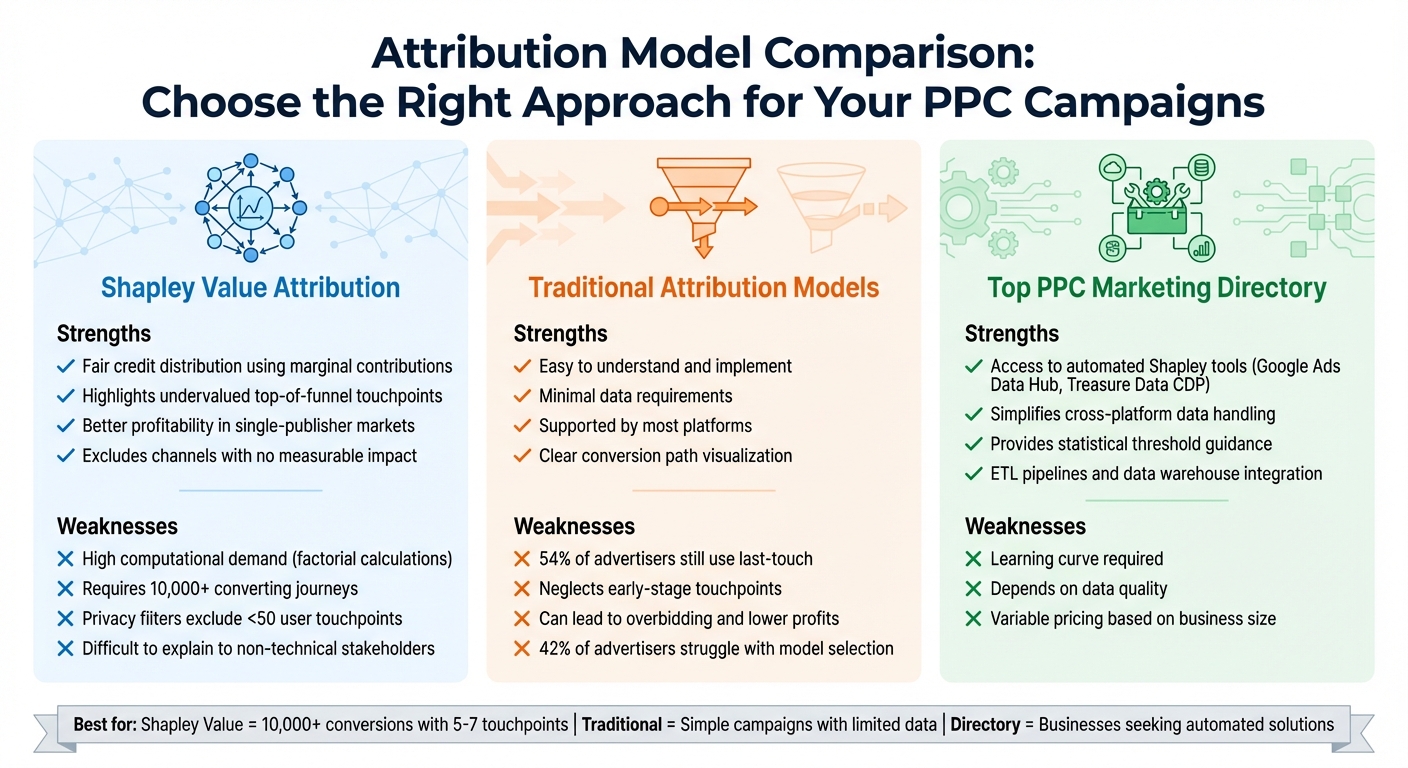
Shapley Value vs Traditional Attribution Models: Comparison Chart
Budget decisions and campaign performance hinge on the attribution approach you choose. Here's a closer look at how different methods compare:
| Approach | Strengths | Weaknesses |
|---|---|---|
| Shapley Value Attribution | Distributes credit fairly using marginal contributions; highlights undervalued touchpoints like top-of-funnel assists; delivers better profitability in markets dominated by a single publisher; excludes channels with no measurable impact. | Requires heavy computation (factorial calculations for multiple channels); demands over 10,000 converting journeys for accurate results; privacy filters exclude touchpoints with fewer than 50 users; challenging to explain to non-technical audiences. |
| Traditional Attribution Models | Easy to understand and implement; minimal data requirements; commonly supported by most platforms; provides clear conversion path visuals. | Skewed toward specific funnel stages (e.g., 54% of advertisers still rely on last-touch); neglects early-stage touchpoints; can lead to overbidding and lower profits; 42% of advertisers struggle to select the right model. |
| Top PPC Marketing Directory | Links marketers to tools like Google Ads Data Hub and Treasure Data CDP for automated Shapley calculations; simplifies cross-platform data handling with ETL pipelines and data warehouses; offers guidance on statistical thresholds and rolling windows. | Requires time and effort to learn; depends heavily on data quality; tool pricing can vary based on business size. |
Each approach comes with trade-offs that shape how marketers allocate their PPC budgets effectively.
The Directory stands out by connecting marketers with tools that combine advanced computational capabilities with user-friendly implementation, making cross-platform attribution more manageable.
Conclusion
Shapley Value attribution is particularly effective for campaigns that include complex multi-touch customer journeys with 5–7 touchpoints and at least 10,000 converting customer journeys. This model shines in situations with high publisher imbalance - where one channel dominates traffic - or when channels work together in ways that traditional models fail to capture.
To get started, make sure your data infrastructure is ready for cross-platform analysis. Specialized platforms can simplify this process. The Top PPC Marketing Directory (https://ppcmarketinghub.com) offers access to tools like Google Ads Data Hub and Treasure Data CDP, which automate Shapley calculations, saving you from the heavy computational workload so you can focus on making smarter budget decisions.
If you're still using last-touch attribution, there's a good chance you're overlooking early-stage channels that drive demand but don't directly close sales. Shapley Value attribution highlights these "Educator" channels, enabling you to allocate budgets based on their true contribution rather than outdated position-based metrics. By adopting this approach, you can fine-tune your PPC investments with more accurate, data-driven insights.
FAQs
When is Shapley attribution worth using for PPC?
Shapley attribution proves incredibly useful in PPC campaigns, especially when you're trying to evaluate how each channel contributes to multi-touch customer journeys. Unlike traditional rule-based models, which often oversimplify things, Shapley attribution provides a more balanced and precise way to understand channel performance - perfect for managing complex campaigns.
What data do I need to run Shapley across platforms?
To use Shapley attribution across platforms, start by collecting data on user interactions. This includes details about touchpoints, user identifiers, and metrics that measure each touchpoint's contribution. Make sure to respect privacy standards by filtering out touchpoints with fewer than 50 users. Organize this data into two key tables: a touchpoint table and a user credit table, which will help structure the information for analysis.
How can I reduce Shapley computation costs?
To cut down on the costs of calculating Shapley values, try the Simplified Shapley Value Method, which simplifies the process by zeroing in on the most important data. This method involves setting up touchpoint and user credit tables while incorporating privacy filters to exclude touchpoints with fewer than 50 users. By filtering out smaller datasets, you can avoid the heavy lifting of analyzing every possible touchpoint combination while still gaining valuable attribution insights.