Managing your Pay-Per-Click (PPC) budget is critical for campaign success. Rising costs - projected to increase 15–30% by 2026 - make choosing the right budgeting strategy more important than ever. Businesses can opt for fixed budgets (predictable, consistent spending) or flexible budgets (adjusting spend based on real-time performance). Both have pros and cons, and the best choice depends on your goals, market, and available data.
Key Takeaways:
- Fixed Budgeting: Ideal for stability and financial control. Works well for small businesses or campaigns with consistent performance.
- Flexible Budgeting: Allows for scaling during high-performing periods. Best for seasonal industries or growth-focused campaigns.
- Hybrid Approach: Combines both strategies - allocating a stable budget for core campaigns while leaving room for testing or scaling.
Quick Stats:
- CPCs have risen 16% year-over-year.
- Flexible budgets can boost ROI by up to 45% during peak periods.
- Weekly budget reallocations can increase revenue by 22% in 60 days.
Bottom Line: Your PPC budget should align with your business needs. Fixed budgets provide predictability, while flexible ones offer growth potential. Hybrid models balance both. Smart tools and consistent monitoring can help make the most of your ad spend.
What Is Fixed PPC Budgeting?
Fixed PPC budgeting involves setting a strict daily or monthly spending limit, regardless of campaign performance. For example, you might allocate $1,500 per month, and that’s the maximum amount you’ll spend.
This method offers predictability and makes planning straightforward. You’ll always know your monthly ad spend, which simplifies forecasting and accounting. It’s especially helpful for new PPC teams or businesses working within strict financial constraints. However, the downside is that fixed budgets lack flexibility. If your ads perform exceptionally well during a high-traffic period, you can’t increase spending to take advantage of the momentum. On the flip side, if your campaign underperforms, you’ll still spend the same amount.
"PPC budget models are about strategic allocation - knowing when to scale, when to pause, and where to invest for the best return." – Errika DeVall, author at Riithink
This rigidity is the main drawback of fixed budgeting, as it limits adaptability. For example, Google Ads allows for occasional daily budget spikes but ensures you don’t exceed your monthly cap. Interestingly, about 57.6% of businesses set their PPC budgets between $1,000 and $11,000 per month, with the average cost-per-click across industries sitting at $3.67.
Key Features of Fixed PPC Budgeting
Fixed PPC budgets operate with a set spending cap - daily or monthly - that doesn’t change, no matter the season, campaign shifts, or performance data. This approach simplifies financial management, as there’s no need for constant budget adjustments or approvals. It’s particularly effective for testing new campaigns or for marketers looking to avoid overspending.
However, the lack of flexibility can be a disadvantage. For example, in competitive bidding environments - where CPCs are rising roughly 16% year-over-year - a fixed budget might mean missing out on high-converting traffic. Additionally, campaigns can hit their daily cap early, leading to a "Limited by budget" status in Google Ads, which prevents your ads from running during peak conversion hours.
Examples of Fixed Budgeting in Practice
Let’s look at a practical example: In July 2025, a small chiropractic clinic in Boise, Idaho, ran a $1,500 monthly search campaign. With consistent, year-round traffic and no seasonal promotions, this fixed budget kept the clinic visible without risking overspending during competitive periods.
Fixed budgeting also works well for project-based campaigns. Imagine launching a 90-day brand awareness campaign with a total budget of $9,000. By allocating $3,000 per month, you ensure the budget lasts the entire campaign duration. Similarly, for smaller campaigns - like a high-performance test with a budget under $2,000 - focusing all funds on a single campaign often yields better results than spreading the budget too thin.
What Is Flexible PPC Budgeting?
Flexible PPC budgeting is all about adjusting your ad spend dynamically based on performance data, auction insights, and campaign objectives. This approach ensures you're channeling funds where they deliver the best results, right when you need them most.
Take Google Ads, for example - it might double your daily budget on high-traffic days but will ensure your monthly spend stays within your daily budget multiplied by 30.4. So, if your daily budget is $100, the system could spend up to $200 on busier days, then scale back on quieter ones to balance things out.
Automation tools like Google’s Smart Bidding (e.g., Target ROAS, Target CPA) and Shared Budgets make this possible. These tools adjust bids in real time and reallocate funds between campaigns, giving high-performing campaigns more resources while scaling back on underperformers.
"Flexible budgets remove the incentive to green light irresponsible tactics [such as 'use it or lose it' spending]." – PPC Hero
A great real-world example comes from Booyah Advertising. In 2025, they shifted over 600 reports to the Improvado platform to handle budgets for 100+ clients. By automating data pipelines, they achieved 99.9% accuracy and cut the time spent on daily budget updates by half. As Tyler Corcoran, their Marketing Analytics Manager, put it:
"If we don't trust the data, the agency won't trust the reports and won't give them to the client... With Improvado, we now trust the data. It's 99.9% accurate." – Tyler Corcoran, Marketing Analytics Manager, Booyah Advertising
Key Features of Flexible PPC Budgeting
Flexible PPC budgets allow for incremental increases - typically 10–20% - when campaigns hit conversion goals, helping algorithms scale spending efficiently.
Automation plays a big role here. Portfolio bidding strategies let you manage multiple campaigns with similar objectives under one roof, while real-time auction signals adjust bids based on factors like device, location, demographics, and even the time of day. For instance, if data shows conversions peak between 8 a.m. and 2 p.m., dayparting can allocate more budget during those hours.
Custom distribution schemes add another layer of control. Google Ads scripts can tweak daily budgets to suit specific timelines, like focusing more spend toward the end of a sale or compensating for underused budgets earlier in the month. This is particularly useful for flash sales or product launches.
That said, flexibility requires vigilance. Big budget adjustments - over 20% - can trigger a "Learning Mode", a recalibration period lasting about seven days, which may affect performance temporarily. Moreover, budget strategies often need at least three weeks of historical data to optimize effectively.
Examples of Flexible Budgeting in Action
Flexible budgeting shines in competitive, seasonal markets. Picture an e-commerce retailer during the holiday season. Instead of spending evenly every day, they could focus more on high-intent shopping days like Cyber Monday and pull back on slower weekdays.
Or imagine a travel company reacting to unexpected weather changes. If a sudden cold snap leads to a spike in searches for "last-minute ski trips", flexible budgeting can automatically ramp up spending to capture that demand - no manual intervention required. This agility is crucial when demand doesn’t follow typical patterns.
Another smart use? End-of-month slowdowns. Lower CPCs during these periods can help you stretch your budget while still capturing quality traffic. Additionally, setting aside 10–20% of your PPC budget for testing new channels, ad creatives, or keywords can uncover new opportunities without risking your core campaigns.
Fixed vs Flexible Budgeting: A Comparison
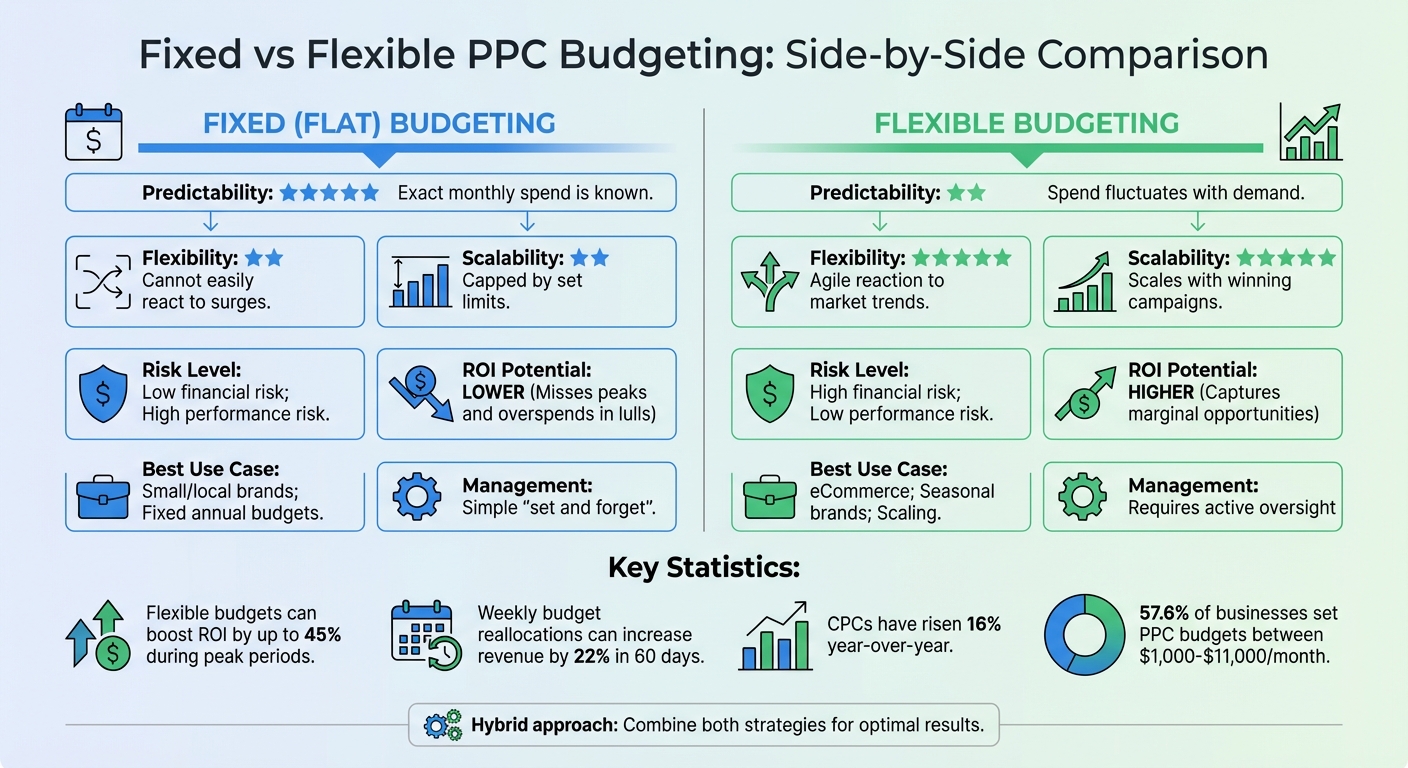
Fixed vs Flexible PPC Budgeting: Complete Comparison Guide
Fixed and flexible budgeting take very different paths when it comes to managing finances. Fixed budgeting locks in a set monthly spend - say, $2,000. This makes accounting straightforward and predictable, but it lacks the ability to adapt when new opportunities arise. On the other hand, flexible budgeting adjusts spending based on current performance and market conditions. It allows for scaling up during high ROAS periods and scaling down when performance dips. The numbers below highlight these differences.
The trade-offs are clear. Fixed budgets provide strict control, but they can lead to missed opportunities during peak times or overspending when demand is low. Flexible budgets, while offering better ROI potential by capitalizing on marginal opportunities, require constant monitoring to avoid overspending.
"With fixed budgets, we will sometimes overpay for the available results. But at other times, we will underpay, missing an opportunity for better results, and leaving money on the table." – David "Psy" Deppner, Founder, Psyberware
Flexible budgets can outperform fixed ones by as much as 45% during peak seasons, with weekly reallocation boosting revenue by 22% over a 60-day period.
Comparison Table: Fixed vs Flexible Budgeting
| Feature | Fixed (Flat) Budgeting | Flexible Budgeting |
|---|---|---|
| Predictability | High - exact monthly spend is known | Low - spend fluctuates with demand |
| Flexibility | Low - cannot easily react to surges | High - agile reaction to market trends |
| Scalability | Low - capped by set limits | High - scales with winning campaigns |
| Risk Level | Low financial risk; high performance risk | High financial risk; low performance risk |
| ROI Potential | Lower - misses peaks and overspends in lulls | Higher - captures marginal opportunities |
| Best Use Case | Small/local brands; fixed annual budgets | eCommerce; seasonal brands; scaling |
| Management | Simple "set and forget" | Requires active oversight |
How to Choose the Right Budgeting Strategy
The budgeting approach you choose should align with your available funds, the current market dynamics, and performance data. If you're operating in a steady market with predictable conversion trends or need tight cost control, fixed budgeting is a solid choice. On the other hand, flexible budgeting is ideal for businesses pursuing growth or managing seasonal demand, where efficiency metrics like ROAS (Return on Ad Spend) or CPA (Cost Per Acquisition) take precedence over strict spending limits.
Your business model plays a big role here. For instance, industries like B2B SaaS and healthcare, which have longer sales cycles and consistent conversion patterns, often lean towards fixed budgets. Meanwhile, e-commerce brands and businesses in competitive markets thrive on flexible budgets. These allow them to ramp up spending during high-opportunity periods, such as holidays or when a trend takes off, and scale back when costs spike without proportional returns.
Another factor to consider is the availability of historical data. A fixed budget is a good starting point to gather initial benchmarks. Once you have enough data to identify seasonal trends and performance patterns, transitioning to a flexible budget can help optimize growth. It’s worth noting that digital advertising now accounts for nearly 72% of total media spend, up from 56% in 2019.
"The key isn't choosing between static and dynamic budgeting; it's knowing when and how to adjust PPC spend using data-driven signals." – Ameet Khabra, Founder, Hop Skip Media
Modern tools like Google’s Smart Bidding and Performance Max thrive on flexible budgets. These platforms use real-time auction signals to adjust spending, making it more effective to treat a ROAS or CPA target as your "budget" rather than sticking to a fixed dollar amount.
When to Use Fixed Budgeting
Fixed budgeting is perfect when stability and predictability are your top priorities. If your organization operates on rigid accounting cycles or follows a "spend what you can afford" approach, this strategy ensures financial control. It also works well for industries like B2B SaaS, healthcare, and professional services, where demand is stable, and sales cycles are longer.
For businesses using a "percentage of revenue" model, fixed budgets help keep marketing costs proportional to revenue. This approach is particularly effective for maintaining brand visibility. For instance, allocating a set budget to branded search campaigns ensures steady visibility without overspending, especially when competitors aren't aggressively targeting your brand terms.
However, fixed budgets have limitations. PPC costs are projected to rise by 15–30% by 2026 due to economic pressures and AI-driven changes reducing clickable impressions. A fixed cap might cause you to miss out on high-ROI opportunities during peak periods or lead to overspending during slower times.
When to Use Flexible Budgeting
If growth and ROI optimization are your focus, flexible budgeting is the way to go. Campaigns that consistently meet ROAS or CPA targets can scale their budgets by 10–20%, maximizing revenue without triggering Learning Mode. This ensures you’re not leaving money on the table during periods of high intent.
Businesses that experience seasonal demand or operate in highly competitive markets benefit significantly from flexible budgeting. For instance, e-commerce brands can allocate more funds during high-opportunity periods like Black Friday and pull back when costs rise faster than returns. Campaigns that adjust budgets weekly based on funnel performance have been shown to deliver 22% more revenue growth over 60 days compared to static budgets.
If you notice "Limited by Budget" warnings in platforms like Google Ads, it’s a clear sign that a fixed cap is holding your campaign back from capturing high-ROI traffic. Flexible budgets allow you to take advantage of unexpected traffic surges or shifts in competition, ensuring you capitalize on low-CPA conversions.
"A ROAS target is actually a budget, but a flexible budget. If actual ROAS is below goals, we automatically cut back... And if actual ROAS starts to run high, we automatically increase spending." – David "Psy" Deppner, Founder, Psyberware
That said, flexible budgeting demands close monitoring and accurate data. You’ll need to track daily spend and conversion data to prevent overspending. It’s also wise to allocate 10–20% of your total PPC budget for testing new channels, ad creatives, or keywords to stay ahead of the curve. Keep in mind that strategies like Target ROAS typically require at least 50 conversions within the past 30 days to perform effectively.
sbb-itb-89b8f36
Steps to Implement Fixed and Flexible Budgeting
Implementing Fixed Budgeting
Start by defining SMART objectives - goals that are specific, measurable, achievable, relevant, and time-bound. For example, aim to generate 500 qualified leads or achieve a 4:1 ROAS within the next quarter. Conduct thorough keyword research to estimate average CPC and better plan your spending.
Next, analyze key funnel metrics like conversion rates, lead-to-customer ratios, and lifetime value (LTV) to align your budget with revenue targets. Choose a budgeting model that fits your goals, such as Goal-Oriented, Percentage of Revenue (e.g., allocating 9.5% of total revenue), or Market Share.
Set daily and monthly caps by dividing your total monthly budget by 30.4 (the average number of days in a month). This approach accounts for fluctuations in traffic. Keep in mind that Google may spend up to twice your daily budget on high-intent traffic days, but it won’t exceed your monthly cap. Use budget pacing tools to compare your actual cumulative spend against your ideal spend daily or weekly, ensuring your budget lasts through the period.
Schedule regular check-ins to keep your budget on track. Conduct weekly pacing reviews, monthly ROAS evaluations, and quarterly strategic adjustments. To quickly catch issues like payment errors or technical glitches, set up spend drop alerts using monitoring tools. Even with a fixed budget, reserve 10–20% for experimenting with new keywords, ad copy, or platforms to improve efficiency over time. Don’t forget to include hidden costs like management fees, software subscriptions (e.g., Semrush, Ahrefs), and creative development when calculating your true ROI.
"Every budget allocation has a defined purpose, and that objective must be measurable." – Brett Kahnke, Forrester Analyst
Once your fixed budget system is running smoothly, you can transition to flexible budgeting to take advantage of performance peaks.
Implementing Flexible Budgeting
Divide your budget strategically: allocate 40–60% for bottom-funnel conversions and 10–20% for top-funnel awareness. Use automated bidding strategies like Target CPA or ROAS to adjust spending in real time based on auction signals.
Set up guardrails to maintain control, even with automation. For instance, establish maximum bid limits and daily spend caps to avoid overspending. Rule-based automation can also help adjust daily spend throughout the month, whether you aim for consistent distribution or focus on specific times like weekends. These safeguards allow you to scale successful campaigns without losing control. For example, in 2025, Johnson Group reduced budget pacing time by 90% using automation, cutting weekly management hours from 12–15 to under five.
When increasing budgets for high-performing campaigns, do so in small increments - ideally 10–20% - to avoid triggering a 3–14-day Learning Mode. Set up automated alerts to catch spending anomalies and unexpected drops, ensuring quick responses to any issues. A great example of this in action is Booyah Advertising, which transitioned over 600 reports to Improvado’s automated platform, achieving 99.9% data accuracy and cutting daily budget-tracking time by 50%.
Pay close attention to negative keywords, as effective management can reduce wasted ad spend by up to 40%. Regularly review your performance metrics, such as daily burn rates and monthly outcomes, to guide budget reallocations. By integrating automation with consistent oversight, your PPC strategy will stay flexible and aligned with ROI goals. However, human involvement remains essential to ensure AI tools optimize for the right ROI targets and maintain high-quality conversion data.
Hybrid Budgeting: Combining Fixed and Flexible Approaches
Advertisers often find success by merging fixed and flexible budgeting strategies. This hybrid approach offers the predictability of fixed spending while retaining the adaptability of flexible allocation. It ensures that essential campaigns remain funded while allowing room to explore new opportunities.
A popular method involves assigning a fixed portion of your budget to core "evergreen" campaigns, while reserving 10–30% for testing new creatives, audiences, or channels. This balance minimizes risk by protecting your primary investments while enabling you to scale promising campaigns as they perform well. Essentially, hybrid budgeting strikes a balance between stability and adaptability.
"PPC success doesn't start with your daily budget. It starts with how you think about that budget." – Errika DeVall, Riithink Digital Marketing
For businesses that operate with fixed annual budgets but experience seasonal fluctuations, hybrid budgeting can be particularly effective. By allocating more funds during peak months and reducing spending during slower periods, you can meet annual targets more efficiently. However, this strategy typically requires several years of historical data to implement effectively.
Strategies for Hybrid Budgeting
Here are a few ways to implement hybrid budgeting:
- 70-20-10 Rule: Allocate 70% of your budget to proven campaigns, 20% to scaling new audiences, and 10% to experimentation.
- CBO/ABO Hybrid on Meta: Begin with Campaign Budget Optimization (CBO) to identify high-performing audiences, then shift successful ad sets to Ad Set Budget Optimization (ABO) for more control. This strategy has reduced cost-per-acquisition by up to 30% for e-commerce accounts. Setting minimum spend limits on valuable audiences can also prevent underfunding during testing.
- Enhanced CPC (ECPC): Use this hybrid bidding strategy to combine manual spending limits with automated adjustments for conversions. This method balances control with automation.
"Running large-scale paid campaigns means thinking like a pilot: automate what can be automated, but always keep your hand on the controls." – Jake Cronin, Paid-Ads Specialist, HOC Digital Solutions
When moving successful tests from your flexible budget into your fixed allocation, increase spending gradually - by 10–20% at a time. This avoids triggering Learning Mode, which can lead to inefficient spending for several days. Monitoring spend distribution every 3–5 days ensures that automated systems focus on high-potential segments.
Advantages of Hybrid Budgeting
Hybrid budgeting offers financial stability while allowing flexibility to seize emerging opportunities. Finance teams appreciate the predictability of fixed budgets, while marketers gain the agility needed to respond to performance changes. For example, conversion-based allocation strategies have been shown to improve lead quality by 30%, while campaigns that reallocate weekly based on funnel performance see a 22% revenue increase over 60 days.
With the average cost-per-click rising 16% year-over-year across industries, rigid fixed budgets often struggle to maintain visibility. Hybrid models can help mitigate this challenge. For instance, in 2025, African Leadership University worked with Ten26 Media to implement a hybrid strategy that led to a 50% increase in high-intent leads, a 35% boost in inquiry-to-application conversions, and a 27% reduction in cost-per-acquisition.
Additionally, hybrid budgeting allows you to take advantage of reduced competition when competitors exhaust their funds. The downside? It requires active monitoring, consistent pacing, and ongoing adjustments based on data. While this adds complexity, the potential rewards make it a worthwhile endeavor for many advertisers.
Best Practices for PPC Budget Management
Managing a PPC budget effectively means staying on top of your campaigns, using the right tools, and making decisions based on solid data. With PPC costs expected to rise by 15–30% by 2026 due to economic changes and AI reducing clickable impressions, managing your budget wisely is more important than ever.
Budget Pacing and Monitoring
Pacing your budget ensures your campaigns run smoothly throughout their duration. For instance, Google Ads can spend up to twice your daily budget on any given day to capture high-intent traffic, but it balances this out over the month to stay within your limits.
Using shared budgets and portfolio bidding is another way to optimize spending. These features allow platforms to shift funds dynamically between campaigns. For example, if one campaign is underperforming and another is driving conversions, funds can automatically flow to the better-performing campaign.
When scaling successful campaigns, increase budgets gradually - about 10–20% at a time. Jumping too quickly can trigger "Learning Mode" in Smart Bidding, which can last 3 to 14 days and lead to inefficient spending during that period. To stay on track, set a weekly review schedule for small adjustments and conduct a deeper analysis monthly to assess ROAS (Return on Ad Spend) and set new baselines.
"If you aren't optimizing your PPC spend, you're playing roulette with your marketing budget." – Ella Brown, Author, Hatch Tribe
These strategies ensure your budget is used wisely and set the stage for integrating advanced tools into your workflow.
Using PPC Tools and Platforms
Modern PPC tools simplify budget management by consolidating data from multiple platforms into one dashboard, making it easier to track performance and spending.
For example, one agency automated over 600 reports, achieving near-perfect accuracy and cutting daily tracking time in half. Similarly, Johnson Group, which manages 1,600+ campaigns across Meta and Google, used Fluency to reduce budget pacing efforts from 12–15 hours a week to less than five hours per month. That’s a 90% drop in manual workload. As Jared Drahonovsky, Group Media Manager, explained:
"Automation has made budget pacing way more efficient than I would have ever expected it to be."
Additionally, many tools now offer AI-powered features like real-time anomaly detection, which flags unusual spending patterns such as sudden CPC spikes. Some even support natural language queries, so you can ask questions like, "Which campaigns are at risk of underspending this week?" and get instant insights. For those juggling budgets across multiple platforms, resources like the Top PPC Marketing Directory offer curated tools for campaign management, bid tracking, and performance optimization.
By leveraging these tools, you can spend less time on manual tracking and more time making informed decisions.
Making Data-Driven Decisions
Every budget decision should be guided by performance data. One effective method is marginal opportunity analysis, which calculates the return on the next dollar spent. This helps identify when a campaign has hit diminishing returns and whether another campaign might yield better results.
Incorporating first-party data, such as Customer Match lists and CRM insights, allows you to allocate your budget toward high-value audiences with strong lifetime value (LTV). For campaigns with longer sales cycles, like B2B, extending conversion windows to 90 days gives Smart Bidding more data to optimize effectively.
Negative keyword management is another critical practice. Reviewing search term reports and adding irrelevant queries to your negative keyword list can reduce wasted spend by up to 40%. Additionally, dayparting - analyzing performance by time of day - can help you allocate budgets during peak conversion hours, such as increasing bids between 8 a.m. and 2 p.m. when lead volume is highest.
"ROAS metrics that better reflect performance lead to superior results because automated tools, based on machine learning, have more accurate input data." – Simonas Lisiukas, Director, Customer Intelligence Engineering
While Smart Bidding offers powerful automation, it’s not a set-it-and-forget-it solution. As Ella Brown wisely notes:
"Smart Bidding is a potent tool but it needs to be set up and monitored correctly. The biggest mistake advertisers make... is switching it on and walking away."
Automated systems can handle bids, but they don’t automatically reallocate budgets across campaigns. Manual adjustments or automated rules are still necessary to ensure that high-performing campaigns receive the funding they need.
Conclusion
Your PPC budget strategy should align with both your business goals and the realities of your market. The choice between fixed and flexible budgeting isn't about finding a "better" option - it's about choosing what works best for your specific needs. Fixed budgets are predictable and straightforward, making them a solid choice for businesses with tight financial controls or longer sales cycles. On the other hand, flexible budgets adjust based on real-time performance and market trends, often yielding a better return on ad spend by capitalizing on peak opportunities.
With PPC costs projected to climb by 15–30% in 2026 and average CPCs increasing around 16% year-over-year, sticking to a static budget could lead to wasted spending. For example, campaigns that reallocate budgets weekly based on performance data have seen a 22% boost in revenue within just 60 days.
Using the right tools can enhance both fixed and flexible strategies. Automated platforms, for instance, can cut budget management time by 63% while improving efficiency by about 3.1%. These tools not only reduce manual effort but also help ensure your budget is allocated more effectively.
"Every budget allocation has a defined purpose, and that objective must be measurable." – Brett Kahnke, Forrester Analyst
Whether you opt for fixed, flexible, or a hybrid approach, success depends on consistent monitoring, data-driven adjustments, and scaling your budget in small increments (10–20%) to maintain algorithm efficiency.
Combining smart budgeting strategies with advanced tools can set your PPC campaigns up for long-term success. If you're looking for more insights, check out resources available at the Top PPC Marketing Directory.
FAQs
What is the difference between fixed and flexible PPC budgets?
Fixed PPC budgets offer stability by maintaining the same spending level over time. This predictability can be useful for planning but may lack the agility to respond to shifts in market trends, seasonal variations, or campaign performance. As a result, businesses might miss growth opportunities or overspend during times of fluctuating demand.
Flexible PPC budgets, however, adapt in real-time to factors like traffic changes, campaign performance, and seasonal trends. By reallocating funds to where they’ll have the most impact, this approach helps optimize return on ad spend (ROAS) and keeps campaigns competitive while aligning with business objectives.
The choice between these two approaches depends on your specific goals, strategy, and how actively you can manage and adjust your campaigns.
Is a hybrid PPC budgeting approach right for my business?
A hybrid PPC budgeting approach offers a smart way to balance stability and flexibility in your advertising spend. It works by combining a fixed baseline budget - to maintain consistent spending - with the option to adjust based on performance, seasonal trends, or unexpected opportunities.
Let’s say your business sees seasonal spikes or faces shifting market conditions. With a hybrid strategy, you can ramp up spending during high-demand periods and pull back when things slow down. This approach also gives you the ability to adapt quickly to changes in campaign performance or market dynamics, ensuring your budget is being used as effectively as possible.
To determine if this method aligns with your goals, ask yourself: Do you have the tools and real-time insights needed to monitor campaign performance and make informed budget adjustments? If predictability and adaptability are priorities for your business, a hybrid budgeting strategy could be the perfect fit.
What are the best tools to manage and optimize my PPC budget?
Effectively managing your PPC budget is all about using the right tools to gain insights, automate repetitive tasks, and make smarter decisions. Platforms like Marin Software are great for analyzing campaign performance and reallocating budgets to boost ROI. Similarly, Adalysis provides tools to monitor budgets and refine strategies using real-time data.
Automation can be a game-changer for tasks like bid management and performance tracking. For example, Fluency Inc. is designed to handle large-scale, multichannel campaigns with precision. On the other hand, budget pacing tools from Inflow allow you to fine-tune daily and monthly spending, ensuring your campaigns align with your financial goals.
By incorporating these tools into your workflow, you can adopt a data-driven strategy that keeps your PPC campaigns efficient and aligned with your marketing objectives.