If I care about pipeline more than clicks, I should use AI to sort B2B PPC keywords by buying intent, ICP fit, and revenue potential - before I spend a dollar.
This article breaks that down into 7 methods: long-tail expansion, competitor gap analysis, solution and pain-point clustering, SERP intent scoring, pipeline filtering, negative keyword discovery, and tool sourcing.
A few numbers frame the problem fast:
- B2B sales cycles often run 60 to 180 days
- Buying groups often include 5 to 11 stakeholders
- Long-tail terms can have 50% less competition
- They can also convert 20% better than broad head terms
So I wouldn’t judge paid search by clicks alone. I’d look at pipeline, CAC, payback, and closed-won revenue.
Here’s the short version of what matters:
- Start with seed topics and turn them into long-tail, job-based searches
- Check competitor gaps and budgets for terms with buying-stage modifiers like vs, pricing, and alternatives
- Group keywords by intent, not just topic
- Read the SERP to tell if a term is informational or commercial
- Filter for revenue fit using buyer job, ICP signals, and sales-call language
- Block bad traffic early with negative keywords tied to poor intent and poor fit
- Pick tools and agencies based on CRM-to-revenue tracking, not traffic reports
A fast way to think about the 7 methods:
| Method | What I use it for | Best use |
|---|---|---|
| Long-tail expansion | Find narrow, high-intent searches | Seed topics |
| Competitor gap analysis | Find missed demand | Conquest and coverage gaps |
| Clustering | Group by buyer stage | Ad and landing page alignment |
| SERP intent scoring | Check commercial fit | Pre-launch filtering |
| Pipeline filtering | Rank terms by revenue fit | Budget decisions |
| Negative discovery | Cut waste | CAC control |
| Tool and agency sourcing | Support execution | Scale and attribution |
Bottom line: this is a pipeline-first keyword process, not a traffic-first one. If I can’t tie a keyword to buyer intent and revenue path, I shouldn’t bid on it.
Why AI Changes B2B Keyword Research
Manual keyword research usually starts with seed lists you already know and search-volume data you can pull from top PPC tools. That sounds fine on paper. In practice, it often misses mid-funnel demand - the searches people make when they’re comparing options, narrowing a shortlist, or looking for proof before they talk to sales.
AI changes that because it can spot those patterns across large keyword sets. And that scale matters. It helps teams find intent signals that are easy to miss when someone is reviewing SERPs by hand.
AI can sort large sets of search terms into intent buckets much faster than manual SERP review. Once that work is done, the next question is simple: can this term support paid spend?
That matters a lot in high-CPC U.S. markets. A batch of low-fit clicks can hurt CAC fast. AI helps teams find lower-cost long-tail terms that still show commercial intent. And that’s not a small detail - long-tail keywords typically have 50% less competition and convert 20% better than short-head terms.
It also helps with enterprise-signal detection at scale. Terms like "SOC 2 compliant" or "enterprise-grade" can hint that the searcher is part of a committee reviewing a higher-value solution. Instead of digging through thousands of terms one by one, teams can use AI to filter for those signals across large keyword sets and put more focus on searches tied to higher-value deals, not casual consumer traffic.
Another shift: AI can cluster keywords by buying stage, not just by topic. So instead of making buckets around product categories alone, it can map terms to specific jobs-to-be-done and stage-of-buying signals. That’s what turns a keyword list into something pipeline-relevant, not just search-volume relevant. And that shift sets up the first method: long-tail expansion from seed topics.
sbb-itb-89b8f36
1. AI Long-Tail Expansion From Seed Topics
Start with a small set of seed topics - like "customer success software" or "onboarding automation" - and use AI to turn them into specific, high-intent search terms fast. The point isn't traffic for traffic's sake. The point is finding the exact job a buyer is trying to get done.
AI helps expand seed topics into the workflows buyers are trying to fix. For example, a seed like "HR software" can turn into something like "tools to track Slack inactivity for offboarding." That's narrow, but that's the point. It ties to a real trigger and a real buying need. AI can also surface question-style queries from Reddit, Quora, and AI search results.
Integration-focused long-tail keywords often beat broad terms on conversion. A keyword with 320 monthly searches and a $0.04 CPC can outperform a broad head term with 50,000 searches and a $0.80 CPC if it lines up with a specific buying job. You spend less, get stronger intent, and attract traffic that fits the pipeline better.
| Keyword Pattern | Example | Pipeline Potential |
|---|---|---|
| Comparison | "[Product] vs [Competitor]" | Very High (5–20x conversion rate) |
| Integration | "[Product] [Partner] integration" | Very High (12–22% conversion rate) |
| Alternative | "Alternatives to [Competitor]" | High (captures existing demand) |
| Use Case | "[Product] for [Industry]" | Medium-High (bridges problem to product) |
| Category | "Project management software" | Low–Medium (high volume, low direct intent) |
A simple way to work this:
- Go after comparison and integration terms first
- Then move into use-case and category terms
- Use broad category terms when you need scale
- Build long-tail clusters to spot where competitors already own demand
2. AI Competitor Keyword Gap Analysis
Next, map competitor gaps. In plain English: find the competitor terms you're not showing up for.
Tools like Semrush and Ahrefs can compare your paid coverage against competing brands and point out missed keywords and weak spots in your bidding strategy. That gives you a clear view of what's missing. But don't stop at missing coverage alone. Focus on terms tied to buying-stage intent.
AI search tools can also spot topic gaps by comparing your brand coverage with competitor coverage. Put the most attention on keywords where competitors show up in the SERP, but not in a strong way. That's often where paid search has room to win.
Don't sort these gaps by search volume. Sort them by estimated pipeline value. A lower-volume keyword with buyer intent can matter far more than a high-volume term that brings in window-shoppers. Once you find the best gaps, group them into solution themes and pain-point themes.
To find higher-intent gaps, pair competitor brand names with modifiers like:
- best
- compare
- vs
- review
- pricing
- alternatives
These searches often come from buyers who are actively weighing options, not people who are just reading up on a topic.
3. AI Clustering for Solution and Pain-Point Terms
After you find the gaps, the next step is to group them into clusters that line up with buyer intent. AI clustering tools do this by sorting keywords by buyer stage, not just by similar wording.
For B2B, the most useful clusters are solution terms and pain-point terms.
Solution terms include phrases like "customer success platform" or "project management software." These usually come from buyers who already know what type of product they need.
Pain-point terms include searches like "why is my SaaS churn rising." Those searches show problem awareness. The buyer knows something is wrong, but may not know the category yet.
Both matter. But they belong to different stages, so they need different ad copy and different landing pages.
In practice, start with bottom-funnel clusters first. Then test pain-point terms and watch pipeline quality closely. Some clusters are just worth more than others:
| Cluster Type | Intent Level | Conversion Rate |
|---|---|---|
| Integration | Very High | 12%–22% |
| Comparison/Vs | High | 8%–15% |
| Alternative | High | 5%–20% |
To keep ICP fit tight, look for technical and audience signals. Terms like SOC 2 or HIPAA, modifiers like "for fintech startups" or "enterprise," and action terms like "pricing", "demo," or "trial" usually show a buyer who is evaluating options, not just looking around.
Next, score those clusters by commercial fit before you bid.
4. AI SERP Intent Scoring for Commercial Fit
Once your clusters are set, the next job is simple: score each keyword for buyer intent.
Don’t stop at the keyword itself. Look at the SERP. AI tools can read live results - including AI Overviews, featured snippets, comparison pages, review sites, and ad density - to figure out what Google thinks the searcher wants. That matters because the SERP often tells you more than the phrase alone.
If the top results are mostly guides, explainers, and definition pages, the term is informational. If you see comparison pages, third-party directories, review content, or heavy competitor ads, that points to commercial intent.
Use intent buckets to turn those SERP signals into PPC decisions. Tools like Semrush group keywords into four buckets - Informational, Commercial, Transactional, and Navigational - which makes it easier to remove low-fit terms before launch. The key is to filter for pipeline fit, not just label the term by intent.
Here’s how each bucket maps to pipeline potential and PPC action:
| Intent Bucket | B2B Example | PPC Action |
|---|---|---|
| Informational | "what is RevOps" | Exclude or shift to SEO |
| Commercial | "best CRM for enterprise" | High-priority PPC; comparison pages |
| Transactional | "book a demo [Product]" | Maximum bid; direct lead-gen page |
| Navigational | "[Brand] login" | Brand protection or negatives |
Before launch, run a simple scorecard. Rate each keyword from 1 to 5 on:
- commercial intent
- difficulty
- volume fit
- asset fit
- sales feedback
Cut anything below 3.0. That keeps spend focused on terms with buying intent instead of paying for traffic that goes nowhere.
5. AI Pipeline-Focused Keyword Filtering
Intent scoring tells you what a keyword means. The next step is simple: use that score to decide which terms deserve budget. Pipeline filtering answers a harder question - is this keyword worth paying for at all?
AI should score keywords by the buyer job behind the search, not only by product category. That shift matters. A term may look relevant on the surface, but if it doesn't support a buyer task tied to revenue, it's probably not worth the spend. Map each keyword to a buyer job, then cut anything that doesn't help move pipeline.
Put more weight on bottom-of-funnel terms like comparisons, alternatives, and integrations. Those terms often convert much better than broad category keywords. Even with low search volume, they can still make sense in B2B. If one contract is worth $2,400 to $48,000 in ARR, paying for terms with just 50 to 800 monthly searches can still pencil out.
ICP fit matters too. Score each term using signals like industry, company size, and compliance language. You can also pull language from sales calls. When the same phrases show up in discovery calls and search queries, that's a strong fit signal. That's the difference between a list built for pipeline and one built for traffic.
| Signal | AI Scoring Input | Impact |
|---|---|---|
| Intent | Modifiers like vs, best, pricing, demo | Increases demo/trial conversion rate |
| ICP Fit | Industry, company size, compliance terms | Reduces wasted spend on non-fit leads |
| Revenue Value | ACV/ARR mapped to buyer workflow | Prioritizes high-contract-value terms |
The end result is a keyword list ranked by pipeline value. You can use paid media optimization platforms to automate these audits and reports. Use those same filters in reverse to find terms you should block instead of bid on.
6. AI Negative Keyword Discovery for CAC Efficiency
Negative keywords do the opposite of pipeline filtering. Instead of sorting good traffic in, they keep bad-fit searches out before you spend money. The same scorecard works here too, just in reverse: if a term scores low on intent or ICP fit, treat it as a negative. AI speeds this up when the search-term set gets large.
AI can review big batches of search terms at once and spot patterns of weak intent that are easy to miss in a manual pass. When you tie that review to CRM data, it gets more useful. AI can compare which terms led to closed-won deals and which ones brought in unqualified leads, so your negative lists are based on revenue results, not just click data.
Use this negative-keyword map to cut waste early. Block these patterns before launch:
| Negative Pattern | Example Terms to Exclude | CAC Impact |
|---|---|---|
| Employment | jobs, careers, salary, hiring, resume | Removes non-buying traffic entirely |
| Support | login, help, support, reset password | Stops paying for existing customer clicks |
| Low-Value Intent | free, cheap, open source, DIY | Filters out budget-unready prospects |
| Educational | what is, definition, how to, research, student | Shifts spend from learners to active buyers |
| Wrong ICP | small business, startup, for individuals | Keeps targeting aligned to deal size |
Still, don't put this on autopilot. Review negatives by hand before launch. B2B buyers often search exact API names, compliance terms like SOC 2 or HIPAA, and partner integration names that AI can label the wrong way.
When this is set up well, CAC comes down without cutting off low-volume terms that still drive pipeline. The next step is finding the tools and people who can optimize your PPC campaigns at scale.
7. AI-Assisted PPC Tool and Agency Sourcing
Tool and agency selection should follow the same pipeline-first logic as keyword discovery. In plain terms, vendor choice is part of keyword strategy - not a separate workstream.
Start with one filter: can the vendor connect ad clicks to closed-won revenue inside your CRM? That should drive your shortlist. If a tool or agency can't explain how it scores commercial intent, difficulty fit, volume relevance, internal asset fit, and sales feedback, it's likely chasing traffic volume instead of pipeline.
For keyword discovery, Semrush and Ahrefs are still the baseline. For AI-search visibility, use tools that track citations in ChatGPT, Perplexity, and Gemini. That matters because search behavior is shifting, and your team needs to see where brand mentions and source citations show up - not just where you rank in Google.
Keep sourcing tight and capability-led. Focus on whether the vendor can handle:
- competitive gap analysis
- intent mapping
- revenue attribution
You can use the Top PPC Marketing Directory to find vetted PPC tools and agencies. Use the criteria below to compare options in a structured way.
How to Apply These Methods Without Losing Pipeline Focus
Finding keywords with AI is only half the work. The other half is making sure those keywords can help create pipeline, not just traffic. After discovery, keep it simple: score the terms, cut weak ones, and measure performance by revenue.
Build a Keyword Scoring Model for Pipeline Potential
Use the same pipeline-first lens to sort the keywords you found. Apply a scoring model before launch so you can rank what goes live first and cut poor-fit terms before any budget is spent. Score each keyword on intent, ICP fit, asset fit, and sales-call signal. Drop anything below 3.0.
Put extra weight on sales-call signal. If a term comes up in 40% of your discovery calls, it should likely be in the campaign - even if your keyword tool shows low volume.
Filter Out Low-Fit Traffic Before Launch
Before spend goes live, strip out the obvious junk. Run a prelaunch negative pass for the lowest-intent patterns already found in the search-term set: employment, educational, DIY and consumer intent, support, and low-intent tool terms.
Here’s a simple gut check: search your core terms by hand and study what Google serves. If the SERP is full of informational listicles or marketplaces instead of product pages, that keyword probably isn’t helping a direct sales cycle. In that case, exclude it or move it to SEO or upper-funnel campaigns.
Review Performance Using Revenue Metrics
Once campaigns are live, track what actually makes it into pipeline. Tie search terms to CRM pipeline and revenue. Watch pipeline sourced, CAC, payback, lead-to-opportunity rate, and closed-won revenue influenced.
A set review rhythm helps keep the team focused on revenue instead of vanity metrics.
| Review Frequency | Task | Goal |
|---|---|---|
| Weekly | Search Term Audit | Add negatives. |
| Monthly | Lead Quality Review | Flag curiosity clicks. |
| Quarterly | SERP and Competitor Language | Refresh comparison and alternative terms. |
If form fills go up while sales acceptance drops, that’s a warning sign. Add negatives or pause the term.
Where PPC Teams Can Find the Right AI Tools and Specialists
Once your keyword scoring model is live, the next step is simple: find agencies like Omnitail that can turn those scores into pipeline. That filter matters. It helps you screen for partners built to drive revenue, not just traffic.
Top PPC Marketing Directory is a curated directory of PPC tools and agencies. It has a section built for mid-market and PE-backed teams that judge paid media by pipeline and payback, not clicks. That can make vendor screening faster.
After you build a shortlist, look at how each vendor separates commercial intent from informational queries. In plain terms, can they help you find terms that are more likely to convert instead of just terms that attract visits?
Focus on whether they can support:
- long-tail expansion
- competitor gap analysis
- clustering
- intent scoring
- negative keyword discovery
Comparison Tables for Key Methods
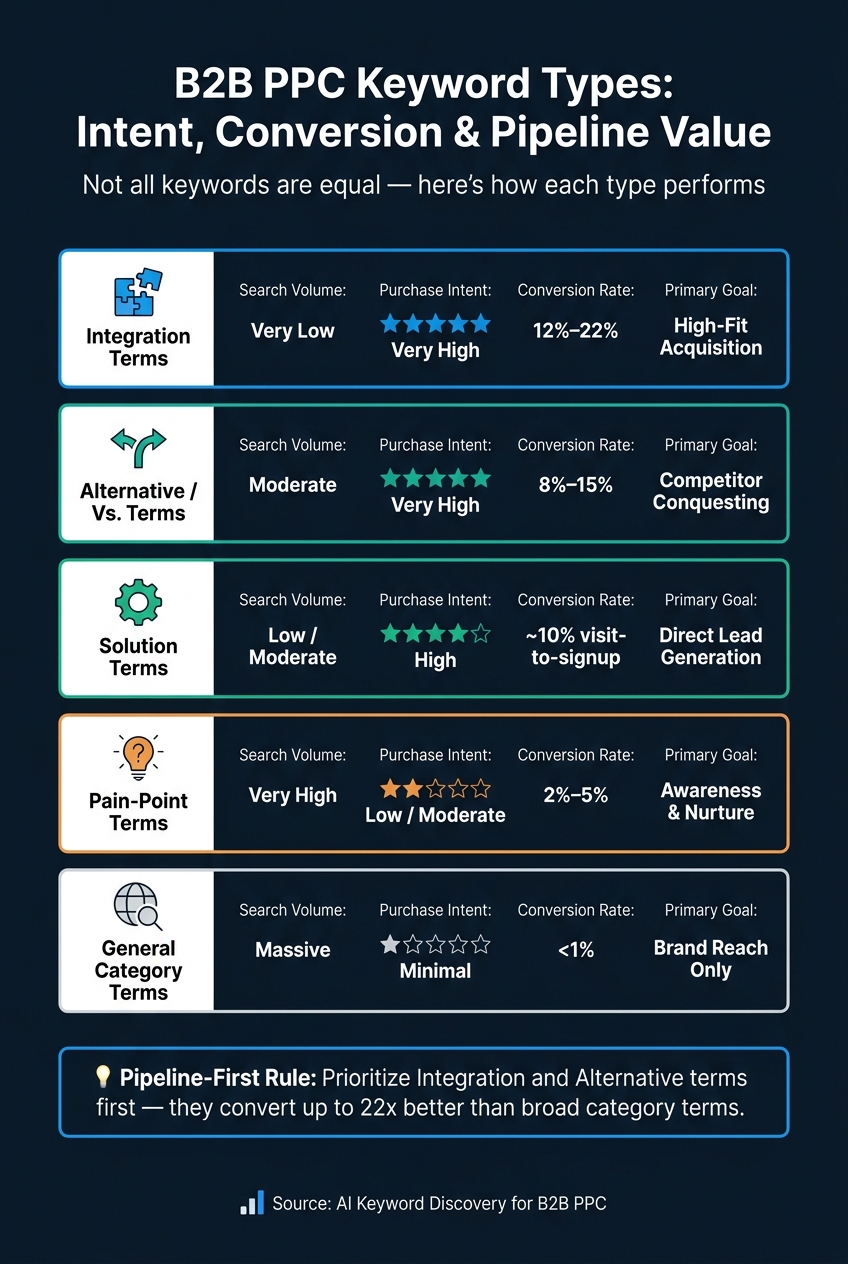
B2B PPC Keyword Types: Intent, Conversion & Pipeline Value
These tables help turn keyword discovery into a ranked shortlist.
Use the first table to pick the right tool for discovery, gap analysis, and bid planning. You can also use automation tools like Opteo to manage these bids once your keywords are live.
| Tool | Primary B2B PPC Strength | Key Feature for Gap Analysis |
|---|---|---|
| SpyFu | Historical ad data and competitor bidding behavior | Kombat Tool: Identifies shared and unique competitor keywords |
| Semrush | Paid and organic market analysis | Keyword Magic Tool: Finds related high-intent themes |
| Ahrefs | SEO/PPC overlap and content gap identification | Content Gap Report: Finds keywords competitors rank for that you do not |
| Google Keyword Planner | Budget planning and bid estimates | Top of Page Bid: Estimates cost to be competitive in B2B auctions |
After you pick a tool, the next step is simple: focus on the keyword types most likely to drive pipeline. Not every term deserves the same weight. Some bring in buyers who are close to a decision. Others just fill the top of the funnel.
| Keyword Category | Search Volume | Purchase Intent | Typical Conversion Rate | Primary Goal |
|---|---|---|---|---|
| Solution Terms | Low/Moderate | High | 10% visit-to-signup | Direct lead generation |
| Alternative/Vs. Terms | Moderate | Very High | 8%–15% | Competitor conquesting |
| Integration Terms | Very Low | Very High | 12%–22% | High-fit acquisition |
| Pain-Point Terms | Very High | Low/Moderate | 2%–5% | Awareness and nurture |
| General Category Terms | Massive | Minimal | <1% | Brand reach only |
Then score each term before launch based on buyer intent and sales value. This is where a lot of teams go off track. They chase volume, get traffic, and then wonder why nothing moves in the pipeline. A term can look good in a keyword tool and still be a poor bet for revenue.
| Pipeline Scoring Factor | What It Measures | Why It Trumps Standard Metrics |
|---|---|---|
| Sales Feedback | Frequency of a query in discovery calls | Direct signal of buyer pain |
| Business Value | Strategic fit with ICP and ACV | Prevents chasing vanity traffic that never closes |
| Commercial Intent | Proximity to a buying decision | Modifiers like "pricing" or "demo" signal readiness |
| Internal Asset Fit | Ability to provide unique proof or data | Shows whether you can support the page with proof |
Conclusion
AI is only as useful as the revenue signals behind it. Used the right way, these methods turn keyword discovery into a form of pipeline screening. But they only work when AI is steered by pipeline data - not raw search volume.
That shift matters because B2B search value shows up in revenue, not volume. In B2B PPC, pipeline contribution, CAC, and payback matter more than clicks.
B2B PPC wins come from better filtering, not bigger keyword lists. The teams that come out ahead tie ad spend to CRM data and score each keyword cluster against closed-won revenue - because AI keyword discovery works only when every query is judged by its path to revenue.
FAQs
How do I score keyword intent before launch?
Use a 5-factor intent-and-fit score to screen keywords:
- commercial intent
- SERP/difficulty fit
- volume relevance to your ICP
- internal asset fit
- sales feedback frequency
Cut keywords below 3.0.
Then sanity-check intent with live SERP reviews so you can confirm how Google reads the query. That step matters more than people think. A keyword may sound like it belongs in a buying campaign, but the results page often tells a different story.
Just as important, your ad and landing page need to line up with the buyer’s question. If someone searches for pricing, show pricing. If they want reviews, send them to proof. If they want an enterprise demo, give them a path to talk to sales.
Keep ad groups tight. Don’t lump pricing, reviews, and enterprise demo terms into the same ad group. Those are different buying motions, and mixing them usually hurts relevance.
Which AI signals best show ICP fit?
The strongest AI keyword signals for ICP fit are:
- Commercial/BOFU intent phrasing
- High conversion proximity, where the SERP leans toward commercial or comparison pages
- Sales feedback showing prospects use that exact phrase
- Strong downstream quality signals, like conversion to sales-accepted leads, not just CTR
It also helps to prioritize solution terms linked to upstream or downstream stack components. Then sanity-check intent against the live SERP, because keyword labels alone can miss the mark.
When should I exclude a keyword from PPC?
Skip a keyword when the likely return doesn’t justify the cost - especially if competitors are bidding hard on it.
You should also pass on terms when the search results are packed with irrelevant content, when they mostly drive vanity metrics or micro-conversions instead of pipeline or sales, or when they don’t match your product or service.