Most PPC waste starts with one problem: the search, the ad, and the landing page do not match. If I map keywords by intent first, I can spend less on low-buying traffic, bid more on high-intent searches, and judge results by conversions - not clicks.
Here’s the short version:
- Informational searches like “how to measure carbon footprint” need low bids and education-first pages.
- Commercial searches like “best [product]” need comparison-focused ads and pages.
- Transactional searches like “buy [product]” need direct CTAs, pricing, and offer pages.
- In some markets, a single click can cost up to $180 - so a few bad clicks can burn through a $1,000/month budget fast.
- I should use search terms, audience signals, CPA, conversion rate, lead quality, and pipeline contribution to decide where budget goes.
The point is simple: PPC ROI tends to improve when each intent group gets its own message, page, and bid level. That gives me a cleaner path from query to conversion and helps cut spend on traffic that is not ready to act.
Targeting Google Ads Keywords - Surfside PPC Podcast Episode 16 (Video)
sbb-itb-89b8f36
Build intent groups before changing bids
PPC Intent Mapping: Match Keywords to Funnel Stage for Higher ROI
Start by grouping search terms by intent. Then layer in audience signals - remarketing, customer lists, and in-market segments - so you can tell researchers from buyers with more confidence. Search terms matter, but behavior fills in the gaps. That gives you a cleaner read on intent than keywords alone.
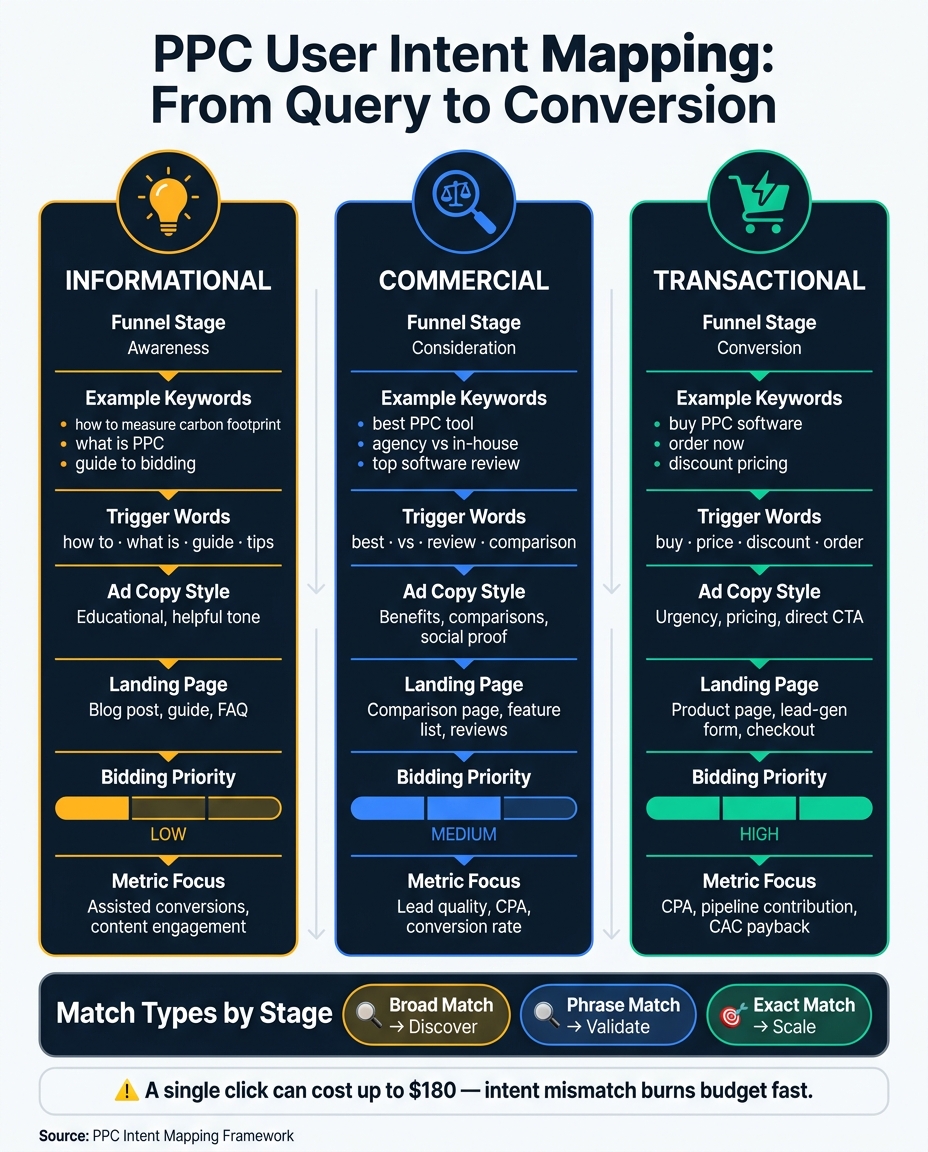
Informational, commercial, and transactional queries
Query wording is one of the clearest signs of intent.
- Informational queries use terms like "how to", "what is", "guide", or "tips."
- Commercial queries use terms like "best", "vs", "review", or "comparison."
- Transactional queries use terms like "buy", "price", "discount", or "order."
When you mix these intents together, it gets hard to see which segment should get higher bids.
Map each group to a funnel stage
Map each intent group to a funnel stage, then set bids from that stage.
Informational intent sits at awareness. These users usually aren't close to converting, so PPC spend should stay limited here. Commercial intent fits the consideration stage. People in this group are weighing options, which makes them strong PPC targets when you want to shape the decision. Transactional intent is where conversion happens. These queries can support premium bids.
Longer B2B cycles can support more spend on informational and commercial terms for nurture.
Comparison table: intent group to campaign treatment
Use the stage mapping to decide how much to bid for each intent group.
| Intent Group | Funnel Stage | Ad Copy Angle | Landing Page Match | Bidding Priority |
|---|---|---|---|---|
| Informational | Awareness | Educational, "how-to" | Blog post, guide, FAQ | Low |
| Commercial | Consideration | Benefits, comparisons, social proof | Comparison page, feature list, reviews | Medium |
| Transactional | Conversion | Urgency, pricing, direct CTA | Product page, lead-gen form, checkout | High |
For match types, use broad match to discover, phrase match to validate, and exact match to scale. Keep discovery-focused campaigns separate from efficiency-focused campaigns so each intent group can be tested and scaled on its own terms.
Once the groups are set, follow a PPC campaign optimization checklist to line up the ad message and landing page with the same intent.
Match ad copy and landing pages to intent
Match the ad and landing page to the same intent. The search term, the ad promise, and the landing page should all point in the same direction.
Ad copy that reflects user goals
Write ad copy based on what the user is trying to do. Use educational copy for informational intent, proof-led copy for commercial intent, and direct CTA copy for transactional intent.
You also need guardrails. Use negatives and tighter match types to keep mixed-intent clicks out of efficiency campaigns.
That same intent match should continue after the click. If the ad sets one expectation and the page delivers something else, performance usually slips.
Landing pages that cut friction by stage
The post-click page matters just as much as the ad. When the page doesn't match the search term, it adds friction - and friction kills conversions.
A simple way to think about it:
- Send awareness traffic to educational pages
- Send consideration traffic to comparison pages
- Send conversion traffic to a focused offer page
For conversion pages, remove any element that does not help the conversion.
Once the post-click path is aligned, budget moves should follow conversion data. For complex accounts, top PPC agencies can help manage these granular optimizations.
Shift spend using conversion data, not click volume
Once search terms, audiences, and landing pages line up, conversion data tells you where intent mapping is working. At that point, the job changes: stop looking at clicks as the main signal and start using conversion data to decide where to scale.
Read search-term and audience data for budget moves
Review each intent segment based on conversion rate, CPA, lead quality, and pipeline contribution. If a transactional segment has a low CPA and a strong conversion rate, it should get more budget. If an informational segment brings in clicks but little pipeline value, it should get less spend - and content that fits its educational role.
Move budget at the segment level, not with a broad brush. Some informational queries help later in the funnel, so judge them by assisted value, not clicks alone.
"Your optimization efforts will fail if you do not understand user search intent's 'what' and 'why.'"
Measure ROI by intent segment
Measure ROI by intent bucket using conversion rate, CPA, lead quality, and pipeline contribution. Tie paid spend to pipeline and CAC payback, not click volume.
A resource for tool and agency selection
If you need tools or partners for this analysis, Top PPC Marketing Directory is a useful resource for PPC tools and agencies focused on campaign performance, CAC efficiency, and pipeline-driven ROI.
Conclusion: intent alignment is the lever that improves PPC ROI
Once you tie budget decisions to conversion data, intent alignment becomes the last big lever for ROI. When search terms, audience signals, ads, and landing pages all point to the same goal, wasted spend drops and conversion quality goes up. That shows actual demand, not just traffic.
Key steps to put this into practice
Use top PPC tools to group queries into intent buckets, then map each one to the right funnel stage. That way, bids, ad copy, and landing pages match where the user is in the buying process. Use negative keywords to block mixed-intent traffic.
Then scale what converts. Use conversion rate, CPA, and pipeline contribution to shift spend toward the intent segments that bring in the best results.
When search terms, audience signals, and landing pages line up around the same intent, PPC gets more efficient and easier to scale. Keep iterating from conversion data until each intent segment earns its share of budget. That feedback loop turns intent mapping into a repeatable PPC system.
FAQs
How do I identify search intent from search terms?
Group keywords by the goal behind them: informational, navigational, commercial, or transactional.
Then check the SERPs to see what kind of pages show up. Are you seeing blog posts, product pages, category pages, comparison content, or homepages? That tells you a lot about what Google thinks searchers want.
It also helps to review search term reports for patterns in the words people actually use. Sometimes the difference between “best,” “buy,” “pricing,” or “how to” says almost everything about intent.
Tools like Google Keyword Planner, SEMrush, Ahrefs, and SpyFu can help here too. They show search trends, competition, and bid signals that may point to transactional intent.
When should I bid on informational keywords?
Bid on informational keywords when your goal is brand awareness at the top of the funnel. Searches like "how to", "what is", or "guide to" usually come from people who are still doing research - not people ready to buy.
Start with lower bids and test performance before you put more budget behind them. Keep the ad copy educational, use non-transactional CTAs like "learn more," and judge results based more on impressions and click-through rate than conversions.
What metrics matter most by intent group?
Match your metrics to the funnel stage.
For awareness campaigns, focus on impressions, click-through rate, and engagement. At this stage, the goal is reach and attention.
For consideration campaigns, track micro-conversions such as content downloads or demo sign-ups. These actions show that people are moving past interest and into evaluation.
For conversion campaigns, zero in on conversion rate, CPA, and ROAS. These are the numbers that show whether the campaign is turning intent into revenue.
Across all intent groups, keep an eye on Quality Score. It helps maintain ad relevance and, in most cases, lowers costs while improving placements.