If I want tighter CAC on YouTube, I’d start with skippable in-stream, in-feed, and strict remarketing - then add Shorts only after I see stable conversion data.
Here’s the short version:
- Best CAC control: skippable in-stream and in-feed
- Harder to keep efficient: Shorts and outstream
- Best setup for $3,000-$10,000/month: 1 in-stream campaign + 1 remarketing campaign
- What I’d track: branded search lift, direct traffic, assisted conversions, and pipeline - not just views or last-click ROAS
- Main risk: mixed-format campaigns that push spend into low-intent inventory
YouTube can help cut blended CAC when it creates demand first and that demand shows up later in Search. So format choice is not just a media decision. It affects payback, lead quality, and where budget leaks.
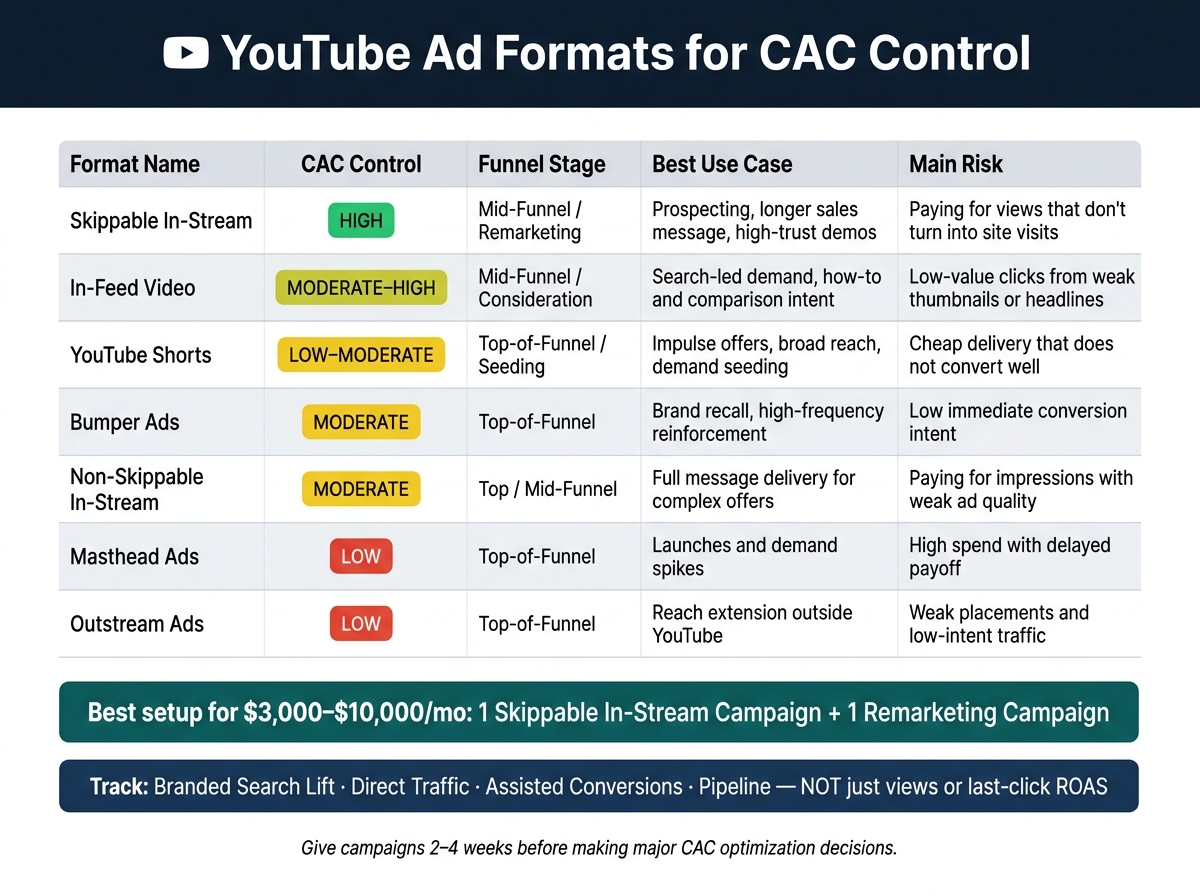
YouTube Ad Formats for CAC Control: Quick Comparison Guide
[Tutorial] Youtube Ad Formats for 2026
sbb-itb-89b8f36
Quick comparison
| Format | CAC control | Best use | Main risk |
|---|---|---|---|
| Skippable in-stream | High | Prospecting, remarketing, longer sales message | Paying for views that do not turn into site visits |
| In-feed video | Moderate to high | Search-led and self-selected demand | Low-value clicks from weak thumbnails or headlines |
| YouTube Shorts | Low to moderate | Reach, impulse offers, demand seeding | Cheap delivery that does not convert well |
| Bumper ads | Moderate | Recall and repetition | Low immediate conversion intent |
| Non-skippable in-stream | Moderate | Full message delivery | Paying for impressions with weak ad quality |
| Masthead ads | Low | Launches and demand spikes | High spend with delayed payoff |
| Outstream ads | Low | Reach outside YouTube | Weak placements and low-intent traffic |
If I had to reduce the whole article to one rule, it would be this: keep formats separated, match each one to funnel stage, and give YouTube 2-4 weeks before making big CAC calls.
How YouTube Ad Formats Affect CAC
Each YouTube format changes three things: how you pay, where the ad shows up, and how much intent the format tends to catch. Those differences shape CAC.
How Billing Models Shape CAC Risk
The billing model sets the kind of CAC risk you take on. CPM buys reach. CPV buys views. CPC buys clicks. Conversion-based bidding such as tCPA and tROAS buys outcomes. Simple enough. But each one comes with a different risk profile based on where the campaign sits in the funnel.
| Funnel Stage | Billing Model / Format | Primary CAC Risk |
|---|---|---|
| Awareness | CPM (Video Reach Campaigns / Bumpers) | High reach but low immediate conversion; risk of low-intent placements |
| Consideration | CPV (In-stream) | Paying for views that don't lead to site visits if the hook is weak |
| Conversion | tCPA / tROAS (Remarketing) | Budget dilution if optimized targeting expands beyond high-intent users |
Without placement controls, Google’s system tends to optimize for delivery, not CAC. That means budget can drift into low-intent inventory. And that risk shifts based on format.
Why Intent and Placement Quality Matter
Not all YouTube views mean the same thing. Someone who chose to watch long-form content is in a very different mindset from someone swiping through Shorts.
In-stream placements hold active attention better. That makes them a stronger fit for problem-solution storytelling, product education, and social proof. Shorts work on swipe behavior. They usually fit awareness plays or offers that can win on impulse.
That’s why it often makes sense to split Shorts and in-stream into separate campaigns instead of putting them into one shared budget. If you blend them together, it gets much harder to see what’s driving CAC and where spend is leaking.
Intent-based targeting pushes this further. When you build YouTube audiences from high-intent search terms pulled straight from your existing Google Search campaigns using top PPC tools, YouTube starts acting less like an interest play and more like an intent-linked channel. That approach drives a 100% higher lift in purchase intent compared to demographic targeting alone. So format separation is not just cleaner account structure. It helps control CAC.
How Measurement Changes the CAC Picture
Last-click attribution usually undercounts YouTube. If you only look at direct conversions, you’ll miss part of the impact.
Track branded search lift and direct traffic alongside conversion data. Also, give campaigns 2 to 4 weeks before making big optimization decisions. Video attribution can swing a lot from day to day.
These CAC effects show up in different ways across formats, starting with skippable in-stream ads.
1. Skippable In-Stream Ads
Skippable in-stream ads are one of the best YouTube formats for CAC control. The reason is pretty simple: they give you reach, attention, and intent in one format.
They fit prospecting when your offer needs more explanation, proof, or a longer story. They also work well for remarketing, especially when you're going after intent-adjacent audiences that recently searched high-int terms on Google. The CAC edge starts with cost-per-view (CPV) pricing and stronger viewer attention.
With this billing model, you pay when someone watches 30 seconds, finishes a shorter ad, or interacts.
For tighter CAC control, keep skippable in-stream in its own campaign. That keeps reporting clean and avoids mixing spend with Shorts. In remarketing, manually switch off optimized targeting so delivery stays focused on your high-int first-party audience.
For U.S. planning, top PPC agencies suggest teams should expect at least $3,000 per month for local-intent campaigns and around $10,000 per month for e-commerce prospecting.
Next: In-Feed, which reaches users who choose the video themselves.
2. In-Feed Video Ads
If skippable in-stream earns attention, in-feed reaches people who are already looking. These ads show up on YouTube's homepage, in search results, and in the Watch Next feed. People have to click to watch, which makes this format a strong fit for high-intent traffic. Put simply, in-feed can help control CAC because users self-select before they click.
In-feed works best for consideration and intent. It tends to perform well when the viewer already has some level of demand. That's why it's often a good fit for products or services that need a bit more context before someone is ready to convert.
Pricing is usually based on clicks or views. CPCs are often under $1.00, and views commonly fall in the $0.03-$0.30 range, depending on targeting and competition. When you're trying to control CAC, the biggest lever is the creative. The thumbnail and headline need to make the value proposition clear so only qualified users click.
A few practical moves matter here:
- Use search-term themes to qualify clicks.
- Keep in-feed campaigns separate from in-stream and Shorts so you can isolate CAC.
- Cut spend on low-value clicks by keeping format-level performance clean.
For budget planning, a practical starting point is about $3,000 per month for localized or niche service targeting using top PPC marketing tools, or $10,000 per month for broader prospecting. And don't judge this format on last-click ROAS alone. Track branded search lift and direct traffic too.
Next: Shorts, which trades intent for scale and speed.
3. YouTube Shorts Ads
Shorts is swipe-first inventory with high churn. In plain English, people move fast. That makes Shorts a reach-first format, not a direct-response channel.
It tends to fit:
- broad-appeal products
- impulse-friendly offers
- brand seeding
A good way to think about it: Shorts can plant the idea, and Search can pick up demand later.
Run Shorts in a dedicated Demand Gen campaign so you can isolate spend, reporting, and optimization with smart recommendations. That separation matters. If Shorts sits inside a mixed campaign, delivery often drifts toward the cheapest inventory. When that happens, the system is optimizing for low-cost delivery - not CAC.
Creative is what separates efficient reach from wasted impressions. Three rules matter here:
- Hook in the first second.
- Use captions for silent viewing.
- Use a 2x2 hooks-by-offers test in vertical format.
Refresh creative every week. If frequency is going up while engagement is dropping, that's a clear fatigue signal.
Don’t judge Shorts on last-click ROAS alone. Watch branded search lift and assisted traffic too. If your goal is recall-first reach, Bumper Ads are the next format.
4. Bumper Ads
After Shorts, bumper ads play the same reach-first job, just in a tighter format. They’re 6-second, non-skippable clips that run before, during, or after YouTube videos. Use them for top-of-funnel reach and demand seeding - not direct acquisition. The goal is simple: seed recall.
Keep the ad mobile-first. In six seconds, you don’t have room to wander. Stick to one idea, one proof point, and one CTA. Start with something people recognize fast - a pain point, a result, a product demo snippet, or a social proof moment. Then end with a clear CTA.
On cost, bumpers sit in the lowest-cost tier for Google Video ads, with average cost per view between $0.03 and $0.30. That cheap reach can look good on paper. But low cost does not mean efficient CAC. Run bumpers in their own campaign so your CAC read stays clean.
Plan on $3,000-$10,000 per month if you want a test that means anything. Go below that, and short test windows can skew what you’re seeing. Watch branded search lift, direct traffic, and assisted conversions over a 2-4 week read window.
If you need more attention and more room to explain the offer in each impression, move next to non-skippable in-stream.
5. Non-Skippable In-Stream Ads
After skippable and bumper placements, non-skippable buys give you guaranteed exposure when the message has to be seen in full. These ads can run for up to 20 seconds before, during, or after a video, and viewers can't skip them. That gives you time to explain a more complex offer in a way swipe-based formats just can't handle.
This format tends to fit best at the awareness stage and in mid-funnel consideration, especially when the offer needs a bit of setup before it clicks. It makes sense for startups, trust-heavy services, and offers that take more than a few seconds to explain.
Billing is impression-based, so the big variable is creative quality, not completion rate. You don't face the same waste from skipped views, but weak creative can still burn budget and hurt brand perception. In plain terms, creative is the main CAC lever here.
Keep non-skippable ads in a separate campaign from Shorts and skippable inventory. If you don't, spend can drift into cheaper placements and blur your CAC read. Measure this format on incremental lift - not on skipped-view economics.
For maximum reach when budget efficiency is less of a concern, use Masthead next.
6. Masthead Ads
Masthead ads sit at the top of YouTube Home and give you maximum visibility. That makes them a demand-spike lever, not an everyday performance buy. Use them for launches, category pushes, or other moments when reach matters more than efficiency. Masthead is the widest-reach option in this set, so it fits best in controlled bursts - not in always-on CAC optimization.
Masthead CAC tends to show up after the impression. These ads rarely drive direct conversion on the spot. Their value usually appears in branded search lift, direct traffic, and assisted conversions. Before launch, get your pages ready for branded queries so the awareness you pay for has somewhere useful to go. Then measure results over 2 to 4 weeks using branded search lift, direct traffic, and assisted conversions.
Don’t judge Masthead on last-click ROAS alone. Give it a 2 to 4 week read window before you decide.
Next, compare each format against U.S. performance benchmarks.
7. Outstream Ads
Outstream helps you reach people outside YouTube. Instead of showing on YouTube itself, these ads appear on mobile apps and sites across Google's 2M+ app-and-site video partners network.
That matters for one reason: this is a low-intent, top-of-funnel format. People usually aren't looking for you in that moment. You're putting your brand in front of new audiences, then letting Search or remarketing pick up that intent later.
Because of that, placement quality matters more than audience size. Cheap reach can look good on paper and still hurt CAC.
Average CPC is often under $1.00, and CPV usually lands between $0.03 and $0.30. But low CPC doesn't solve weak inventory. If the placement is bad, the traffic is bad.
The main CAC risk here is budget drift. If you mix outstream with other formats, delivery can slide toward the cheapest placements. That can push CPV down while pushing CAC up. Keep outstream in its own campaign. Then review placements every week and exclude low-quality apps or sites.
Sound is often off in these placements, so the ad has to work without audio. If the visual doesn't stop the scroll, you lose the impression.
And don't judge outstream by last-click ROAS. That's the wrong lens. Better signals include:
- Branded search lift
- Direct traffic trends
- Assisted conversions in GA4
Use a 2-4 week read window, and track branded query lift in Search. That's the cleaner way to compare outstream against the benchmark ranges below.
Format-by-Format Benchmarks for U.S. Performance Teams
Each format in this article comes with a different mix of cost, control, and test speed. This table makes those tradeoffs easier to compare, with a focus on budget, pacing, and pipeline fit.
| Format | Pricing / Bid Model | Placements | Funnel Stage | Spend Level | Testing Speed | CAC Predictability | Best Use Case |
|---|---|---|---|---|---|---|---|
| Skippable In-Stream | CPV / CPM / tCPA | Pre/mid-roll, long-form | Mid-funnel / Bottom / Remarketing | Moderate | Moderate | High | High-trust demos, B2B lead gen, story-driven proof |
| In-Feed Video | CPV / CPM | Search results, Home feed, Watch next | Mid-funnel | Low to Moderate | Slow | Moderate | How-to and comparison intent, content discovery |
| YouTube Shorts | CPM / tCPA | Shorts Feed (vertical) | Top-of-funnel / Seeding | Moderate | Very Fast | Volatile | Impulse-friendly offers, UGC-style demos, broad seeding |
| Bumper Ads | CPM | In-stream (6s) | Top-of-funnel | Low | Fast | Moderate | High-frequency brand reinforcement, message repetition |
| Non-Skippable In-Stream | CPM | In-stream (15s) | Top-of-funnel / Mid-funnel | Moderate | Moderate | Moderate | Forced message delivery for key value props |
| Masthead Ads | CPD / CPM | YouTube Home Feed | Top-of-funnel | Enterprise | Instant | Low | Large product launches, seasonal peaks |
| Outstream Ads | CPM | Mobile web / partner apps | Top-of-funnel | Low | Slow | Low | Reach extension beyond YouTube, branded lift seeding |
Two patterns stand out.
- Skippable in-stream and in-feed are the easiest formats to control.
- Shorts and outstream are the hardest to stabilize.
That matters when you're judging early performance. In-feed, for example, takes longer to build enough data to read with confidence. So if you change budgets too early, you can end up reacting to noise instead of signal.
For U.S. mid-market teams, $3,000 to $10,000 per month is a practical starting range. Use that range as a baseline when you set the budget mix in the next section.
How to Match Formats to Funnel Stage and Budget
Use your budget to decide how many formats you can run without starving each one of data. That’s the key idea here. Format choice matters most when it lines up with the amount of conversion data your spend can produce.
With smaller budgets, spreading spend across too many formats usually backfires. Each campaign gets too little volume, learning slows down, and CAC tends to go up.
The practical rule is simple: fewer formats at lower spend. Add more coverage only after each campaign has enough volume to give you a clear read.
Best Format Mix for Smaller Monthly Budgets
In the $3,000-$10,000/month range, a tighter setup usually works best: one skippable in-stream prospecting campaign and one remarketing campaign for site visitors. Build audiences from high-performing search terms. Keep optimized targeting off on the remarketing side.
This setup does two things well. It gives you a clean prospecting lane, and it keeps remarketing tight enough to avoid waste.
When Broader Format Mix Makes Sense
Once you’re above $10,000/month, add Shorts only after in-stream and remarketing are stable. At that point, a three-campaign structure often works well: Shorts prospecting, in-stream prospecting, and strict remarketing - each in its own campaign. Keep each format in its own campaign.
That separation matters. If you mix formats in one campaign, it gets harder to see what’s working and where CAC starts to drift.
Sample Budget Splits by Funnel Stage
The split below keeps intent, reach, and remarketing in the right order as spend scales.
| Budget Level | Recommended Split | Audience Focus |
|---|---|---|
| Small ($3,000/mo) | 70% In-stream, 30% Remarketing | Intent-based search audiences + first-party lists |
| Mid-market ($10,000/mo) | 40% Shorts, 40% In-stream, 20% Remarketing | Intent signals + controlled audience expansion |
| CAC pressure | Shift toward in-stream + strict remarketing | Exclude low-performing placements; turn off optimized targeting |
Once the mix is set, creative and placement controls have a big impact on whether CAC stays in line or starts creeping up.
If CAC starts rising, look first at placement hygiene and creative fatigue. If branded search demand goes up but conversions don’t, fix landing-page friction first.
Creative and Testing Guidelines for Better CAC Control
Creative and testing choices decide whether each format lowers CAC or burns budget. With smaller budgets, you need fewer moving parts, cleaner tests, and more time before making calls.
Creative Rules by Format
Each format has its own viewing context, and the table below sums up the main creative specs.
| Format | Aspect Ratio | Ideal Length | Hook Timing | CTA Style |
|---|---|---|---|---|
| YouTube Shorts | Vertical (9:16) | < 60s (best < 6s) | First 1 second | Fast, direct, captioned |
| In-Stream | Horizontal (16:9) | No hard max (best 30-90s) | First 5 seconds | Problem-solution, human-centric |
| Bumper Ads | Horizontal/Vertical | 6 seconds | Immediate | Single brand message |
| In-Feed | Thumbnail-based | Varies | Thumbnail is the hook | "Watch Now" / Discovery |
Shorts run on swipe behavior. That means the hook needs to hit in the first second. Baked-in captions matter too, since many mobile viewers watch with the sound off. Keep each video to one idea. Then show proof fast - a demo, a use case, or a concrete result.
In-stream gives you a little more room. You have a few seconds to show a clear problem before you ask someone to listen to your pitch.
Testing Cadence and Decision Windows
Use the budget band to set how many creative variables you test at one time. A simple setup works best: 8 assets total, built from 2 hooks x 2 offers x 2 formats across Shorts and in-stream. Then refresh one variable each week.
Set a 2-4 week minimum window before making any major optimization calls. Early on, pay more attention to engagement, CTR, and landing-page conversion than last-click ROAS. It helps to write decision rules before launch. Decide what will trigger a change, and just as important, what noise you'll ignore during the learning window.
What to Measure Beyond Media Efficiency
CPV tells you what traffic costs. It doesn't tell you much about quality.
For tighter CAC control, look at branded search lift, direct traffic trends, and assisted conversions so you can see YouTube's part earlier in the buyer journey.
For B2B and service teams, keep an eye on:
- Form quality
- Spam rate
- Geo fit
- Pipeline contribution
- Payback period
Low CPV means very little if the leads are bad.
If in-house testing starts to drag, outside support can help move creative testing faster and tighten placement control.
Tools and Partners That Can Improve YouTube CAC Efficiency
When Outside Support Is Worth the Cost
Once your structure, creative, and measurement are set, outside help can make it easier to keep execution on track. It tends to pay off when CAC starts drifting because attribution is weak, creative output is too slow, or placement control is loose. If you can't connect placements to pipeline, you're still making decisions with only part of the picture.
Placement exclusions can cut wasted spend in a meaningful way and save your team from constant manual cleanup. The goal with outside help isn't to rehash what exclusions are. It's to make sure someone is actually managing them on a steady cadence.
Creative output is the other common bottleneck. YouTube tends to perform better when teams keep shipping format-specific assets for Shorts and in-stream. If your internal team can't match the testing pace set earlier, outside creative support can help you keep iterating without losing momentum.
Where to Find CAC-Focused PPC Support
If your team needs that kind of help, a curated directory can narrow the field fast. For CAC-focused PPC support, the Top PPC Marketing Directory is a practical place to find tools and agencies built around pipeline and payback, not clicks.
Conclusion
Across these seven formats, CAC control comes down to matching intent, placement, and budget to the right buying stage. The best format depends on three things: how much intent your audience has, where they are in the buying cycle, and whether your ad fits the placement. Cheap reach can still push CAC up.
The main rule is simple: track branded search, direct traffic, and pipeline - not just views, clicks, or CPM. If those signals are moving the right way, the format is working, even if last-click attribution hasn’t picked it up yet. If those numbers stay flat, the problem is often the ad itself, the placement mix, or the landing page experience.
The job is to give each format a clear role in the funnel. Pick the format that fits the job, then judge it by branded demand, direct traffic, and pipeline.
FAQs
Which YouTube ad format should I start with for lower CAC?
Start with Demand Gen campaigns. They give you more control over audience targeting and placements, which can help lower CAC.
Build audiences using high-intent search terms and first-party data. Then split budget by placement - like Shorts and in-stream - so spend stays focused on the inventory that performs best. Match the creative to each format to keep performance efficient.
How long should I wait before judging YouTube CAC performance?
Give YouTube CAC 3 to 6 weeks before you judge it.
That window matters because these campaigns need time to learn. Performance Max often settles in 2 to 3 weeks. Demand Gen usually takes longer - about 3 to 6 weeks - because it has to learn from both creative and audience signals.
During that stretch, avoid big changes. If you keep tweaking budgets, targeting, or ads, you can reset the learning phase and muddy the read on performance.
For A/B tests, let the test run for 3 to 4 weeks. And don't act on early noise - wait for 95% statistical confidence before making a call.
What metrics matter most if last-click ROAS misses YouTube impact?
If last-click ROAS misses YouTube’s impact, look at the metrics that show how YouTube builds demand that converts later. The main ones are branded search trends, direct traffic trends, assisted conversions, and changes in new vs. returning visitors on landing pages.
If you want a stronger read, use incrementality testing. It helps confirm actual lift instead of leaning on correlation alone.