If I need fast reach, I’d lean contextual. If I need conversions from warm traffic, I’d lean audience. That’s the core difference.
Here’s the short version: contextual targeting matches ads to the page, while audience targeting matches ads to the person. Contextual is often a better fit for awareness, brand safety, and privacy limits. Audience is often a better fit for remarketing, lead gen, and bottom-funnel campaigns. The article also points out two data points worth noting, which can be analyzed using top PPC tools: 49% of U.S. advertisers use contextual targeting, and some advertisers may lose up to 30% of conversion data as third-party cookies fade.
If I were boiling the article down for a fast read, I’d keep it to this:
- Use contextual when I want to appear next to related content
- Use audience when I want to reach people based on behavior or CRM data
- Use contextual for cold traffic and safer placements
- Use audience for warm traffic and higher purchase intent
- Use both when I want reach at the top of the funnel and follow-up at the bottom
Quick Comparison
| Criteria | Contextual Targeting | Audience Targeting |
|---|---|---|
| Main focus | The page | The user |
| Best for | Awareness, prospecting, brand safety | Retargeting, lead gen, conversions |
| Data need | Page/topic signals | User signals, first-party data, lists |
| Privacy fit | Higher | Lower |
| Reach limit | Available content inventory | Audience size and signal quality |
| Cost pattern | Often lower for reach | Often higher for precision |
| Control | Where ads appear | Who sees ads |
Put simply: contextual says "show up in the right conversation." Audience says "show up for the right user." For most PPC accounts, I’d treat this as a both-and choice, not an either-or one.
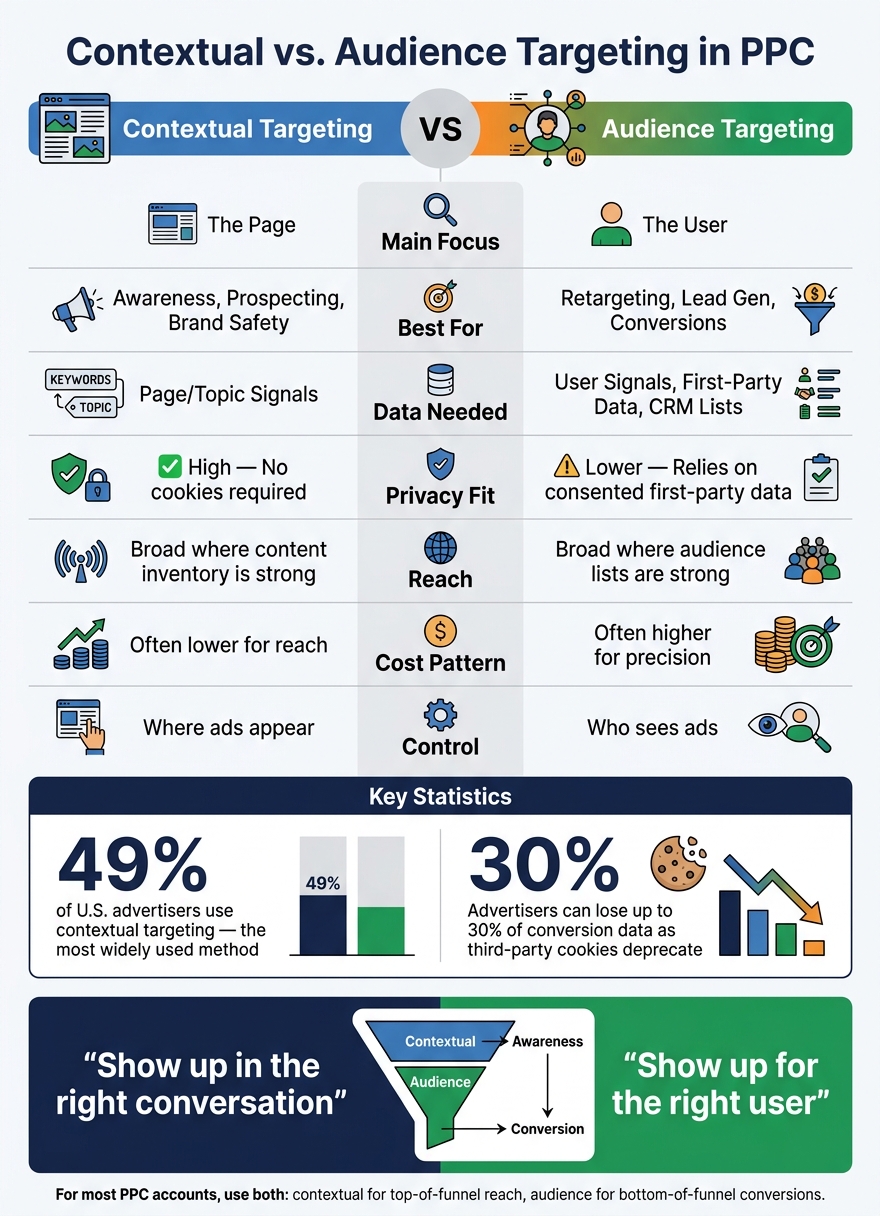
Contextual vs Audience Targeting: PPC Comparison Chart
How contextual targeting works for search and display advertisers
Contextual targeting matches ads to the content on a page. In search, that means keywords line up with query intent. In display, ads appear on placements that fit the topic. The system scans a webpage's text, metadata, keywords, phrases, alt text, and site taxonomy to decide if that page is a fit for your ad. Put simply, contextual works best when content relevance matters more than user history.
And it goes past simple keyword matching. Modern contextual systems use machine learning to read sentiment, tone, and nearby terms. So a travel ad can be kept off a crash story even if the page still mentions flights.
Best use cases: awareness, prospecting, and brand-safe placements
Contextual targeting is a strong fit for reaching people who are already reading or watching content tied to your category, but who haven't shown clear purchase intent yet. That's why it tends to work best at the top of the funnel.
Brand safety is one of the biggest reasons advertisers use it. You can control the types of pages where your ads appear. More top PPC agencies add sentiment analysis on top of topic matching, which helps screen out negative or sensitive editorial contexts at scale.
Scale, control, and privacy trade-offs
Reach depends on how much matching content exists across the web. Broad categories like sports, news, and weather offer a lot of inventory. Niche verticals with a small content footprint have tighter reach because fewer pages meet the targeting rules.
It also does not rely on third-party cookies or individual identifiers, so it fits privacy-restricted settings and browser limits. That matters more now than it did a few years ago. Contextual targeting is also widely used: 49% of U.S. advertisers use it, making it the most widely used targeting method in the country.
The trade-off is control. Contextual gives you control at the placement and topic level, not at the user level. You can choose content categories, topics, or specific placements, but you can't add user-history or purchase-data signals.
Typical cost patterns and campaign fit
Contextual display usually costs less than high-intent search. Advertisers can use automated optimization platforms to manage these cost fluctuations across different campaign types. But narrow verticals can cost more because inventory is limited. If your goal is to stay in front of known users as they move through the funnel, audience targeting is often the better fit. Contextual buys the setting. Audience targeting buys the person.
sbb-itb-89b8f36
How audience targeting works for search and display advertisers
Audience targeting uses user signals in both Search and Display. But the job it does in each channel is different.
In Search, it sits on top of keyword intent. Someone already searched for something, and audience data helps you narrow who should see the ad. In plain English, Search audience targeting helps you sharpen intent that already exists.
In Display, the starting point is different. Instead of waiting for a search, Display uses browsing behavior, purchase activity, and CRM data to reach people or bring back past visitors. So while Search tightens the shot, Display is often about expanding reach or re-engaging people who already know you.
That difference matters most when you look at reach, control, privacy, and cost.
Best use cases: retargeting, lead generation, and high-intent segments
Audience targeting works best when you have strong first-party signals, like purchase history, products viewed, or specific actions on your site.
The most common use cases are pretty straightforward:
- Remarketing to past visitors
- Reaching users who got to a sign-up page but didn’t convert
- Running Customer Match campaigns with CRM lists
For colder audiences, hard-sell offers often fall flat. Lower-friction offers, like guides or ebooks, tend to do better because they ask for less up front.
Scale, signal quality, and privacy limits
Scale comes down to two things: the quality of your first-party data and the size of the audience available on the platform.
Signal quality can drop fast when lists are small, site traffic is light, or targeting still leans on third-party cookies. Advertisers that still depend on browser-based pixels are estimated to lose up to 30% of their conversion data because of third-party cookie deprecation. That’s a big hit.
This is why consented first-party data is now the baseline, not just a nice extra. Clean lists, proper consent records, and regular uploads give ad platforms better data to learn from.
Server-side tagging can help too. It sends conversion signals from your server straight to the ad platform, which cuts reliance on browser-based tracking.
Typical cost patterns and campaign fit
Display audience campaigns usually come with lower CPCs and CPAs than Search. Search, though, often converts at a higher rate because the intent is immediate.
That’s the trade-off. Display can often buy you cheaper traffic or cheaper conversions, while Search tends to win when someone is ready to act now.
Because of that, audience targeting is a strong fit for retargeting, lead generation, and other conversion-focused campaigns where better first-party signals can improve efficiency over time. Those trade-offs stand out even more in the side-by-side comparison below.
Contextual vs audience targeting: side-by-side PPC comparison
The main question is simple: do you need to reach the right page, or the right person? For U.S. search and display advertisers, that choice shapes reach, cost, privacy exposure, and conversion potential.
| Factor | Contextual Targeting | Audience Targeting |
|---|---|---|
| Best fit | Cold prospecting and brand-safe placements | Warm retargeting and conversions |
| Privacy resilience | High - does not depend on user-level identifiers | Lower - depends more on consented first-party data and platform tracking |
| Reach | Broad where content inventory is strong; limited in niche segments | Broad where audience inventory is strong; limited by small lists |
| Cost efficiency | Often cheaper for reach; often pricier for precision, but can convert better on warm segments | Often higher for precise segments, but stronger conversion rates on warm audiences |
| Control | Over the content environment | Over the user profile |
Use cases, reach, and campaign goals
Contextual targeting makes sense when the goal is broad awareness or top-of-funnel prospecting. It can work especially well for niche products, where the surrounding content helps qualify intent before the click.
Audience targeting works best when you already have warm signals. Retargeting past visitors or reaching people who viewed sign-up or product pages are good examples. In those cases, user-level signals can lead to stronger conversion performance.
Control, brand safety, privacy, and cost efficiency
Contextual targeting gives you control over the environment, not the individual. Newer Google Ads automation tools can look at topic, sentiment, imagery, and video context to help avoid unsafe placements.
Audience targeting flips that. You control who sees the ad, not where it appears. That added precision can improve conversion efficiency, but it often comes with trade-offs in media spend and privacy durability, especially as third-party cookies become less reliable.
A simple way to think about it: contextual says, "show up in the right conversation." Audience says, "show up for the right user." Both can work. The better fit depends on what the campaign needs most.
When a hybrid setup outperforms either method alone
In many PPC accounts, the best setup uses both. Contextual prospecting can drive upper-funnel reach, while audience retargeting picks up people who already showed interest. That mix gives you scale at the top of the funnel and tighter conversion focus at the bottom.
That leads to the last piece: which setup lines up with your goal?
Conclusion: Choosing the right targeting method for your PPC goals
The simplest rule is to match the method to the job. The main choice comes down to awareness vs. conversion - page or person.
Contextual targeting fits awareness and prospecting. It places your ads in the right environment and does not depend on cookies or user-level tracking, which helps as browser limits tighten.
Audience targeting fits retargeting and conversion work. It uses past behavior to reach people who are more likely to be ready to buy.
Cost tends to follow the same logic. Contextual often works better when the goal is broad reach at a lower cost. Audience targeting often works better when the goal is converting warm segments with more precision. In plain terms, cost depends on what you want more: reach or precision.
In many accounts, the best setup uses both. Contextual prospecting builds awareness and warms up cold traffic. Audience retargeting then picks up the demand that comes next.
That ties back to the article's main frame: contextual says "show up in the right conversation," while audience says "show up for the right user." The right choice depends on what the campaign needs most.
FAQs
Which targeting method is better for small budgets?
For small budgets, contextual targeting is often the better bet. It puts your ads next to the content someone is viewing right now, so you can reach people based on current intent - without complex audience modeling or big remarketing programs.
Audience targeting can be more precise, but it usually takes deeper research and more testing to dial in the right segments. If your budget is tight, contextually relevant placements often give you a more direct path to people who are already interested.
How should I split spend between contextual and audience targeting?
Base your spend split on campaign goals and regular performance reviews. Use conversion tracking to spot your best-performing segments, then move budget to match. In some accounts, advertisers shift up to 40% of spend to those segments to improve ROAS.
Use search for transactional, high-intent traffic. Use display or audience targeting for awareness and for warming up cold leads.
When you test, change one variable at a time. That makes it much easier to see what’s driving the result. Then adjust bids anywhere from -50% to +100% based on your ROAS and CPA targets.
What first-party data do I need for audience targeting?
For effective audience targeting, use first-party data from your own sources, like website visitor data and customer lists.
That gives you a clear way to retarget high-intent users who already know your brand. It also helps you build privacy-safe, compliant campaigns based on their past actions, behavior, and likely needs.