If I need tighter CAC control, I treat Google Display and Search Partners very differently. Display usually gives me cheaper clicks but lower intent. Search Partners can add search volume, but they often trail core Google Search on CVR and CPA.
Here’s the short version:
- Display is usually best for reach, retargeting, and visual ads
- Search Partners can add extra search traffic, but quality is often lower than Google Search
- Cheap CPC does not equal low CAC
- I would judge both by CVR, CPA/CAC, and CRM quality
- For Display, I can cut waste at the placement level
- For Search Partners, I usually have to make a network-level call
If I’m auditing spend, I look for two things first:
- Display placements with spend above target CPA and zero conversions
- Search Partner CPA that is far above Google Search CPA
Quick Comparison
| Criteria | Google Display Placements | Search Partners |
|---|---|---|
| User intent | Lower - people are browsing | Medium - people are searching, but often with weaker intent than Google Search |
| Best use case | Awareness, retargeting, visual products | Extra reach when core Search is capped |
| CPC | Usually lowest | Usually lower than Google Search, higher than Display |
| CVR | Often lowest | Often below core Google Search |
| CAC risk | High if low-intent placements pile up | High if cheap clicks hide weak lead quality |
| Control | High - placement reports and exclusions | Lower - mostly on/off at network level |
| Main audit move using top PPC tools | Exclude bad placements | Compare partner CPA vs Google Search CPA |
My take is simple: Display is easier to clean up, and Search Partners are easier to misread. If I care most about closed-won revenue, I would not keep either one on just because CPC looks good.
sbb-itb-89b8f36
Google Display Placements: Reach, Control, and Quality Issues
Traffic and Lead Quality on Display
The Google Display Network spans more than 35 million websites and apps worldwide. That reach is the draw - and also the main risk.
At that kind of scale, cheap clicks can make performance look better than it is. You might see low CPCs and solid CTR, but the traffic often comes with weak intent and poor conversion later in the funnel. The bigger issue is low-grade traffic: mobile apps and thin sites can drive accidental clicks at scale.
Those accidental app clicks and weak-site clicks can inflate CTR, throw off Smart Bidding, and burn budget. If you're running direct-response lead gen or any campaign with tight CAC targets, broad Display placements usually don't line up with intent-based channels.
That's why Display often sits below Search Partners on lead quality, even when the CPC looks attractive.
How Display Affects CPC, CVR, and CAC
Display CPCs are usually lower than Search CPCs. On the surface, that can look good in a headline report. But low CPC does not mean low CAC.
Once CVR drops on passive inventory, the math changes fast. A cheap click that doesn't convert is still expensive.
The audit step here is simple: pull the placement report, sort by spend, and flag any placement that has spent more than 1.5x your target CPA with zero conversions. Those placements are pushing CAC up without adding pipeline. Using an audit and optimization platform can help automate this identification process.
Invalid-click traffic makes the problem worse. Research shows that traffic with invalid clicks converts at 1.29% versus 2.54% for valid clicks. That's about half the CVR. At scale, that gap adds up fast.
For auditors, the main question isn't cost per click. It's whether those cheap clicks turn into CAC you can live with. On Display, that makes placement-level exclusions matter more than they do on channels that sit closer to core Search intent.
When to Keep, Limit, or Exclude Display Placements
Use these rules to decide when Display helps growth and when it pushes CAC in the wrong direction.
| Keep Display When | Limit or Exclude When |
|---|---|
| Building awareness for a new product with low search volume | Running bottom-of-funnel direct-response campaigns |
| Retargeting users who visited but didn't convert | Lead gen programs with high bot or spam volume |
| Long sales cycles that need steady brand presence | Any placement spending above target CPA with zero conversions |
| Promoting visual products like fashion, travel, or luxury | Mobile apps and kids' games with high accidental click rates |
For accounts spending more than $5,000/month, a monthly placement audit is the minimum, often managed by top PPC agencies to ensure efficiency. Enterprise accounts spending $50,000+/month should run that audit weekly. As of January 15, 2026, account-level placement exclusions let you block specific websites, apps, and YouTube channels across all campaigns from one list.
"Strategic placement exclusions at the account level act as a firewall, cutting off low-quality inventory where these bots thrive and helping your AI optimize around clean, human traffic." - Heather Brousell, Head of Paid Media, Single Throw Marketing
One mid-market e-commerce retailer cut wasted placement spend by 42% and improved ROAS from 2.1x to 2.7x after using account-level exclusions.
Search Partners present a different tradeoff: less visual clutter, more search-like intent, and less placement control.
Google Search Partners: Added Search Volume With Less Control
Traffic and Lead Quality on Search Partners
Unlike Display, Search Partners still look like search traffic. That makes them easier to leave on - and easier to misread.
Search Partners extend Google Search across third-party search properties. They sit closer to core Search than Display does, but intent is often weaker.
People are still searching. But their intent is usually more mixed than it is on core Google Search. In many accounts, Search Partners post 20-40% lower CTR and 30-50% lower CVR than core Google Search. Lower CPC can mask that gap. On paper, traffic may look cheap. In practice, weaker conversion rates can push CAC above core Search.
That’s the trap. Low-quality partner traffic can make Search appear cheaper while making pipeline more expensive. Independent research also flagged more than 36,000 partner sites for possible fake clicks.
So the main metric isn’t CPC. It’s CAC.
"Search Partners should be judged like any other inventory source. If it earns its keep, keep it. If it introduces fraud risk, low-intent traffic, or brand exposure you don't want, cut it fast." - Chase McGowan
How Search Partners Affect CPC, CVR, and CAC
Use the "Network (with Search Partners)" segment to compare Search Partner CPA against Google Search CPA. If Search Partner CPA is 2x Google Search CPA and the extra volume is not meaningfully incremental, cut it.
Cheap clicks don’t mean much if they don’t turn into pipeline. That’s why CPC can’t be the only readout here. CVR and CAC tell the clearer story.
When to Keep Search Partners On or Turn Them Off
Search Partners are mostly a network-level choice, not a placement-level one. You’re not tuning site by site. You’re deciding whether the network as a whole earns budget. Using Google Ads automation tools can help surface these performance discrepancies more quickly.
Standard Search campaigns let you turn Search Partners off with a single toggle. In Performance Max, there’s no direct opt-out, so you need account-level placement exclusions to limit exposure.
Use downstream performance - not lower click costs - to make the call.
| Keep Search Partners On When | Turn Search Partners Off When |
|---|---|
| You need incremental reach and core Search volume is constrained | Search Partner CPA is 2x+ higher than Google Search CPA |
| Partner traffic holds up in CRM and downstream conversion reporting | B2B or high-ticket lead gen shows weak close rates |
| The added volume is efficient enough to justify the tradeoff | More than 30% of partner budget is going to parked domains or bot clicks |
| Core Search is already fully scaled | You need tighter control for pipeline and payback goals |
For mid-market and PE-backed teams, the bar should be higher. If Search Partners can’t show clean downstream results, it’s often better to turn them off and move budget back to core Search.
Google Display Placements vs Search Partners: Performance Metric Comparison
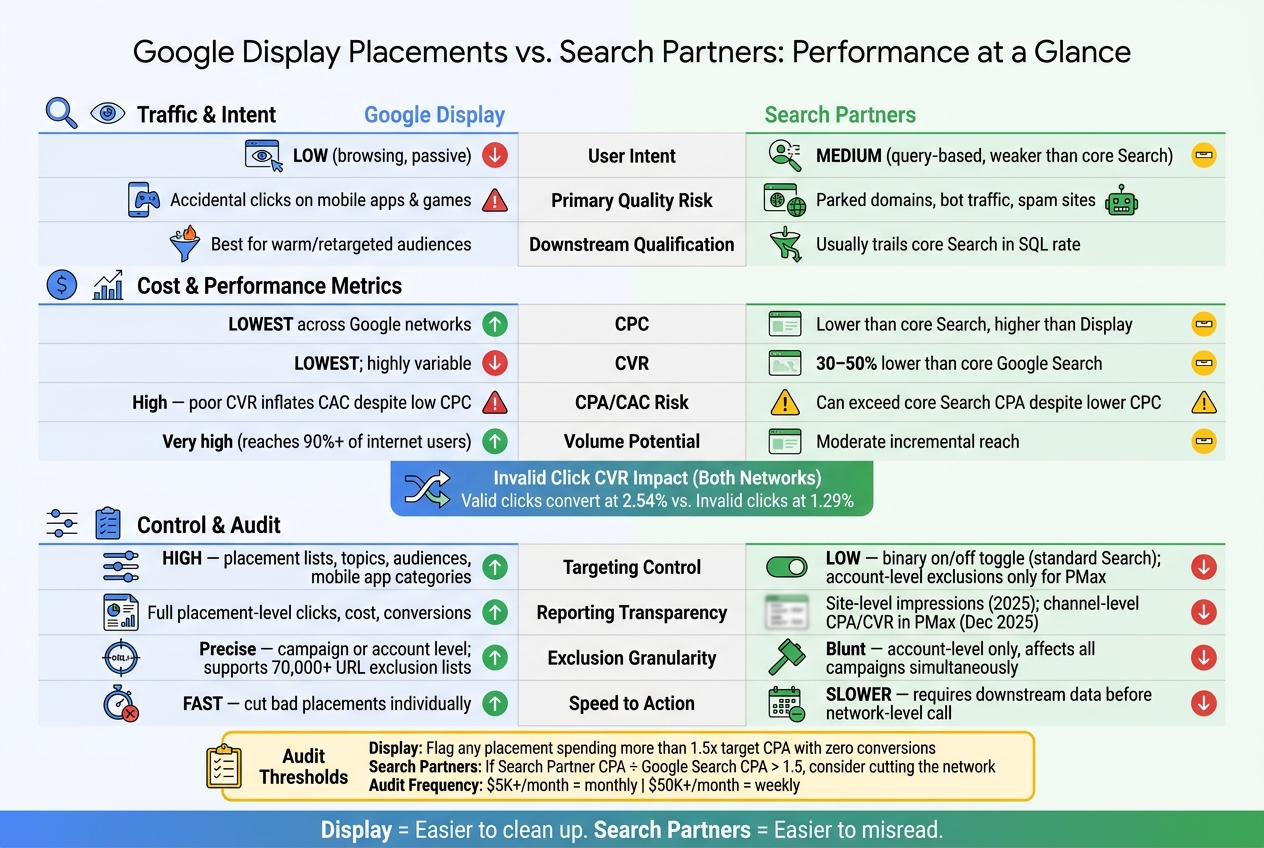
Google Display vs Search Partners: CPC, CVR, CAC & Control Compared
Display gives you placement-level control. Search Partners usually force a network-level call. That changes how you audit each one - and how fast you can cut waste.
Traffic Quality and Lead Quality: Side-by-Side
| Dimension | Google Display Placements | Search Partners | What It Means for Audits |
|---|---|---|---|
| User intent | Low - users are not actively searching | Medium - query-based, but usually weaker than core Search | Display fits warm audiences; Search Partners need CPA/CAC benchmarks against core Search |
| Primary quality risk | Accidental clicks on mobile apps and games | Parked domains, bot traffic, and spam sites | Both can inflate platform metrics while hurting downstream results |
| Downstream qualification | Strongest on warm audiences; cold Display traffic converts poorly | Usually trails core Search in SQL rate; mixed intent | Judge both by CRM acceptance and SQL volume, not form fills |
When intent is this different, CPC matters less than what actually makes it into CRM.
CPC, CVR, and CAC: Front-End Cost vs Down-Funnel Results
| Metric | Google Display Placements | Search Partners |
|---|---|---|
| CPC | Lowest across Google networks | Lower than core Search, higher than Display |
| CVR | Usually the lowest; highly variable | 30-50% lower than core Google Search |
| CPA/CAC | Often high relative to CPC due to poor CVR | Can exceed core Search CPA despite lower CPC |
| Volume potential | Very high - reaches 90%+ of internet users | Moderate incremental reach beyond core Search |
On the surface, both networks can look cheap. But cheap clicks don't help if they fall apart after the form fill.
Both also carry invalid-click risk, and that tends to show up farther down the funnel in CVR and CAC. One study found CVR drops to 1.29% for invalid clicks versus 2.54% for valid clicks. The average ad fraud rate across networks reached 5.1% in 2024, and some networks were above 46.9%.
That pushes the conversation away from front-end efficiency and toward reporting and exclusions using top PPC tools.
Control, Reporting, and Exclusion Options
This is where the gap gets much clearer in day-to-day account work. Display gives you fine control. Search Partners give you one broad lever.
| Lever | Google Display Placements | Search Partners | Practical Impact |
|---|---|---|---|
| Targeting control | Placement lists, topics, audiences, mobile app categories | Binary on/off toggle for standard Search; account-level exclusions for PMax | Display lets you prune site by site; Search Partners are mostly network-level |
| Reporting transparency | Full placement-level clicks, cost, and conversions | Site-level impressions in 2025; channel-level CPA/CVR in PMax in December 2025 | Display audits are more actionable; Search Partners reporting is still catching up |
| Exclusion granularity | Campaign- or account-level; supports 70,000+ URL exclusion lists | Primarily account-level; affects all campaigns simultaneously | Display exclusions are precise; Search Partner exclusions are blunt |
| Speed to action | Fast - bad placements can be cut individually | Slower - requires downstream data before a network-level call makes sense | Display responds faster to audit findings |
In plain terms, Display is easier to diagnose and clean up. Search Partners often need more patience because you can't trim them one site at a time in the same way.
Next, use these control gaps to decide whether to trim placements or shut off the network. For complex accounts, consulting with a top PPC agency can help refine these exclusion strategies.
Audit Workflow and Conclusion: Matching Placement Type to Growth Goals
A Simple Audit Process for Display and Search Partners
Display runs at the placement level. Search Partners run at the network level. So the audit process should not be the same.
Start with 30-60 days of data and segment by "Network (with Search Partners)."
For Display, pull placement-level reports and sort by impression volume. Then look for placements that keep spending but produce no conversions. Flag them and add them to your exclusion list.
For Search Partners, compare CPA across networks. Using automation platforms like Adalysis can help streamline these cross-network audits. Use this formula:
Search Partner CPA ÷ Google Search CPA
If that ratio is above 1.5, cut the network or isolate it.
Then check the numbers against your CRM. That step matters. Platform conversion data can make Search Partner traffic look better than it is. The better test is downstream behavior - CRM acceptance, SQL rate, and close rate.
How Mid-Market and PE-Backed Teams Should Evaluate Fit
For CAC-sensitive teams, the main question is simple: does this traffic turn into closed-won pipeline?
Not which network looks cheaper. Not which one drives more top-line conversion volume. What matters is which one leads to revenue, often requiring the right PPC tools and strategies to track accurately. That one shift changes how you read the account.
In January 2026, a mid-market e-commerce brand cut wasted placement spend by 42% and lifted ROAS from 2.1x to 2.7x by excluding placements with more than $250 in spend and zero conversions over 60 days.
That is the standard mid-market and PE-backed teams should use. Judge inventory by closed-won pipeline, not platform CPA.
Key Takeaways
Once your thresholds are set, this becomes an operating decision: keep what clears CAC and cut what does not.
Display is easier to prune. Search Partners are easier to misread.
Display vs Search Partners comes down to reach, traffic quality, and CAC control. If the account needs tight CAC discipline, use the audit thresholds above instead of leaning on network defaults. When Search Partner CPA is much worse than Google Search, or when Display placements keep spending without converting, it is usually time to limit or exclude them.
FAQs
How much data do I need before excluding Display placements or turning off Search Partners?
Use data windows, not snap calls. If you change things too fast, automated campaigns don’t get enough time to settle and learn from the traffic coming in.
For automated campaigns, wait 14 to 30 days before making major changes. That gives the system time to build a baseline you can judge against.
For placement reviews, look at 60 to 90 days of data. One common rule is to exclude placements that spent more than $250 with zero conversions over 60 days. Another is to cut placements with under 30% viewability when CPA is more than 3x your target.
For Search Partners, segment performance by network first. Then test any change over 14 or 28 days so you can compare results with enough data behind them.
Which metric matters most if CPC is low but lead quality is weak?
The metric that matters most is downstream conversion performance - things like qualified lead rate, sales acceptance rate, or revenue per lead.
A low CPC can look good on paper and still hurt you if that cheap traffic brings junk leads or bot activity. Put placement data next to CRM results and sales feedback. If lead quality starts to slip, tighten your exclusions first.
Should B2B and e-commerce accounts evaluate Display and Search Partners differently?
Yes. For B2B lead generation, Search Partners can waste budget on low-intent clicks and risky placements. That’s why a conservative approach, with a tight focus on pipeline quality, usually makes sense.
For e-commerce, Search Partners can bring in extra conversions. But performance can be less steady, and CPAs can come in higher. In both cases, review placement data and exclude underperforming or irrelevant inventory.