Pinterest ad copy works best when it is clear, short, specific, and matched to what people want to do next. In this article, I’d boil it down to 7 rules: lead with the main benefit, use Pinterest search terms naturally, front-load mobile copy, keep text tight, make the offer specific, match the CTA to the goal, and keep the ad and landing page saying the same thing.
A few points stand out fast:
- Lead with the offer, not brand fluff
- Use search-style wording people already type into Pinterest
- Put key words first because mobile cuts copy off
- Add specifics like price, shipping, discounts, or end dates
- Match the CTA to awareness, consideration, or purchase intent
- Keep message match tight from pin to landing page
The article backs this up with a data point too: Maguire Shoes hit a 5.6% conversion rate on Pinterest in 2026. That reinforces the main point - on Pinterest, words help turn browsing into action.
How to Create Pinterest Ads That Actually Convert (+ Free Templates)
Quick Comparison
| Best practice | What it means | What to do |
|---|---|---|
| Clear value proposition | Say the main reason to click | Lead with the top benefit or offer |
| Natural Pinterest keywords | Use the same terms shoppers search | Add search phrases like product + use case |
| Mobile-first copy | Put the best words first | Front-load headline and description |
| Short, scannable text | Make copy easy to scan | Cut filler and keep one main idea |
| Specific offer framing | Give people details they can judge | Add price, discount, shipping, or deadline |
| CTA matched to goal | Ask for the next logical action | Use Save, Learn More, Sign Up, or Shop based on intent |
| Ad-to-page alignment | Keep the promise the same after the click | Repeat the headline, offer, and visual on the landing page |
If I were using this article as a working guide, I’d treat it as a checklist for every pin before launch: clear benefit, search wording, short copy, concrete offer, correct CTA, and a landing page that matches the pin.
Why Pinterest Ad Copy Works Differently From Other PPC Channels
Pinterest sits in a different lane from most PPC channels. People use it to plan - home projects, outfits, recipes, gifts, and a lot more. That changes how ad copy should sound.
On Pinterest, users are in discovery mode, but they often have clear intent too. So the copy should feel useful, specific, and calm - not pushy. Unlike Google Search or passive social feeds, Pinterest tends to reward copy that helps someone move from an idea to the next step, instead of copy that tries to force an instant sale.
The best Pinterest ads feel shoppable and action-driven without sounding aggressive. They help users go from inspiration to action, and the copy needs to line up with the landing page. If the ad promises one thing and the page delivers something else, the click loses steam fast.
That’s why the first rule is simple: lead with a clear value proposition.
1. Lead With a Clear Value Proposition
Start with the benefit users want.
Say the main benefit in plain language and use search terms that match what people type when they’re ready to act. Phrases like "buy", "shop," or "best [product]" help line up your message with those searches. More specific long-tail terms tend to work better than broad phrases because they reflect how people narrow down their options. Once the value is clear, weave in natural keywords so the message is easy to find.
2. Use Pinterest Keywords Naturally
Use the exact words people type into Pinterest. Match the language your audience already uses.
Keep keywords natural. Don't stuff them. High-intent phrases like "buy", "shop," or "best [product]" tend to work well. Long-tail terms like "top CRM tools under $50" help you target specific intent without making the copy sound awkward.
Use the same keyword theme in the Pin headline, description, and landing page. That match keeps the message clear from the click through the conversion. It also helps on small screens, where every word has to pull its weight. Once you've picked the keyword, trim the copy for mobile.
3. Write Mobile-First, Front-Loaded Copy
Pinterest users move fast on mobile. They scan, tap, and keep going. So your strongest phrase needs to come first, before the copy gets cut off.
Lead with the part that matters most. If you're selling something, start with an actionable, searchable phrase. "Shop handmade leather wallets" is stronger than "Our handmade leather wallets are available now." The first version still works even if the rest disappears. That's a big deal, especially in descriptions, where the opening words carry most of the load.
Use the same approach in descriptions. Open with a searchable phrase like "Affordable home office desks under $300." Phrases like this are easier to scan and line up better with what users are already typing into search.
Put the benefit up front so the copy still makes sense when mobile truncates it. Once the lead is clear, keep the rest tight too.
4. Keep Text Short and Scannable
Once the lead is clear, cut the extra words.
Pinterest users move fast. They scan for ideas, answers, and products in seconds. So your headline needs to be short enough to look clean on mobile.
Descriptions should be brief too. But they still need to do a job. Aim to include one benefit, one keyword, and one thing that sets the offer apart. If you add length, use it for one useful detail - not filler.
Put the benefit and the difference-maker first. That way, the copy stays easy to scan even when people only glance at it.
Short copy tends to work best when the offer is specific.
sbb-itb-89b8f36
5. Frame the Offer With Specifics
Once your copy is easy to scan, make the offer concrete.
Vague offers don't convert. "Great deals on home decor" gives the shopper no clear reason to click. "Top CRM tools under $50" does.
Pinterest users often compare options before they buy. Specific prices, discounts, promo codes, and end dates help turn a loose idea into a decision. In a fast scroll, those details make short copy more useful.
Carry that same specificity into the description. Name the product, price, discount, or deadline. Concrete details make the offer easier to scan and judge.
Once the offer is specific, match the CTA to the next step.
6. Match the CTA to the Campaign Goal
Once the offer is clear, line up the CTA with the next step. Pinterest users are often still in planning mode, so the CTA needs to match what they’re ready to do.
| Campaign Goal | CTA Examples | User Intent |
|---|---|---|
| Awareness | Save, Learn More | Collect ideas, explore options |
| Consideration | Sign Up, Get the Guide | Research, compare, evaluate |
| Conversion | Shop, Store, Buy | Make a purchase decision |
For awareness campaigns, use save-worthy how-to content. A pin like "5 layouts for a 10x12 living room" with a "Save" prompt lines up well with how people use Pinterest when they’re gathering ideas.
For consideration campaigns, use CTAs tied to a guide, checklist, or signup. For conversion campaigns, use direct-action CTAs like "Shop" or "Store." If a pin features a kitchen backsplash under $100, the landing page should lead with those products, not make people dig for them.
Next, keep the same message in the creative and landing page.
7. Align Copy, Creative, and Landing Page
Once the CTA is in place, the last step is message match. After someone clicks, the landing page should confirm the same message, visuals, and offer they just saw in the ad.
The easiest fix is often the most obvious one: if your ad says "Boho Rugs Under $200 + Free U.S. Shipping," the landing page hero should say the same thing. Don’t send people to a generic All Rugs page and make them hunt for it. Put the headline, hero image, and offer details above the fold so visitors can confirm the value right away.
Use U.S. formatting for prices and date-based offers, like $799, Save $200-$400, or Offer ends 09/30/2026.
Visual match matters too. Keep the same hero image, color palette, and typography on the landing page. If the ad promises 50% off but the page shows full price, or if the page looks like it belongs to a different brand, people are more likely to bounce and trust drops fast.
Also keep the main CTA above the fold, and make sure the wording lines up with the ad. For example, use Shop Rugs instead of Explore Our Brand.
The examples below show how tighter message match changes the copy.
Before-and-After Copy Examples for U.S. Advertisers
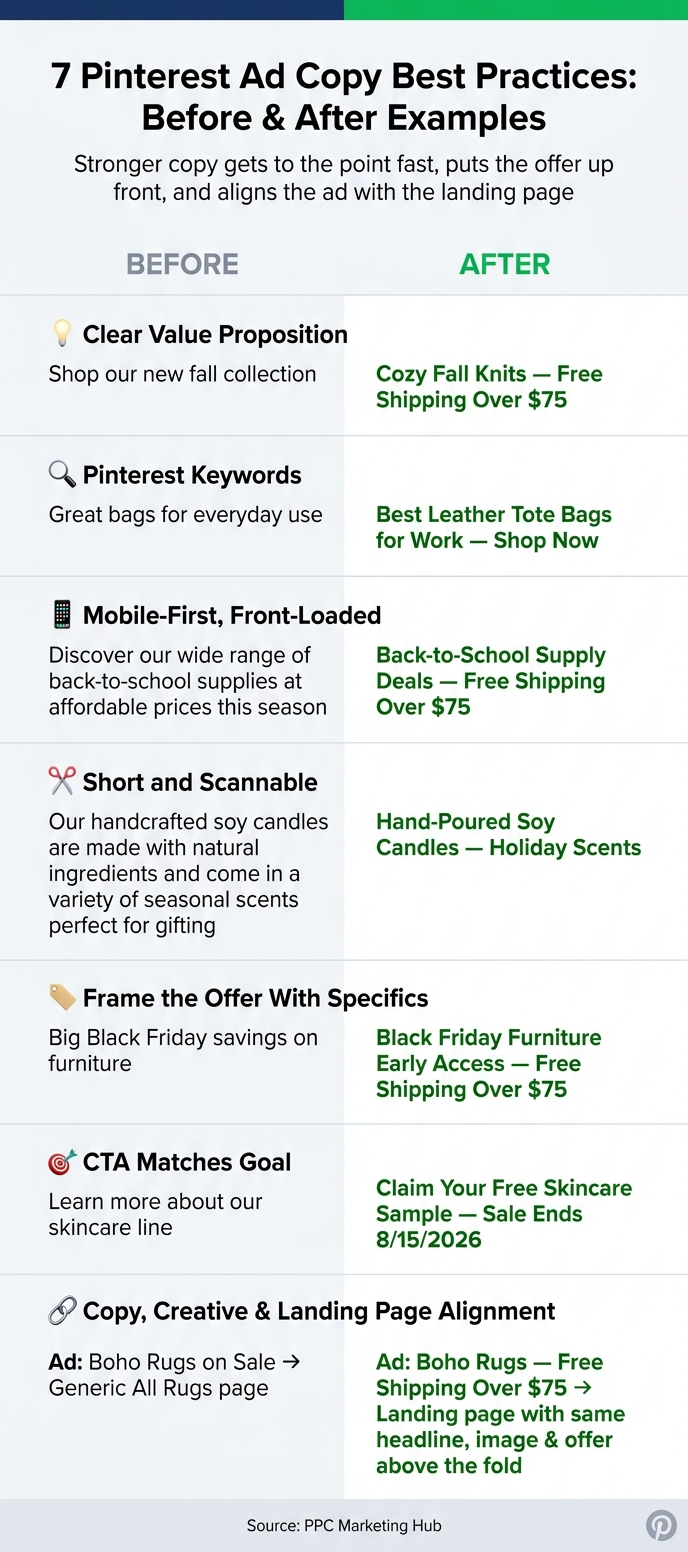
7 Pinterest Ad Copy Best Practices: Before & After Examples
These rewrites show what each Pinterest copy rule looks like in actual ads for U.S. advertisers. Think of them as plug-and-play templates you can use before you start testing.
| Best Practice | Before | After |
|---|---|---|
| Clear Value Proposition | "Shop our new fall collection" | "Cozy Fall Knits - Free Shipping Over $75" |
| Pinterest Keywords | "Great bags for everyday use" | "Best Leather Tote Bags for Work - Shop Now" |
| Mobile-First, Front-Loaded | "Discover our wide range of back-to-school supplies at affordable prices this season" | "Back-to-School Supply Deals - Free Shipping Over $75" |
| Short and Scannable | "Our handcrafted soy candles are made with natural ingredients and come in a variety of seasonal scents perfect for gifting" | "Hand-Poured Soy Candles - Holiday Scents" |
| Frame the Offer With Specifics | "Big Black Friday savings on furniture" | "Black Friday Furniture Early Access - Free Shipping Over $75" |
| CTA Matches Goal | "Learn more about our skincare line" | "Claim Your Free Skincare Sample - Sale Ends 8/15/2026" |
| Copy, Creative, and Landing Page | Ad: "Boho Rugs on Sale" → Page: generic All Rugs category page | Ad: "Boho Rugs - Free Shipping Over $75" → Landing page hero: same headline, image, and offer above the fold |
A clear pattern shows up in the "after" column. The stronger version gets to the point fast, puts the offer up front, and uses terms people are likely to search on Pinterest. It also lines up the ad with what the shopper sees after the click. That last part matters more than many teams think.
Use these rewrites as your starting variants before testing new copy. Then test these angles with copy tools before you change the creative format.
Tools to Support Pinterest Copy Testing
Start with the examples above as your test variants. Then check performance with both Pinterest’s own tools and third-party platforms.
Use Performance+ to test and tune copy inside Pinterest. It’s the native option, so it makes it easier to see what’s working without adding extra steps.
For attribution, use TripleWhale or Northbeam. These tools help tie conversions back to specific headlines, descriptions, and CTAs, which matters when you’re trying to figure out which message is doing the heavy lifting.
Creative velocity matters. You need to produce and rotate new copy variants fast enough to spot winners before performance stalls. If you test too slowly, you miss the chance to learn what’s landing now.
You can also use Top PPC Marketing Directory to find tools for copy optimization, A/B testing, keyword research, and performance tracking.
Conclusion
Strong Pinterest copy works when value, keywords, brevity, specificity, CTA, and message match all support the same offer. The goal isn’t to treat each rule on its own. It’s to make them work together.
When your headline, pin image, and landing page make the same promise, the path from discovery to action feels smoother. After that, keep testing the angle that gets results. Check saves against clicks as you iterate, review your copy each month, and keep the pin, image, and landing page in sync.
FAQs
How long should Pinterest ad copy be?
Pinterest ad copy should be short and concise. People scroll fast, and Pinterest is a visual-first platform, so your text needs to support the image - not compete with it.
That means each word has a job to do. Use clear, punchy language that shows the value fast. Pinterest runs on discovery, so your ad needs to make a strong impression right away.
Which Pinterest keywords should I use?
Prioritize long-tail keywords that match clear search intent, like "best [product name]" or "small apartment kitchen storage ideas." Broad terms can help with visibility, but your main focus should be multi-word phrases because they often face less competition and can cost less.
Your keywords should also fit naturally into ad copy and headlines. If they sound forced or stuffed in, the ad will feel spammy fast.
How do I match the ad to the landing page?
Keep your Pinterest ad and landing page in sync - copy, CTA, and page content should all line up. That consistency helps people trust what they’re clicking, and it can lead to more conversions.
Your CTA should match what the page delivers. If the click goes to a product detail page, something like “View pricing and features” makes sense. It sets the right expectation before the user lands.
With carousel ads, be specific. Send each card to the page that fits that card’s content, not to a generic homepage. If one card shows Product A and another highlights Product B, each click should go to the matching page. That makes the path feel direct instead of confusing.