I start cookieless attribution with permissioned data and CRM revenue - not a promise to track every touchpoint. Connect eligible customer IDs, click IDs, and server events, then separate observed results from platform estimates.
I use 4 evidence types: observed, matched, modeled, and aggregated. They help explain what your reports can support - and where the customer path is incomplete.
My approach is simple:
- Build clean data: Define events, record consent, join permitted IDs, and remove duplicates.
- Keep platform credit separate: Use Google and Meta reports for bidding, not as a combined customer journey.
- Choose a model that fits your data: More complex math cannot restore missing touches.
- Check revenue weekly: Compare platform results with CRM records using the same definitions, dates, and windows.
- Respect privacy limits: Apply opt-outs, retention, and deletion rules. Server events and hashed IDs do not remove those duties.
- Test before shifting spend: Use lift tests alongside attribution, and track coverage, modeled share, delays, CAC, and payback.
My rule: <u>credit is not proof of lift</u>. Use attribution to describe the activity you can measure, not to claim a complete view.
Multi-Touch Attribution: What’s Working, What’s Dead, and How to Fix It
sbb-itb-89b8f36
Data Sources for Cookieless Attribution
Cookieless attribution relies on 4 raw inputs: identity records, server events, platform match signals, and aggregate reports.
First-Party IDs, Server Events, and CRM Revenue
Start with a stable internal ID. Store permitted click IDs, hashed customer data, campaign metadata, and revenue records in separate fields. Carry the internal ID through forms, CRM, and billing. Logged-in account IDs connect known activity, click IDs connect eligible ad clicks, and CRM and billing joins reconcile revenue. These sources do not recover anonymous sessions before login or view-throughs.
Backend events record business actions without relying entirely on browser tags. Webhooks add refunds, renewals, and cancellations. Offline conversion imports send eligible assisted sales conversions back to platforms. Keep transaction IDs, event timestamps, USD values, and consent state attached to every record. Server-side delivery does not bypass consent requirements. Use stable event IDs so webhook retries or duplicate browser and server submissions don't inflate revenue.
Identity and revenue data stay in your systems. Platform match signals stay inside each ad platform.
Google and Meta Signals and Aggregate Reports
Google Enhanced Conversions and Consent Mode improve matching and tag behavior within Google. They do not create advertiser-owned cross-platform identity. Where permitted, advanced Consent Mode can send limited, non-identifying pings even when storage consent is denied. Modeled conversions remain estimates, not recovered customer paths.
Meta Conversions API improves matching and optimization within Meta, but matched events stay inside Meta’s reporting system. Google and Meta matches cannot be merged into a portable person-level graph.
Aggregate reports reduce exposure, but they come with delays, thresholds, noise, fewer dimensions, and reporting windows. They cannot reconstruct an ordered cross-platform path or link it directly to CRM revenue.
The Attribution Reporting API requires a secure HTTPS context and enrollment in the relevant browser privacy process. The gathered sources do not establish availability across all browsers, operating systems, or platforms. Confirm support for each target browser and advertising platforms and tools before implementation.
Set Up Cross-Platform Cookieless Attribution
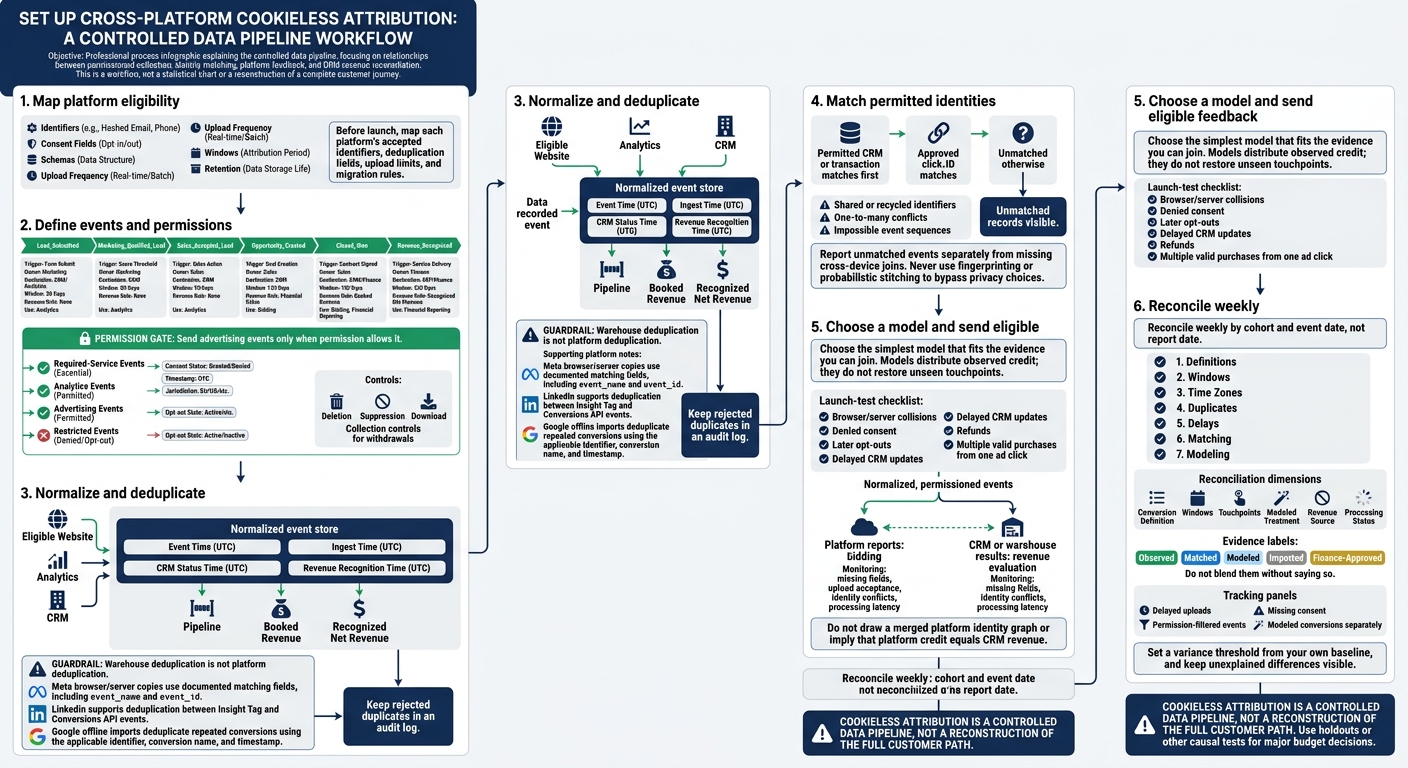
Cookieless Attribution Setup Workflow
Cookieless attribution is a controlled data pipeline, not a reconstruction of the full customer path. Send normalized, permissioned events from the CRM and warehouse to separate platform connectors and agencies. Route eligible website, analytics, and CRM events through a normalized event store before sending bidding feedback.
Maintain a platform-eligibility matrix that covers identifiers, consent fields, schemas, upload frequency, windows, and retention. Before launch, map each platform’s accepted identifiers, deduplication fields, upload limits, and migration rules. Then define events, map identities, and reconcile platform results with CRM revenue.
Define Events, Permissions, and Deduplication Rules
Create a measurement spec for Lead_Submitted, Marketing_Qualified_Lead, Sales_Accepted_Lead, Opportunity_Created, Closed_Won, and Revenue_Recognized. For each event, define its trigger, owner, destination, attribution window, revenue rule, and use: bidding, analytics, or financial reporting.
Separate required-service, analytics, advertising, and restricted events. Send advertising events only when permission allows it. Honor withdrawals through collection, deletion, and suppression controls, and store consent status, timestamp, jurisdiction, and opt-out state with every event.
Store event time, ingest time, CRM status time, and revenue recognition time separately. Keep UTC and the source time zone, and represent local timestamps with an unambiguous offset or IANA time zone. Keep pipeline, booked revenue, and recognized net revenue separate - even when their dollar values match.
Warehouse deduplication is not platform deduplication. Meta browser/server copies should use the documented matching fields, including event_name and event_id. LinkedIn supports deduplication between Insight Tag and Conversions API events. Google offline imports deduplicate repeated conversions using the applicable identifier, conversion name, and timestamp. Keep rejected duplicates in an audit log.
Before turning on bidding feedback, test browser/server collisions, denied consent, later opt-outs, delayed CRM updates, refunds, and multiple valid purchases from one ad click. Monitor missing fields, upload acceptance, identity conflicts, and processing latency.
Once events are standardized, connect only identities supported by consent and durable IDs.
Match Identities and Choose Attribution Models
Document a matching hierarchy: permitted CRM or transaction matches first, approved click-ID matches next, and unmatched otherwise. Check for shared or recycled identifiers, one-to-many conflicts, and impossible event sequences. Report unmatched events separately from missing cross-device joins. Never use fingerprinting or probabilistic stitching to bypass privacy choices.
Select a model only after these checks. Use holdouts or other causal tests for major budget decisions.
Choose the simplest model that fits the evidence you can join. Models distribute observed credit; they do not restore unseen touchpoints. Cookieless gaps can make complex models appear more precise than they are.
| Model | Evidence needed | Useful for | Main limitation | Control |
|---|---|---|---|---|
| Linear | At least two observable touchpoints and a defined journey | Neutral descriptive reporting when no strong causal assumption is preferred | Weights all touches equally | Advertiser-controlled |
| Position-based | Identifiable first and last touchpoints plus agreed weights | Reporting that emphasizes acquisition and conversion actions | Arbitrary weights favor selected positions | Advertiser-controlled |
| Time-decay | Ordered timestamps and a chosen decay period | Longer B2B journeys where recent touches are expected to matter more | Favors late touches over awareness | Advertiser-controlled |
| Markov-chain | Sufficient path volume, ordered touchpoints, and conversion/nonconversion paths | Estimating removal effects from observed paths | Sensitive to sparse or incomplete paths and channel grouping | Advertiser-controlled |
| Shapley-value | Sufficient observations across channel combinations and a defined value function | Distributing credit across channel combinations | Computationally demanding; depends on observed channels | Advertiser-controlled |
| Platform data-driven attribution | Platform event history, eligible conversion volume, consented signals, and platform-specific rules | Bidding feedback within the platform that owns the model | Limited portability and visibility | Platform-contained |
After selecting a model, compare platform credit with CRM outcomes to identify gaps in definitions, windows, and deduplication.
Reconcile Platform Reports With CRM Results
Reconcile weekly by cohort and event date, not report date. Check definitions, windows, time zones, duplicates, delays, matching, and modeling - in that order.
Track delayed uploads, permission-filtered events, missing consent, and modeled conversions as separate sources of cookieless reporting gaps. Label metrics as observed, matched, modeled, imported, or finance-approved. Do not blend them without saying so.
Use platform reports for bidding and CRM or warehouse results for revenue evaluation. Account for missing CRM contacts, offline activity, and late updates. Set a variance threshold from your own baseline, and keep unexplained differences visible.
| Dimension | Compare | Common difference | Record |
|---|---|---|---|
| Conversion definition | Same event and funnel stage | One system counts forms while another counts accepted leads | Matched, translated, or unresolved |
| Windows | Click, view, engaged-view, and revenue windows | Different defaults assign different conversions | Window documented |
| Touchpoints | Ads, direct, email, organic, and offline | Some systems omit or suppress non-ad interactions | Coverage documented |
| Modeled treatment | Observed versus estimated conversions | Platform totals may exceed observable events | Observed, modeled, or unknown |
| Revenue source | CRM opportunity, order system, or recognized finance revenue | Pipeline and revenue are confused or delayed | Source and currency approved |
| Exclusions | Spam, duplicates, refunds, cancellations, employees, test orders, and out-of-scope regions | Filters are applied inconsistently | Exclusion rule versioned |
| Processing status | Pending, accepted, rejected, late, or deleted events | Upload delay and API failures create temporary gaps | Status and last refresh recorded |
Track missing touchpoints and privacy-driven suppression separately from setup errors. Use the comparison to show where cookieless attribution loses accuracy and where privacy rules prevent a fix.
Manage Accuracy Gaps and Privacy Requirements
Find Missing Touchpoints and Attribution Bias
Cookieless attribution has 2 expected failure modes: missing coverage and bias. Missing coverage hides interactions. Bias favors channels with better tracking, shorter paths, more clicks, or stronger identity resolution. Compare CRM and observed results by geography, consent state, browser, device, source, campaign, conversion type, and sales stage.
| Risk | Symptom and cause | Diagnostic metric | Mitigation | Evidence characteristic |
|---|---|---|---|---|
| Non-consented traffic | Fewer reported conversions where permission limits signals | Consent rate; regional CRM-to-platform variance | Respect consent choices; disclose permitted modeling | Modeled or aggregate evidence with less user-level certainty |
| Anonymous visits | Events lack a permitted identity | Identifier presence; CRM match rate | Keep aggregate reporting; do not force matches | Observed events without reliable person-level links |
| Cross-device gaps | Devices lack a shared permitted ID | Authenticated-session share; cross-device match rate | Use permitted account IDs; report unmatched journeys separately | Deterministic matches are stronger; disclose modeled matches |
| Closed platforms | Limited exports prevent independent checks of attribution credit | Export coverage; platform-to-CRM variance | Reconcile by campaign, week, geography, or account | Platform-only evidence with limited export |
| Missing impression logs | Exposure cannot be verified | Impression coverage; view-through share | Separate click-through and view-through reporting; obtain permitted logs or use lift studies | View-through claims are weaker without verified exposure |
| Long sales cycles | Revenue arrives after reporting closes | Stage-to-close lag; cohort payback | Use cohort reporting, stage-weighted pipeline, and dated revenue windows | Early evidence is incomplete, not necessarily negative |
| Small samples | Signal loss leaves channel results unstable | Conversion count; uncertainty interval | Aggregate time or geography, suppress unstable breakdowns, and test before reallocating budget | Directional evidence with high uncertainty |
Report click-through and view-through credit separately. Use CRM checks for data quality, holdouts or geo tests for lift, and MMM for allocation. Keep those outputs separate.
Disclose coverage, modeled share, latency, and exclusions. Report ranges only when analysis supports them. Missing data does not mean missing conversions. Calculate CAC as acquisition spend divided by new customers. Calculate payback as the time cumulative customer gross profit takes to recover CAC, rather than using platform-reported ROAS. After identifying the gap, limit what you collect, keep, and use.
Set Privacy Controls and Track Measurement Quality
Accuracy gains stop at consent and retention limits. A matchable identifier is not permission to use it. Work with privacy counsel to document geographic requirements, purposes, applicable U.S. state opt-outs and recognized opt-out signals, withdrawal, retention, deletion, vendor roles, and access controls.
Treat hashed IDs as personal data under access, retention, and deletion rules. The IAB Tech Lab’s Global Privacy Protocol can transmit consumer choices, but it does not establish compliance. Deduplicate platform claims against the master CRM conversion record so the same conversion isn't counted twice.
| Scorecard metric | Explicit denominator or calculation |
|---|---|
| Consent rate | Permitted decisions ÷ all eligible consent prompts |
| Event delivery | Valid received events ÷ expected eligible source events |
| Deduplication | Duplicates removed ÷ received candidate events |
| Identifier match | Matched permitted identifiers ÷ identifier-bearing records submitted |
| CRM match | CRM-linked records ÷ eligible records submitted for reconciliation |
| Disclosed modeled share | Modeled conversions or value ÷ total reported conversions or value |
| Offline latency | Median and 95th-percentile time from business outcome to platform or warehouse receipt |
| Revenue variance | Platform value minus reconciled CRM value, divided by that CRM baseline |
| Channel coverage | Channels with usable documented signals ÷ channels included in the media plan |
| Retention exceptions | Records retained beyond the approved period ÷ all retained records, with reason and approval documented |
Review these metrics monthly by geography, consent state, device, and channel. Assign owners and business-specific escalation thresholds. Account-level sales reporting needs stronger matches than awareness reporting.
Investigate revenue variance before reallocating spend. A rising modeled share calls for a coverage review, not an automatic budget cut. Document reasons and approvals for retention exceptions.
Use these controls to assess whether tools are safe for reporting, not just optimization.
Conclusion: Choose Tools for Revenue Reporting and Data Quality
Choose providers that show permitted collection, CRM revenue links, coverage disclosures, deduplication, evidence labels, reconciliation, and auditable deletion - not perfect attribution. Test delayed outcomes, duplicate events, and withdrawals before trusting reports.
The Top PPC Marketing Directory can help shortlist tools and agencies for pipeline, CAC, and payback reporting. Inclusion does not replace technical, security, contractual, or privacy due diligence.
FAQs
How much data do I need for cookieless attribution?
Data-driven attribution generally needs 300 to 500 conversions per month to produce reliable results. Below that range, rule-based models such as time-decay or position-based attribution are more reliable options. Shapley Value attribution requires at least 10,000 converting journeys.
Privacy filters also set limits on what you can analyze. In environments such as Google Ads Data Hub, each touchpoint must have at least 50 users to be included in the analysis.
How can I tell tracking errors from privacy-related gaps?
Calculate your overlap coefficient by dividing platform-reported conversions by actual CRM orders. A result below 0.8 typically points to privacy-related data loss, such as ad blockers or iOS opt-outs. A result well above 1.0 suggests double-counting or tracking errors.
Use automated monitoring to flag broken tags, missing events, and misconfigured UTM parameters. Audit cross-platform consistency regularly. Differences often stem from attribution models, time zone mismatches, or conversion windows rather than privacy settings.
When should I use lift tests instead of attribution?
Use lift tests, such as geo-holdouts or A/B tests, to check attribution findings and determine whether credited touchpoints drive incremental conversions. Attribution assigns credit based on observed patterns. Lift tests directly measure causality.
For example, if your model credits a channel with 30% of revenue but pausing its ads for a holdout group barely changes results, reassess the model.