Most PPC tests should not be judged in 7 days. From this study, I’d plan around 2-4 weeks for Google Search, 4-6 weeks for Performance Max, and 10-14 days or more for Meta conversion tests - then extend if volume is low or conversion lag is long.
Here’s the short version:
- I would use sample size and conversion lag to set test length - not the calendar alone.
- I would treat early checks as health checks, not winner calls.
- I would use top PPC tools and channel baselines as planning ranges:
- Google Search: 2-4 weeks at strong volume, 4-6 weeks for bid, budget, or landing-page changes
- Low-volume Search: often 6-8 weeks+
- Display/Video: about 2-4 weeks, longer for conversion-led tests
- Performance Max: 4-6 weeks
- Meta upper-funnel tests: 7-14 days
- Meta lead/purchase tests: 10-14 days or more
- I would not rely on the 100 conversions per variant rule by itself. It’s a rough planning shortcut, not a final answer.
- For bigger CAC or budget calls, I’d want 300-400 conversions per variant, especially if I’m trying to spot a small lift like 5%.
- I would not call a test final until it clears runtime, sample size, and lag.
A simple way to think about it: if a variant gets 500 clicks per week at a 5% conversion rate, that’s about 3.57 conversions per day. Hitting 100 conversions takes about 28 days. If your volume is lower, your test needs more time.
Bottom line: I’d review PPC tests daily for issues, weekly for health, mid-test for integrity, and only make final budget or CAC calls after the data has had time to settle and mature, or consult with top PPC agencies for expert analysis.
How To Use The A/B Testing Duration Calculator
sbb-itb-89b8f36
Channel Benchmarks: Typical PPC Test Length by Platform
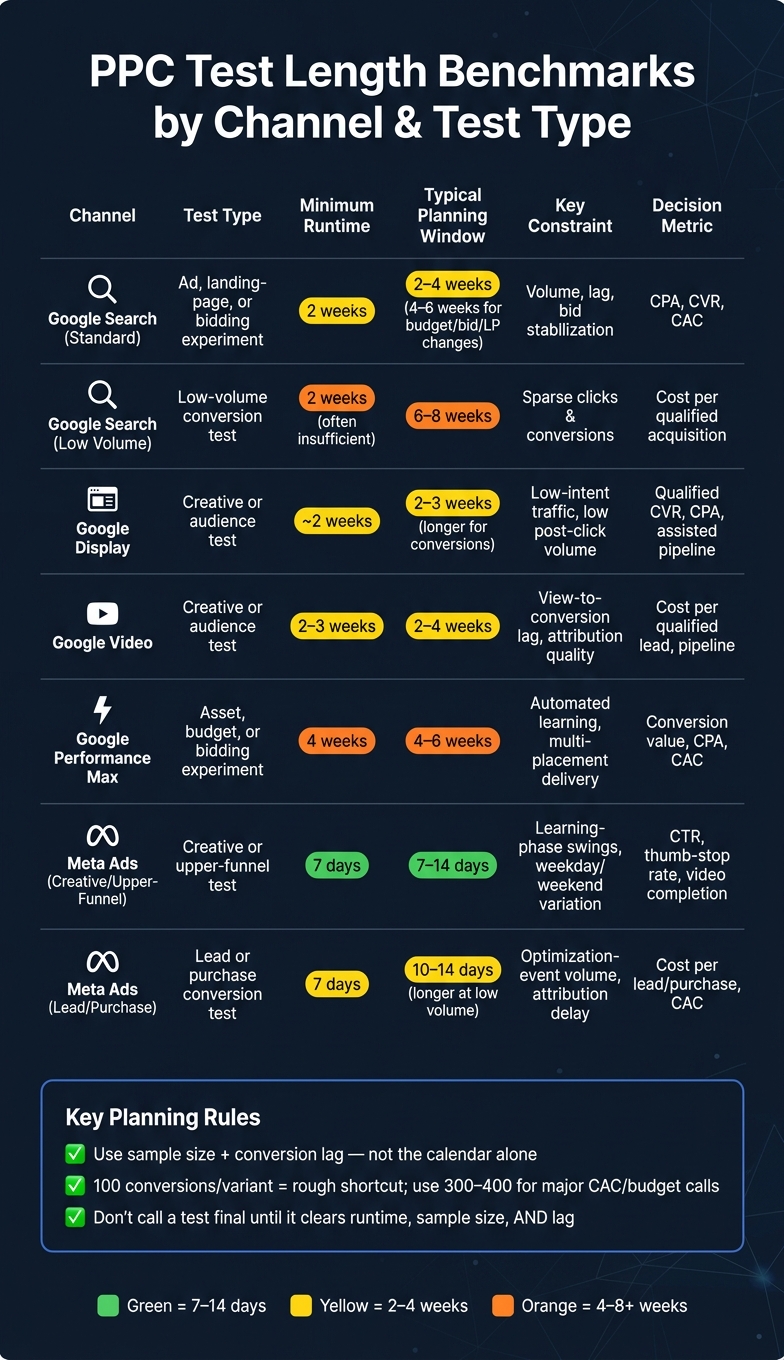
PPC Test Length Benchmarks by Channel & Test Type
The benchmarks below show two things: the earliest practical review point and the typical runtime needed to make a defensible call. Think of them as a starting line, not a hard rule. If volume is low, conversion lag is long, or delivery is uneven, tests usually need more time.
Google Ads: Search, Display, Video, and Performance Max
For Search campaigns, a 2-4 week window works when volume is strong. If you're testing budget, bid, or landing-page changes, plan for 4-6 weeks. And if you're below 500 weekly clicks, expect 6-8 weeks or more.
It also helps to ignore the first 7 days if ramp-up skews the data. Some tests still won't be clear after that. In those cases, give them 1-2 full conversion cycles before making the call.
Display and Video work a bit differently. If you're testing upper-funnel signals like view rate or CTR, you can often start reading the data in 2-3 weeks. But if the test is tied to conversions, you usually need more time - especially when post-click volume is thin or attribution takes longer to show up.
Performance Max usually needs 4-6 weeks. That's because it spreads budget across Search, Display, YouTube, Discover, Gmail, and Maps, and automated bidding needs enough conversion data to settle across all of those placements.
Meta follows much of the same logic, but the first week tends to matter more because delivery often needs time to settle.
Meta Ads: Conversion Tests vs. Creative Tests
Creative and upper-funnel tests - things like hook rate, thumb-stop rate, or video completion - can often give you directional readouts in 7-14 days. But lead and purchase conversion tests should run for at least 7 days, with 10-14 days usually being the better planning window.
Be careful with early swings. Performance in the first 48-72 hours is often noisy because learning-phase movement can distort the picture.
A common practitioner benchmark for Meta conversion tests is about 20-50 conversions per variant before treating a test as ready for a decision. That's a planning guide, not a platform requirement.
Bidding Strategy and Conversion-Lag Constraints
Automated bidding changes the timeline because results aren't stable until the learning period is over. The practical rule is simple: wait for at least two complete conversion cycles before making a final call.
If your conversion lag is longer than the test window, extend the review period until downstream conversions have had time to mature. Otherwise, you're judging the test before the data has finished arriving.
The table below pulls the practical ranges together by channel and test type, similar to resources found in a PPC Marketing Directory. Use it as a planning baseline, then adjust based on conversion rate and budget.
| Channel | Test Type | Minimum Runtime | Typical Planning Window | Principal Constraint | Decision Metric |
|---|---|---|---|---|---|
| Google Search | Ad, landing-page, or bidding experiment | 2 weeks when volume is strong | 2-4 weeks; 4-6 weeks for budget, bid, or landing-page changes | Volume, lag, bid stabilization | CPA, conversion rate, qualified-lead rate, CAC |
| Google Search | Low-volume conversion test | 2 weeks minimum, but often insufficient | 6-8 weeks or until event threshold is met | Sparse clicks and conversions | Cost per qualified acquisition |
| Google Display | Creative or audience test | About 2 weeks | 2-3 weeks for engagement; longer for conversions | Low-intent traffic, low post-click volume | Qualified conversion rate, CPA, assisted pipeline |
| Google Video | Creative or audience test | About 2-3 weeks | 2-4 weeks depending on conversion volume | View-to-conversion lag, attribution quality | Cost per qualified lead, pipeline |
| Google Performance Max | Asset, budget, or bidding experiment | 4 weeks | 4-6 weeks | Automated learning, delivery across placements, conversion volume | Conversion value, CPA, CAC |
| Meta Ads | Creative or upper-funnel test | 7 days | 7-14 days | Learning-phase swings, weekday/weekend variation | CTR, thumb-stop rate, video completion, cost per qualified action |
| Meta Ads | Lead or purchase conversion test | 7 days | 10-14 days or longer at low volume | Optimization-event volume, attribution delay | Cost per lead/purchase, qualified-lead rate, CAC |
These are channel baselines. In practice, volume and budget are what set the final test length.
Benchmarks by Conversion Rate, Traffic, and Budget
Channel baselines give you the starting point. After that, traffic and conversion rate decide whether a test can get enough data to mean anything.
Sample-Size Logic and Estimated Test Days
Use this formula:
Estimated test days = required conversions per variant ÷ expected conversions per variant per day
Here’s the simple version. Take the weekly traffic for each variant, multiply it by the expected conversion rate, then divide by 7 to get daily conversions. If each variant gets 500 clicks per week and converts at 4%, that works out to about 2.86 conversions per day per variant. If your target is 100 conversions per variant, you’re looking at about 35 days.
The table below shows how that math looks in common traffic and budget setups. It assumes a 50/50 split, a $4.00 average CPC, and stable traffic. These are still estimates. Conversion lag, learning, weekend swings, auction volatility, and lead-quality filters can all stretch the run time. Treat this as a quick feasibility check before launch.
| Expected conversion rate | Traffic per variant per week | Total daily budget | Est. days to 100 conversions/variant |
|---|---|---|---|
| 2% | 500 clicks | $571 | 70 days |
| 5% | 500 clicks | $571 | 28 days |
| 10% | 500 clicks | $571 | 14 days |
| 5% | 1,000 clicks | $1,143 | 14 days |
| 10% | 1,000 clicks | $1,143 | 7 days |
| 5% | 250 clicks | $286 | 56 days |
Even if the math says the sample is reachable, teams should still let the test run through full weekly cycles and allow for ramp-up before making a call. If you can’t get to the needed counts, the problem isn’t the calendar. It’s the test design.
Low-Volume Campaigns and Budget-Constrained Tests
Moderate programs - around 15 to 50 conversions per variant per week - usually need 2 to 7 weeks to get to 100 conversions per variant. If a campaign is only producing 10 conversions per variant per week, it would need about 10 weeks to hit that same mark.
This is why feasibility should be worked out before launch. A 7-day or 14-day window doesn’t create statistical power by itself. If a campaign generates 10 conversions per variant each week and the team only has budget for a 4-week run, the test will end with about 40 conversions per variant. That’s far short of a sound decision point.
When raw conversion volume is thin, use metrics like CAC, qualified acquisition cost, or pipeline per dollar instead. And if volume still isn’t there, change the test. Pool volume, go after a bigger effect, or use a higher-funnel proxy while keeping downstream revenue guardrails in place.
When volume is tight, the decision threshold needs to fit the risk.
Heuristics vs. High-Stakes Decision Thresholds
Higher-stakes PPC decisions need more sample. The reason is simple: the price of getting it wrong is higher.
For routine PPC decisions, the 100-conversion heuristic is often enough when tracking is clean.
For major CAC or budget calls, aim for 300 to 400 conversions per variant, especially if the lift you expect is small. Small lifts are harder to detect. For example, a 5% MDE can need about 4x the sample of a 10% MDE.
It’s also worth being blunt here: conversion count is only a data-quality check, not the whole answer. A test can hit 100 form fills per variant and still tell you almost nothing about qualified opportunities, sales acceptance, revenue, CAC, or payback. For paid-to-pipeline teams, the primary decision metric should be set before launch, and sample size should be based on the lowest-volume qualified event - not the higher-volume form fill.
Review Cadence and Decision Gates
A set review schedule helps you avoid two expensive mistakes: missing issues that can spoil a test, and picking a winner too soon because early numbers looked good. These gates turn the runtime benchmarks above into decisions you can defend for CAC, payback, and pipeline. Just as important, they keep the test tied to the benchmarks above - not early noise.
Daily, Weekly, Mid-Test, and Final Reviews
Use four review layers. Each one has a different job.
| Review stage | Timing | What to inspect | What not to do |
|---|---|---|---|
| Daily operational check | Every day | Spend pacing, delivery, tracking fires, disapprovals, anomalies | Declare a winner or reallocate budget |
| Weekly health review | After at least 7 days | Full weekday/weekend mix, allocation balance, external events | Treat an early lead as final |
| Mid-test validation | Around the planned midpoint | Exposure balance, learning status, conversion lag, CRM reconciliation, test integrity | Change variables without documenting a reset |
| Final decision review | After planned sample and lag window | Confidence, effect size, economic impact, guardrail metrics | Rely on statistical significance alone |
Use the table as the schedule. Use the checks below as decision gates.
Daily checks are operational only. Focus on serving, pacing, tracking, and delivery integrity. If something is off, fix it. Don't use that review to make budget shifts or winner calls.
The mid-test checkpoint is there to protect the test itself. Check that exposure is reasonably balanced, the planned audience and placements still match, conversion tracking is complete, and no big changes in budget, bids, creative, or targeting have tainted the comparison. If a change had to happen, record the date and the expected effect. That paper trail matters later.
The final decision review happens only after three things are done: the planned runtime, the planned sample size, and the conversion-lag window. Before making any CAC, payback, or scaling call, reconcile platform data with your CRM or analytics system.
Predeclared Stopping Rules and False-Positive Control
Peeking drives up false positives. Before launch, lock the primary metric, minimum effect, confidence threshold, and conversion count. Also spell out emergency stop conditions - broken tracking, severe overspend, policy risk, or brand-safety risk - so the team knows the difference between a valid early stop and a rushed decision.
If your team needs to watch results on a rolling basis, use a sequential-testing method built for that use case instead of running a standard fixed-horizon significance test at every check.
When Not to Call a Test: A Checklist
Statistical significance by itself is not enough. Before you call a winner, make sure none of these invalidators are in play:
- The campaign is still in its learning phase or delivery has not stabilized
- The test ended before 7 full days, unless there is a documented, defensible reason
- Either variant has not reached the prespecified conversion count
- Conversion lag has not been accounted for - especially for demos, trials, sales opportunities, or offline-qualified conversions
- Budget, bidding strategy, targeting, creative, landing pages, or attribution changed during the test without a documented reset
- Tracking is broken, duplicated, delayed, or inconsistent across the ad platform, analytics, and CRM
- A holiday, promotion, outage, or seasonality spike made the period unrepresentative
- The result is statistically significant, but the lift is too small to change CAC, payback, or pipeline economics
When in doubt, call the result inconclusive, cap the extension at one more conversion cycle, and keep the original rules in place.
The next section translates these gates into CAC, payback, and pipeline decisions.
What the Benchmarks Mean for CAC, Payback, and Pipeline
CAC and Qualified Acquisition Decisions
Use the same decision rule here: raw conversions alone aren't enough if the test hasn't produced qualified outcomes.
A short test can make performance look better than it is. Cheap form fills may lift conversion counts, but that doesn't mean they turn into qualified opportunities or closed customers. Before you move budget, follow each variant through the full funnel: spend → tracked conversion → MQL → sales-accepted lead (SAL) → opportunity → closed-won customer.
Report both raw conversion counts and qualified acquisition metrics. That usually means:
- Cost per SAL
- Cost per opportunity
- CAC
A practical formula is:
CAC = incremental campaign spend ÷ incremental customers acquired
If closed-won data still isn't ready, use qualified pipeline as a temporary metric. Just label it clearly and keep it separate from realized CAC. This matters because Google Ads ties conversions to the ad interaction date, so newer cohorts can look thin or incomplete when qualification happens days or weeks later.
Payback Windows and Paid-to-Pipeline Measurement
Once you have CAC, the next step is simple: when does margin recovery catch up?
Revenue usually doesn't show up in the same week as the lead conversion. A 2025 B2B benchmark puts median sales cycles at 84 days for deals under $50,000 ACV and 192 days for deals above $100,000 ACV. That's a big gap. It supports directional reads on lead volume from 14-day or 30-day tests, but not final CAC or payback calls for longer-cycle campaigns.
Track these dates as separate fields:
- Test start date and end date
- Ad interaction date
- Initial conversion date
- Qualification date
- SAL date
- Opportunity-stage progression
- Closed-won date
- Revenue-recognition date
If those dates get blended together, it's hard to tell whether a campaign actually paid back its spend or just looked good early on.
Use a lag-aware review schedule so early signals don't get mistaken for final results:
| Review point | What to assess |
|---|---|
| 14 days post-conversion | Initial lead quality |
| 30–60 days post-conversion | Sales acceptance, opportunity creation |
| Full sales-cycle window | Closed-won customers, CAC, payback |
For payback, use gross-margin contribution, not revenue by itself. A simple payback formula is CAC divided by monthly gross-margin contribution per customer.
Also split projected payback from realized payback. Projected payback uses expected contract value and retention. Realized payback uses verified revenue data.
Key Takeaways and Useful Resources
These benchmarks are planning inputs, not fixed rules. Use the benchmarked test windows to set minimum thresholds. Make decisions based on qualified conversion volume. Review results on a set cadence. And when a test doesn't have enough volume, mark it inconclusive instead of forcing a win-or-loss label.
That's the honest read. A low-volume campaign with thin pipeline data hasn't failed just because it didn't give you a clean answer. But calling it a winner before the pipeline matures isn't right either.
For teams comparing PPC tools or agency help, the Top PPC Marketing Directory is a useful starting point for CAC and paid-to-pipeline work.
FAQs
How do I calculate the right PPC test length for my volume?
Calculate PPC test length by estimating the sample size you need for 95% confidence and 80% statistical power, using your current conversion rate and the smallest lift you want to detect.
As a rule of thumb:
- 1,000+ daily clicks: 7-14 days
- 500-1,000 daily clicks: 14-21 days
- Low-traffic accounts: 30+ days, or until you reach a statistically significant number of conversions
This gives you a practical way to set expectations before a test starts. More traffic usually means you can reach a decision sooner. Lower-traffic accounts need more time because random swings can distort the results if you call the test too early.
When should I extend a PPC test instead of ending it?
Extend a PPC test if you haven’t yet reached statistical significance or gathered enough data to make a reliable call.
That matters most when traffic is low, when market trends are still settling, or when seasonality has thrown the test off course and you need results that better reflect normal business conditions.
What metric should I use if raw conversions are too low?
When raw conversions are too low, shift your focus to a statistically meaningful volume of impressions or clicks. That gives you enough data to make calls without guessing.
For diagnosis, look at secondary metrics such as:
- Click-through rate
- Bounce rate
- Time on site
You can also use impression share and quality score to see what's pushing performance up or pulling it down.
For mid-market or PE-backed companies, put revenue-based metrics first - pipeline sourced, CAC, and payback tend to matter more than surface-level conversion counts.