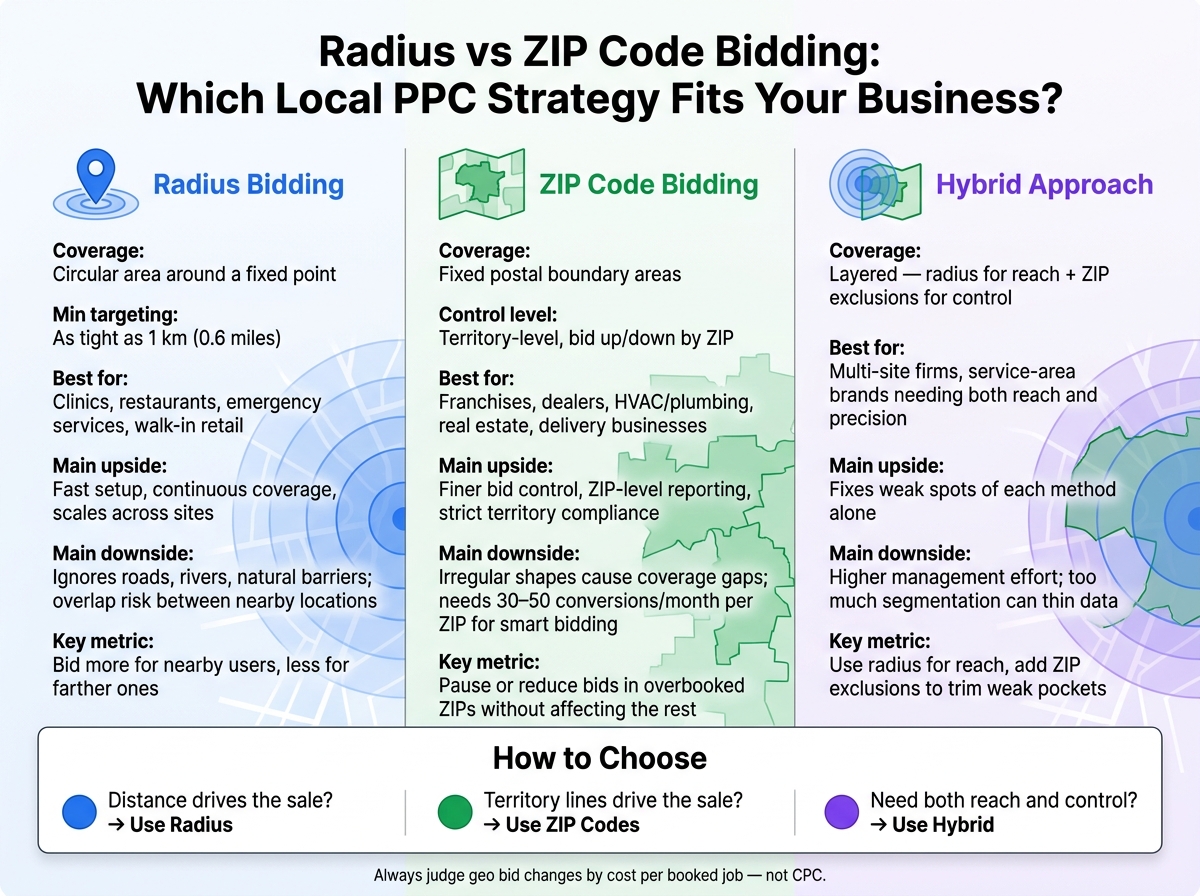
If distance drives the sale, I’d lean radius. If territory lines drive the sale, I’d lean ZIP codes. That’s the short answer.
Here’s the simple breakdown:
- Radius bidding fits businesses where people buy based on how close they are
- ZIP code bidding fits businesses that serve set areas and need tighter location control
- Hybrid setups fit brands that need both reach and tighter trimming
A few points matter most:
- Google Ads radius targeting can go as tight as 1 km, which is about 0.6 miles
- Small, tight location targeting using top PPC tools can help cut wasted spend
- Too much segmentation can hurt learning if some areas do not get enough conversions
- For local PPC, I’d judge geo changes by cost per booked job, not just CPC
Radius vs ZIP Code Bidding: Which Local PPC Strategy Fits Your Business?
Google Ads Location Targeting Explained | Radius, Postal Code & Advanced Targeting
sbb-itb-89b8f36
Quick Comparison
| Method | Best when | Main upside | Main downside | Fit |
|---|---|---|---|---|
| Radius bidding | Distance matters most | Simple setup and clean area coverage | Circles ignore roads, traffic, and natural barriers | Clinics, restaurants, emergency services |
| ZIP code bidding | Service areas follow fixed lines | More control by territory | More setup work and possible coverage gaps | Dealers, franchises, home services |
| Hybrid | You need both reach and trimming | More precise coverage | More work and thinner data by segment | Multi-site firms and service-area brands |
Put another way: if you want proximity-based reach, use radius. If you want postal-area control, use ZIP codes. If neither one fits cleanly, combine them with care and keep monthly location reviews tight.
Radius Bidding: How It Works, Where It Fits, and Its Limits
Radius bidding works best when distance from a location matters more than postal lines. In Google Ads, you can target as tightly as 1 kilometer, or about 0.6 miles, and adjust bids based on how close someone is to that location. You can bid more for nearby users and less for people farther out.
One setting matters a lot here: use "Presence" to focus spend on people who are actually in the area, not people somewhere else who are just researching it. That makes radius targeting a good fit for proximity-based campaigns, but a weaker option when a service area follows actual local boundaries instead of a circle on a map.
Where Radius Bidding Works Best
Radius bidding tends to fit businesses where drive time is the main factor behind a conversion. That includes urgent care clinics, restaurants, showrooms, dealers, and emergency trades like locksmiths. If someone needs help now - or wants the closest option - radius targeting makes sense.
Home-service brands often begin with a broader radius, then tighten it once job data starts to show where work is coming from. Walk-in businesses usually do better with a smaller radius from the start. But when demand groups around certain neighborhoods or suburbs, ZIP code targeting is often the better match.
Key Advantages and Risks of Radius Bidding
| Category | Details |
|---|---|
| Key Advantages | Fast setup; continuous coverage around a location; scales across multiple sites |
| Limits | Circular shape ignores natural barriers like rivers or mountains and high-traffic corridors |
| Common Risks | Overlapping radii between nearby locations causing internal competition; weaker cost-to-serve control at outer distance bands; mobile location data can be inaccurate |
For multi-site firms, the biggest operational issue is radius overlap. When locations sit close together, their target areas can collide and create internal competition.
Radius reporting shows performance by circular territory by default, which is a key part of a PPC campaign optimization checklist. That helps with diagnosis, but it doesn't give you postal-level control. ZIP code bidding does, because it lets advertisers pick exact postal areas.
ZIP Code Bidding: How It Works, Where It Fits, and Its Limits
Radius targeting is built on distance. ZIP code bidding is built on fixed lines.
Instead of drawing a circle around a point, ZIP code bidding targets specific postal areas. Google Ads uses location signals to connect users to those postal areas, which gives you direct control over defined territory. That makes it a strong fit for franchise territories, dealer zones, and other cases where service areas are set by hard boundaries.
That kind of control matters when the business can’t blur the edges. You can bid up in ZIP codes that perform well and cut bids in weaker ones. Radius targeting can’t give you that same postal-level control. ZIP-level reports also show which areas are driving leads, which helps when you need to make budget calls by territory. To cut traffic from outside the area, use Presence: People in or regularly in your targeted locations.
Where ZIP Code Bidding Works Best
ZIP code targeting works best when territory lines are tied to how the business operates. Think franchises with strict rules, HVAC and plumbing companies with set service zones, real estate agencies centered on certain neighborhoods, and delivery businesses that need clean coverage by area.
It also helps in multi-site programs. You can push more spend into the ZIP codes where margin, lead quality, or customer lifetime value is strongest.
Key Advantages and Risks of ZIP Code Bidding
ZIP code bidding gives you control that radius targeting doesn’t. But it also comes with a few ways things can go sideways.
| Category | Details |
|---|---|
| Key Advantages | Finer bid control by postal area; ZIP-level reporting; strict territory compliance; the option to pause or lower bids in overbooked areas without changing the rest of the campaign |
| Common Risks | Irregular ZIP shapes that can leave gaps; spillover near borders; lower impression volume if you target too few codes; more hands-on management |
| Best-Fit Businesses | Franchises, home service providers, dealers, delivery businesses, multi-site firms with territory rules |
| Budget Strategy | Shift spend from low-converting ZIPs to stronger ones; check location reports monthly |
The biggest issue is coverage. ZIP code shapes are uneven, so they don’t stack together like neat circles. That can leave awkward pockets in or out of the campaign. Then there’s boundary spillover. A user near the edge of a ZIP code may be counted in or out based on how their device maps to that postal area.
You can tighten things up with negative location exclusions and demographic filters, especially around border areas. Still, they won’t fully solve the issue.
Volume is the other pressure point. If your campaign needs 30-50 conversions per month to support automated bidding, each ZIP code needs enough traffic (which can be managed using Google Ads automation tools) and conversion data to send a clear signal. Spread budget across too many postal areas, and some ZIPs may never gather enough data to optimize well.
Those tradeoffs matter most when you’re sizing up ZIP targeting against radius targeting.
Radius vs ZIP Code Bidding: Direct Comparison and Use-Case Fit
Both methods target local users, but they solve different problems. The choice comes down to control, coverage, and how much day-to-day work the campaign can support.
| Method | Coverage Pattern | Control | Setup | Best For | Main Risk |
|---|---|---|---|---|---|
| Radius Bidding | Circular | Proximity-based | Low | Clinics, walk-in retail | Overlap, wasted spend |
| ZIP Code Bidding | Irregular (postal boundaries) | Territory-level | Moderate to high | Dealers, multi-site firms | Coverage gaps, territory conflicts |
| Hybrid Approach | Combined/layered | Very high | Very high | Service-area brands, multi-site firms | Higher management effort |
Accuracy, Coverage, and Reporting: Key Differences
The main difference isn't just reach. It's how each method lets you control targeting and read performance metrics.
Radius bidding gives you clean coverage around a fixed point. That matters when distance has a direct effect on conversions. If someone is more likely to visit or book when they're close by, radius can line up well with how demand works.
ZIP code bidding gives you tighter territory control. It also makes area-by-area budget moves simpler. If one territory is pulling its weight and another isn't, ZIP-level structure makes those shifts easier to act on. Using automation and reporting tools can further streamline these adjustments. ZIP-level data matters most when you need to move budget by territory.
Which Method Fits Service-Area Brands, Clinics, Dealers, and Multi-Site Firms
Use case decides the better fit. It comes down to how the business actually serves customers.
Service-area brands often start with radius targeting, then add ZIP exclusions to trim weak pockets. Clinics usually do better with tighter radii, since nearby demand often converts at a higher rate. Dealers and multi-site firms usually need ZIP control, especially when sales territories or location ownership lines don't match a simple circle on a map.
When a Hybrid Approach Beats Either Method Alone
A hybrid setup works when one method fixes the other's weak spot. That's the whole point.
Use a hybrid when radius gives you reach and ZIPs give some of that control back - especially when radius overlap creates internal competition, or when ZIP coverage gaps leave small pockets outside the campaign. One catch: too much segmentation can weaken data quality.
Conclusion: Choosing the Right Local Bidding Method
Choose radius targeting when proximity drives conversions - like storefronts, clinics, and emergency services. Choose ZIP code targeting when territory control matters more - like dealers, service-area brands, and multi-site firms. If neither option fits the whole picture, a hybrid approach gives you both reach and precision.
After setup, review performance by location each month using top PPC tools and agencies and shift spend toward the strongest areas.
If one area converts better or helps keep travel costs lower, that area may justify a higher bid. Judge bid changes by cost per booked job, not CPC.
FAQs
How do I choose between radius and ZIP code bidding?
Choose radius targeting when you want to reach people within a set distance of a specific location, like a storefront or service center. It works well for local businesses that serve a clear physical area.
Use ZIP code targeting when your service area lines up with ZIP boundaries or when you want tighter control over neighborhoods that perform well. In both cases, set location targeting to Presence so you focus on people who are physically in your area.
When does a hybrid setup make sense?
A hybrid setup makes sense when you can split lead intake from control. Use LSAs for high-visibility, pay-per-verified-lead coverage on core service searches. Then add standard Search PPC for broader keyword reach, tighter control, and better scale.
A lot of local businesses run both at the same time, especially after 3 to 6 months of conversion data. That gives them enough signal to tune standard PPC without shutting down the LSA channel too soon.
How many locations or ZIPs are too many?
There’s no hard limit. But if you target too many ZIP codes, your budget can get spread too thin. When that happens, targeting gets less precise.
Set your target area around places where you can realistically deliver services or where customers are willing to travel. Start with a tight list of areas that tend to perform well. Then cut ZIP codes that bring clicks but no conversions. Also use Presence so you’re not paying for traffic from outside your target zones.